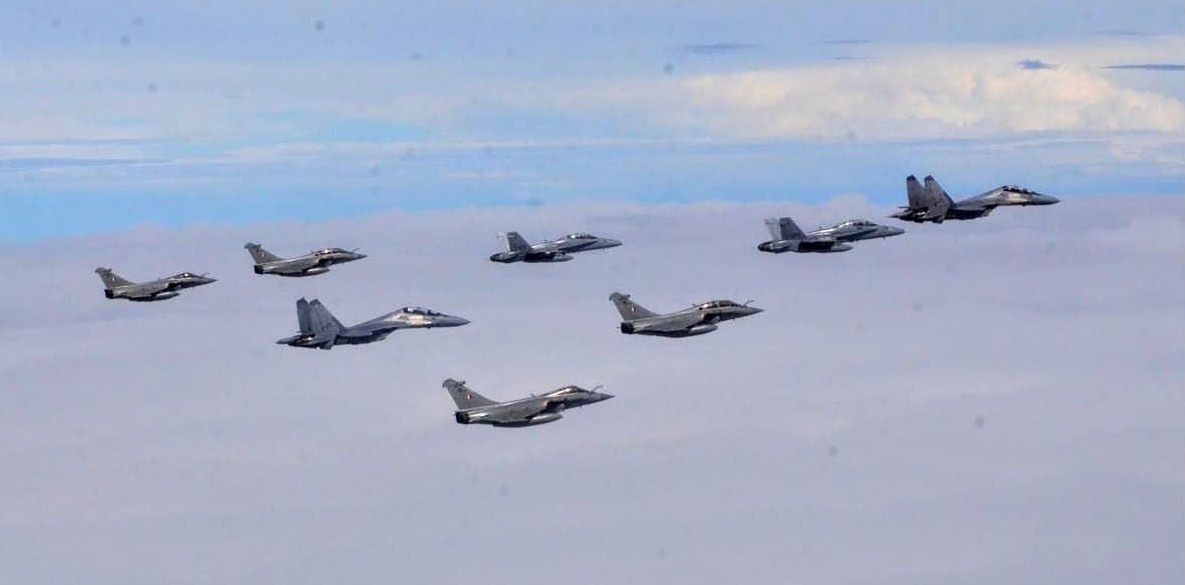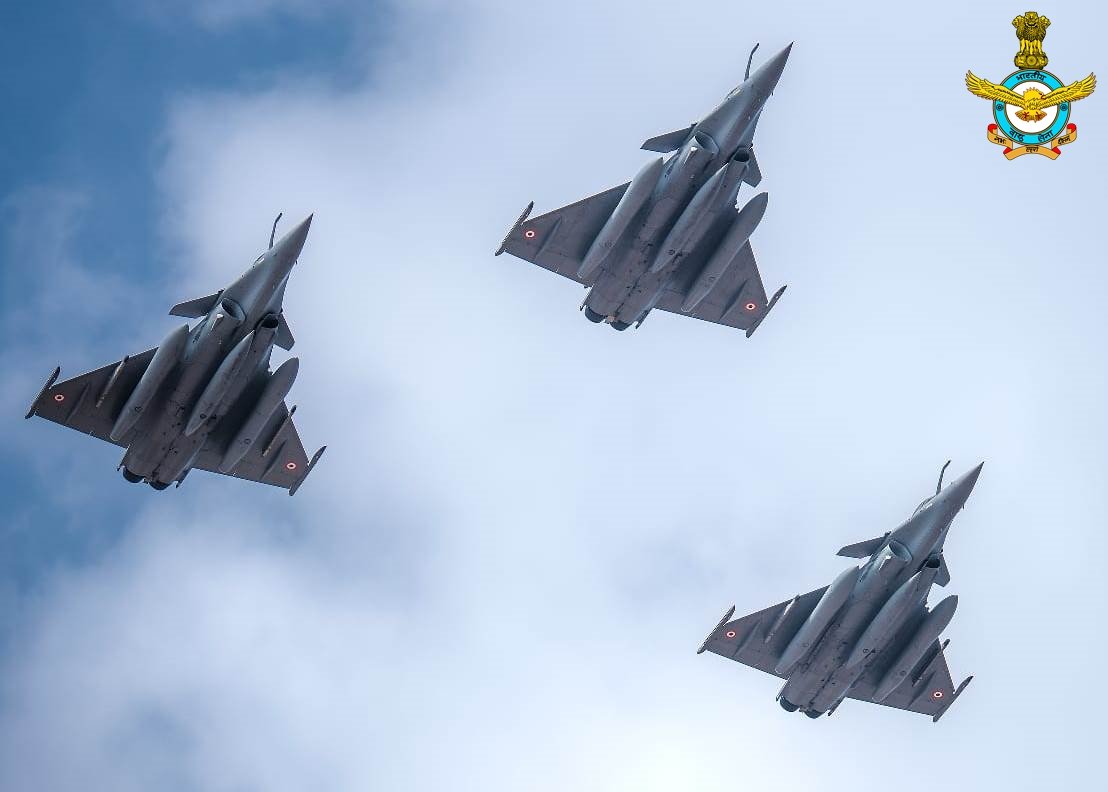
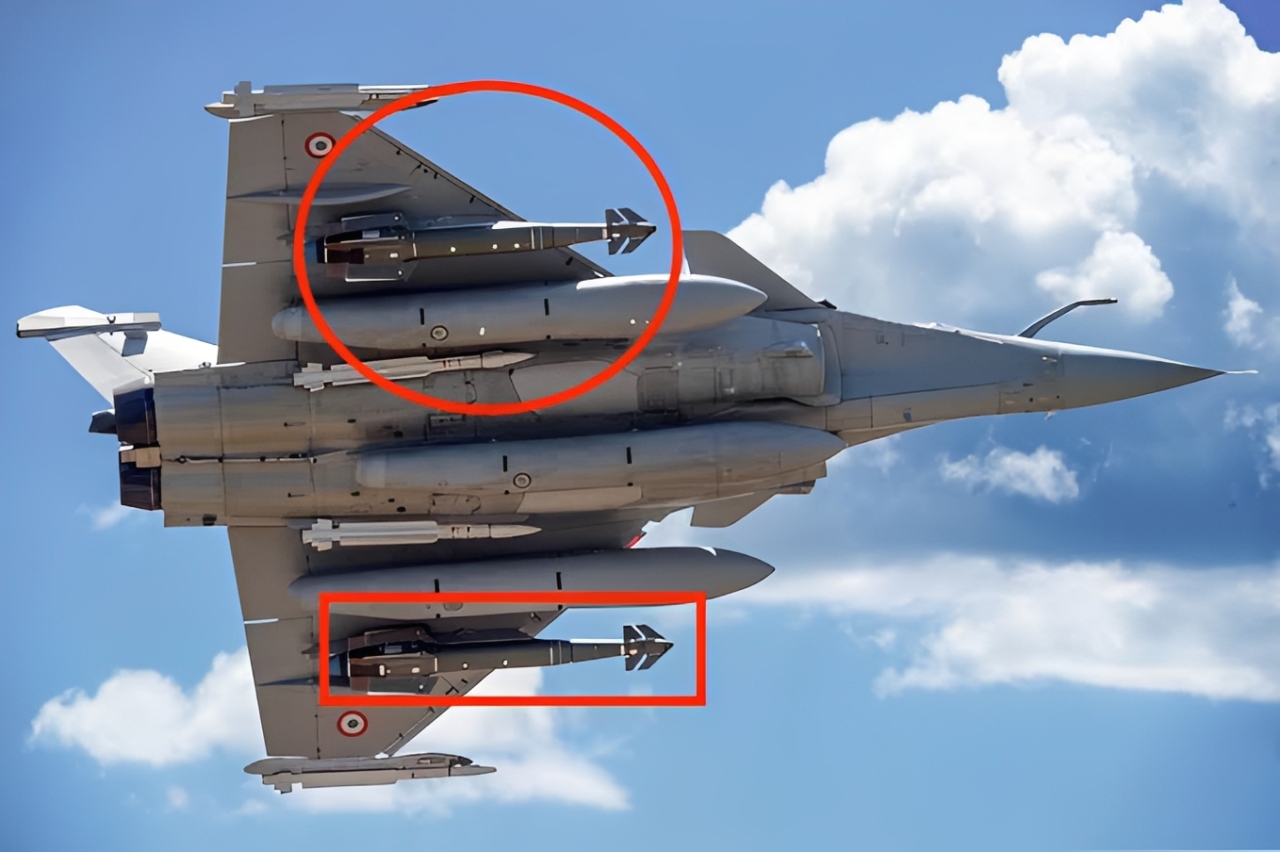
 An Indian Air Force Rafale fighter carrying two Hammer precision weapons. (Photo via X)
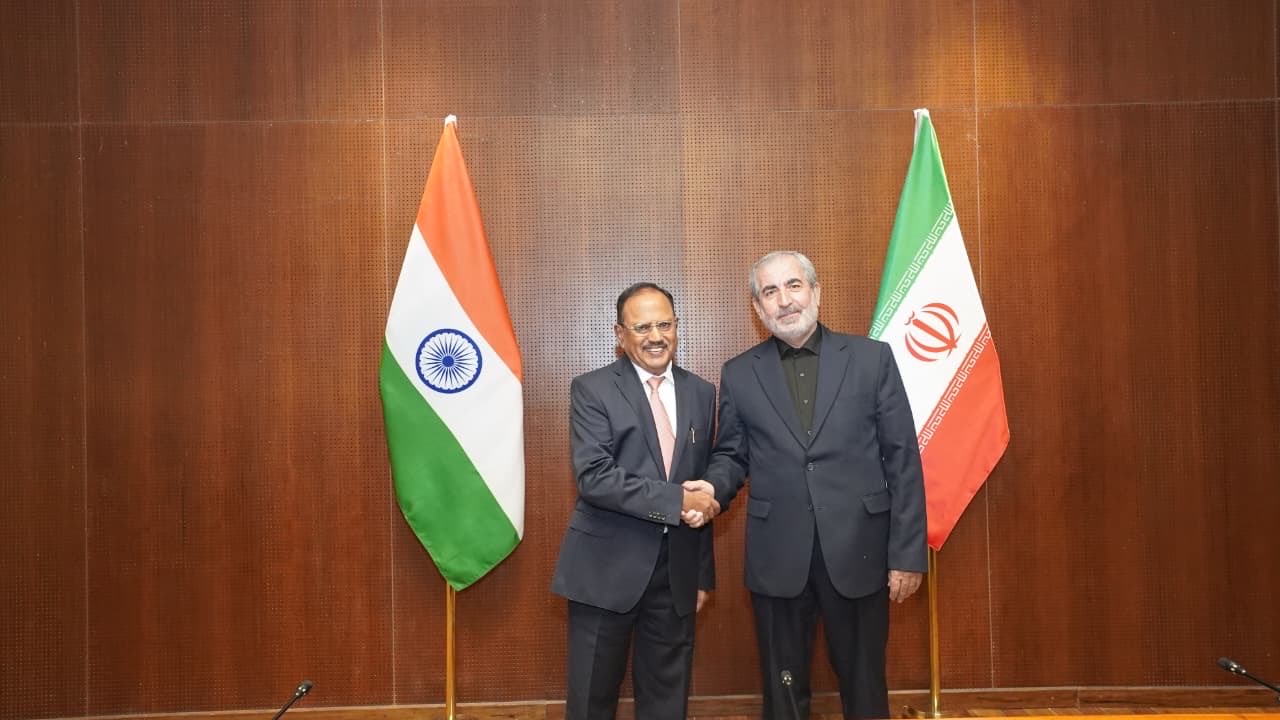
New Delhi: The defence minister, Rajnath Singh, will co-chair the sixth India-France annual defence dialogue with France’s minister of the armed forces and veterans affairs, Catherine Vautrin, in Bengaluru on Tuesday. The meeting comes at a moment of unusual momentum in bilateral defence ties, days after New Delhi approved a sweeping ₹3.6 lakh crore ($39.7 billion) military procurement package that includes a reported order for 114 Rafale fighter jets from French manufacturer Dassault Aviation.
The dialogue is expected to produce two significant outcomes: the renewal of a defence cooperation framework agreement for another 10 years, and the signing of a memorandum of understanding (MoU) for a joint venture to manufacture Hammer air-to-ground precision glide bombs in India. An announcement is also anticipated on the reciprocal deployment of officers between the Indian Army and the French land forces – a step toward deeper operational integration between the two militaries.
The two ministers are further scheduled to join the virtual inauguration of the H125 light utility helicopter final assembly line of Tata Airbus at Vemagal in Karnataka, which will be launched by the prime minister, Narendra Modi, and the French president, Emmanuel Macron. Macron’s visit, which runs from Tuesday to Thursday, will include wide-ranging discussions on bilateral cooperation under the Horizon 2047 Roadmap, the jointly agreed long-term vision for the India-France strategic partnership. The two leaders are also expected to inaugurate the India-France Year of Innovation 2026.
The timing of the defence dialogue is hard to overlook. The Ministry of Defence’s Defence Acquisition Council, which is headed by the defence minister, cleared the proposal to buy 114 Rafale multirole fighter jets days before Macron’s visit, in what would amount to one of the largest military hardware procurements in the country’s history. Local media reported that 18 aircraft would be delivered directly by Dassault, with the remaining 96 manufactured domestically under technology-transfer arrangements. A formal contract, however, is unlikely before the end of the year, as the defence ministry must still negotiate cost and other specifics with Dassault.
The Hammer MoU adds another dimension to what is becoming a substantial manufacturing partnership. The Hammer – a modular, precision-strike weapon developed by Safran – is already integrated with the Rafale jets operated by the Indian Air Force and was reportedly used during India’s 2025 military conflict with Pakistan. French companies are also increasing their participation in the government “Make in India” initiative, with industrial collaboration now a central focus of the bilateral defence agenda.
In June 2025, Tata Advanced Systems Limited and Dassault Aviation signed an agreement to manufacture Rafale fuselage sections at a new facility in Hyderabad – the first such production line outside France. Broader discussions are underway on a partnership between Hindustan Aeronautics Limited and Safran for an engine production plant, and a maintenance, repair and overhaul hub in Uttar Pradesh.
Defence has long anchored the India-France relationship. Modi attended the Bastille Day parade in July 2023 as guest of honour, while Macron was the chief guest at the Republic Day parade in January 2024. The two countries regularly conduct three bilateral military exercises – Exercise Shakti with the Indian Army, Exercise Varuna with the navy, and Exercise Garuda with the Indian Air Force. The recent India-EU security and defence partnership has also broadened the framework of engagement between India and European nations.
This will be Vautrin’s first visit to India since she assumed office as France’s defence minister on October 12, 2025. The previous, fifth edition of the annual dialogue was held in France from October 11 to 13, 2023.
What is the Hammer precision weapon?
The Hammer – an acronym for “highly agile modular munition extended range” – is a precision-guided air-to-ground weapon of French origin, developed by Safran Electronics & Defense. Formally designated the Armement Air-Sol Modulaire, or AASM, it entered service with the French Air and Space Force in 2007 and has since established itself as a serious tool of modern aerial strike warfare.
What distinguishes Hammer from conventional unguided bombs is its modular architecture. Rather than replacing a bomb altogether, the system converts standard munitions – in weights of 125kg, 250kg, 500kg, and 1,000kg – into standoff precision weapons by attaching advanced guidance kits and a range-extension unit.
Depending on mission requirements, operators may select from several guidance options such as inertial guidance with GPS for all-weather conditions, GPS with imaging infrared for high-resolution targets, and GPS with laser guidance for targets requiring top accuracy. This flexibility makes Hammer effective against both fixed installations and moving targets.
The weapon’s operational range extends beyond 70 kilometres, which allows launching aircraft to stay well outside the envelope of many air-defence systems – a significant survivability advantage. Platforms cleared to carry Hammer include the Dassault Rafale, Mirage variants, the F-16, and India’s own HAL Tejas LCA (light combat aircraft). The weapon has seen active combat use in Afghanistan, Libya, Mali, Syria, and Ukraine, and was reportedly deployed during the India-Pakistan military exchanges in 2025, accumulating a credible operational record across markedly different theatres and conditions.
Why Hammer matters to India
For India, the significance of Hammer goes well beyond another weapons acquisition.
India’s evolving security doctrine places growing emphasis on deep-strike capability with minimal risk to aircraft and crew. Hammer’s range of over 70 kilometres means strike aircraft can engage hardened targets – bunkers, command centres, radar installations – without having to penetrate hostile air-defence zones, directly supporting that doctrine.
The indigenization dimension is equally important. A joint venture between Bharat Electronics Limited (BEL) and Safran, structured on a 50:50 basis, will manufacture and support Hammer on Indian soil. This fits squarely within the “Atmanirbhar Bharat” (self-reliant India) framework, which will reduce import dependency and building domestic expertise in a class of weapons where India has historically been a net buyer.
Platform integration broadens the weapon’s utility further. While Hammer is already operational on India’s Rafale fleet, planned integration with the Tejas means the capability will extend across a wider portion of the Indian Air Force’s combat inventory, which will enhance the overall strike potential of the force.
Finally, Hammer is engineered to resist jamming and electronic interference – a quality that matters considerably in the kind of contested electromagnetic environments that modern air campaigns are increasingly fought in, and one that gives India a more dependable precision-strike option when conditions are least predictable.