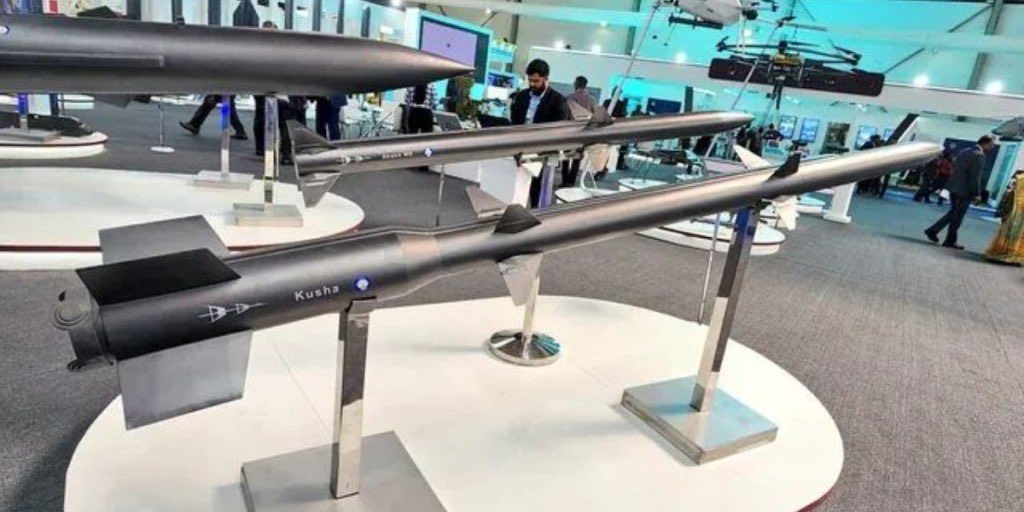
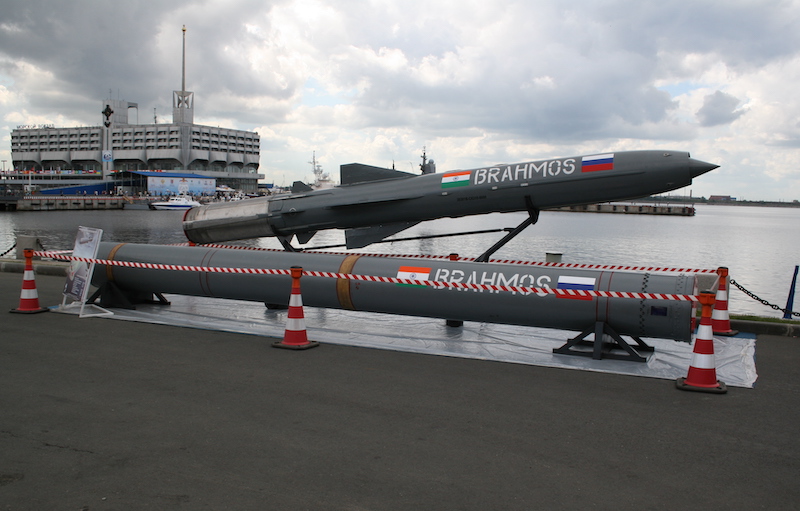
 A BrahMos missile. (Photo: IMDS/Public Domain)
New Delhi: The defence secretary, Rajesh Kumar Singh, confirmed on Saturday that a deal to supply BrahMos supersonic cruise missiles to Vietnam has already been signed, while negotiations with Indonesia are in the final stages. The disclosure, made at the 23rd Shangri-La Dialogue in Singapore, effectively ended months of diplomatic ambiguity around one of India’s most consequential defence export agreements.
“My understanding is that with both Indonesia and with Vietnam, the deal is in the final stages. In fact, for Vietnam, I understand that it has already been signed, probably not publicly announced, but it’s already been signed,” Singh told a panel at the forum, which is hosted annually by the International Institute for Strategic Studies (IISS) and draws defence ministers, military chiefs and security strategists from across Asia and the West.
The venue lent the confirmation a particular weight. Shangri-La is where the region’s strategic architecture is debated in the open, and the public acknowledgement of the Vietnam deal – before an audience that includes Chinese and American officials – was unlikely to be accidental.
The defence secretary, Rajesh Kumar Singh, has confirmed that the #BrahMos missile deal with Vietnam has been signed and that talks with Indonesia are at the final stage, as India cements its emergence as a credible defence exporter across Southeast Asia.#ShangriLaDialogue pic.twitter.com/NTtZ6kKvJp
— India Sentinels (@indiasentinels) May 30, 2026
Vietnam deal
The agreement with Vietnam is valued at approximately ₹5,800 crore, making it among Hanoi’s largest single defence acquisitions in recent years. The package is understood to cover shore-based coastal defence missile batteries, an initial missile supply, crew training and long-term logistics support. Vietnamese officials have separately indicated interest in air-launched variants for future procurement, suggesting the relationship may extend well beyond this initial contract.
The deal’s conclusion follows Vietnamese president To Lam’s state visit to India earlier this month, during which both sides reviewed their Enhanced Comprehensive Strategic Partnership. It may be noted that the BrahMos negotiations had been gaining visible momentum since March, when a delegation from the Society of Indian Defence Manufacturers visited the Vietnamese capital to explore procurement opportunities – a visit that, in retrospect, appears to have been a precursor to the final push.
Indonesia’s negotiations
Indonesia’s talks, while not yet concluded, are described as being at an advanced stage. New Delhi and Jakarta have established a Joint Defence Industry Cooperation Committee that covers not only the BrahMos acquisition but also technology transfer, joint research and development, and supply-chain integration – a framework that suggests both governments are thinking beyond a single transaction. If the deal is finalized, Indonesia would become the second Asean member after the Philippines to field the system. Manila has been operating BrahMos missiles since 2024, when it received its first delivery under a contract signed in 2022 – the first-ever export of the missile to a foreign country.
India’s export trajectory
The wider context is one of structural change in India’s position within the global arms trade. For decades, India was the world’s largest arms importer, reliant on Russia, France, Israel and the United States for a range of critical platforms. That dependence is beginning to shift. India’s defence exports reached a record $2.76 billion in 2024-25, an increase of over 12 per cent from the previous year. The BrahMos deals with Vietnam and Indonesia, if fully accounted for, would add well over $1 billion to that aggregate, bringing India considerably closer to its stated target of ₹50,000 crore in defence exports by 2030.
BrahMos Aerospace, the joint venture between India’s Defence Research and Development Organisation (DRDO) and Russia’s NPO Mashinostroyeniya, produces a missile that travels at roughly three times the speed of sound and carries a 200- to 300-kilogram warhead with a range that has been progressively extended to around 450 kilometres in its most advanced variants. Few countries outside the major arms-producing nations can offer a precision-strike system of comparable performance on the export market. That relative scarcity has become India’s advantage.
The strategic credibility of India’s defence-industrial claims received an unplanned but significant boost following Operation Sindoor in May 2025, when India demonstrated domestic precision-strike capability in a live operational context. The episode conferred on BrahMos – and on Indian defence manufacturing more broadly – a battlefield legitimacy that no trade fair or brochure could replicate.
Several analysts tracking Southeast Asian procurement decisions have noted that Sindoor materially accelerated buyer confidence among countries already in discussion with New Delhi.
Geopolitical factor
The geopolitical subtext of the BrahMos export programme is not difficult to read. The South China Sea has become the central arena of China’s maritime assertiveness, and the prospect of multiple Asean members fielding a supersonic anti-ship missile system that Beijing cannot easily intercept represents a meaningful complication for the People’s Liberation Army – Navy’s regional calculus. Vietnam and Indonesia are both claimants or interested parties in South China Sea disputes; the Philippines, already equipped with BrahMos, has one of the most active territorial disputes with China in the region.
For India, the defence diplomacy in Southeast Asia also carries a message directed toward Beijing over the Himalayan frontier. The 2020 Galwan valley clash and the prolonged standoff along the line of actual control (LAC) sharpened New Delhi’s appetite for expanding its strategic footprint in China’s near abroad. Arming Beijing’s maritime neighbours with India’s most capable export weapon is one way of signalling that the contest has dimensions well beyond the mountains.
What comes next
Malaysia and Thailand are understood to be in various stages of discussion about potential BrahMos acquisition. If those negotiations reach conclusion, the missile would be deployed by a majority of the littoral states along the South China Sea – a strategic outcome that would have seemed implausible a decade ago, when India’s arms industry was still largely synonymous with delays, overruns and import dependency.
The BrahMos programme is, in that sense, both a commercial story and a strategic one – and increasingly, the two are inseparable.
Follow us on social media for quick updates, new photos, videos, and more.
X: https://x.com/indiasentinels
Facebook: https://facebook.com/indiasentinels
Instagram: https://instagram.com/indiasentinels
YouTube: https://youtube.com/indiasentinels
© India Sentinels 2026-27