 Photo via Ministry of Defence.
New Delhi: India has successfully tested an indigenously developed fighter aircraft ejection system at speeds of 800 kilometres per hour, placing the country among a select group of nations with advanced capabilities in this critical life-saving technology.
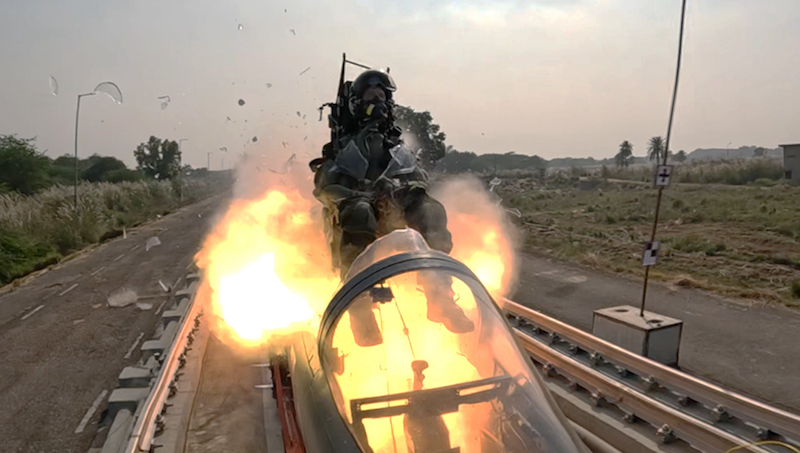
The Defence Research and Development Organisation (DRDO) conducted the trial on Tuesday, at the Rail Track Rocket Sled facility of the Terminal Ballistics Research Laboratory in Chandigarh. The test validated key safety mechanisms including canopy separation, ejection sequence timing, and complete crew recovery procedures under conditions simulating real combat scenarios.
The complex experiment employed a dual-sled configuration, with the forward section of a Tejas LCA (light combat aircraft) propelled along rails by multiple solid-propellant rocket motors fired in phases. An instrumented anthropomorphic test dummy recorded loads, moments, and accelerations experienced during the ejection sequence, providing data essential for certifying the system’s safety parameters.
The trial was conducted jointly with the Aeronautical Development Agency (ADA) and Hindustan Aeronautics Limited (HAL), with observers from the Indian Air Force, the Institute of Aerospace Medicine, and certification authorities present.
Strategic implications
The successful test reduces India’s dependence on foreign suppliers for ejection systems, which are among the most critical safety components in military aviation. Currently, most Indian fighter aircraft rely on imported ejection seats, primarily from Martin-Baker of the United Kingdom and NPP Zvezda of Russia.
The indigenous system is intended for integration into current and future Indian combat aircraft, including the Tejas Mk2 variant, the proposed TEDBF (twin-engine deck-based fighter) for aircraft carriers, and the AMCA (advanced medium combat aircraft) programme.
Ejection systems must function reliably across extreme conditions – from zero speed on the ground to supersonic speeds at high altitude – making their development and certification particularly challenging. The 800 km/h test represents mid-range operational speeds typical of fighter aircraft during takeoff, landing, and low-altitude manoeuvring, when ejections are statistically most common.
Technical development
The test follows years of development work on escape system technology at DRDO laboratories. India has previously conducted lower-speed trials and static tests, but Tuesday’s validation represents the first high-speed dynamic assessment of the complete ejection sequence.
The defence minister, Rajnath Singh, congratulated the organizations involved, describing the achievement as significant for India’s defence self-reliance goals.
Developing proven ejection systems typically requires extensive testing programmes spanning several years. Western manufacturers have decades of operational data and hundreds of successful ejections to validate their designs. India’s programme will require further trials across varying speed ranges, altitudes, and environmental conditions before the system can be certified for operational use.
The test comes as India seeks to expand its domestic defence manufacturing base and reduce imports, which have historically accounted for a substantial portion of military procurement. The government has set a target of achieving 70 per cent self-reliance in defence production by 2027.