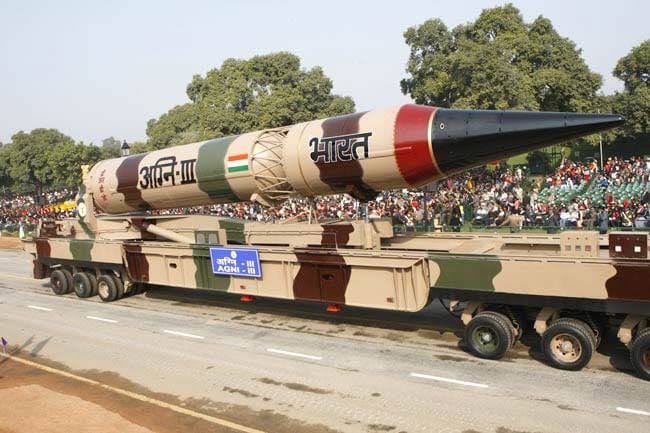
 Agni-III missile system during Republic Day parade in Delhi (File Photo)
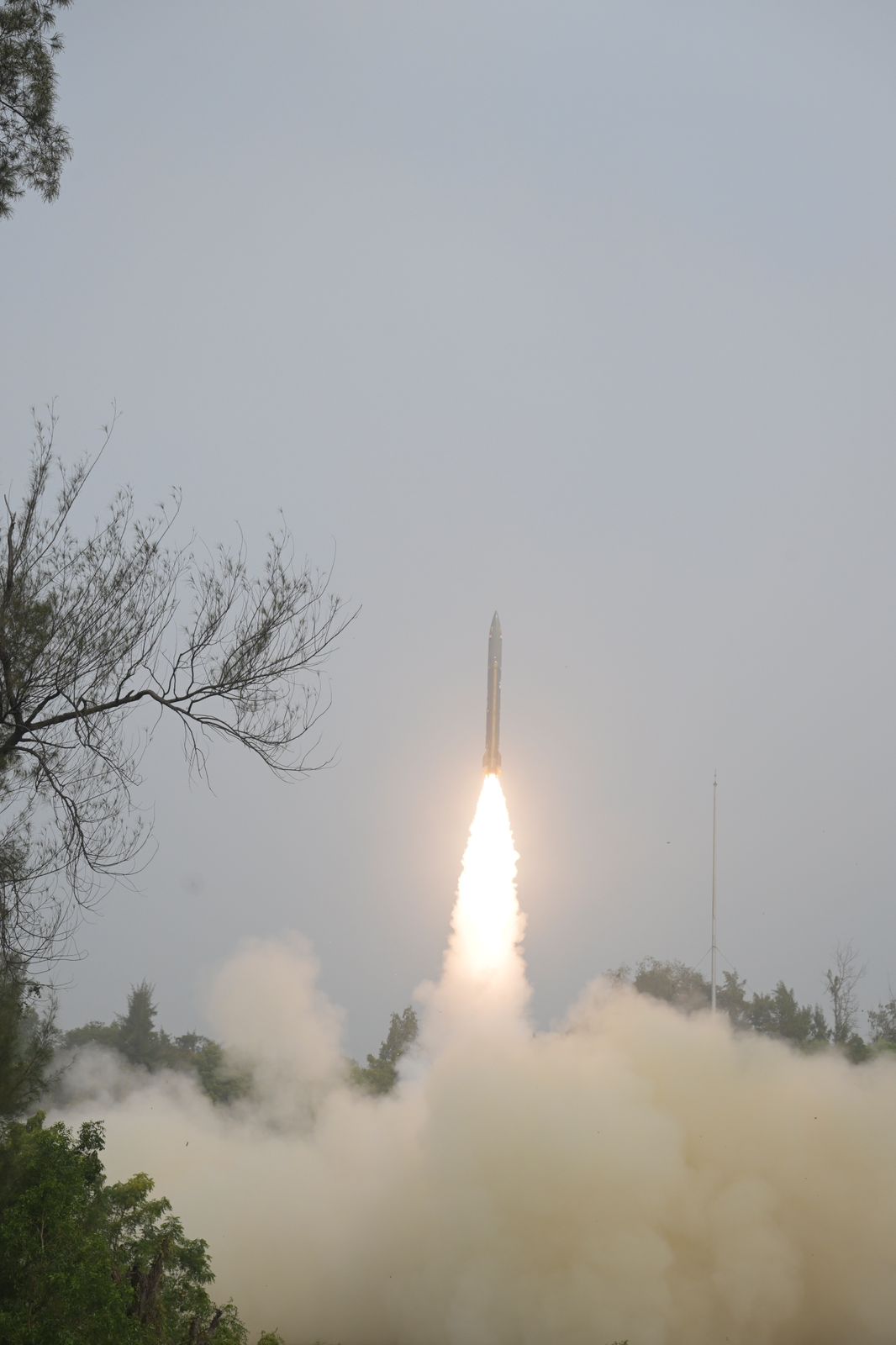
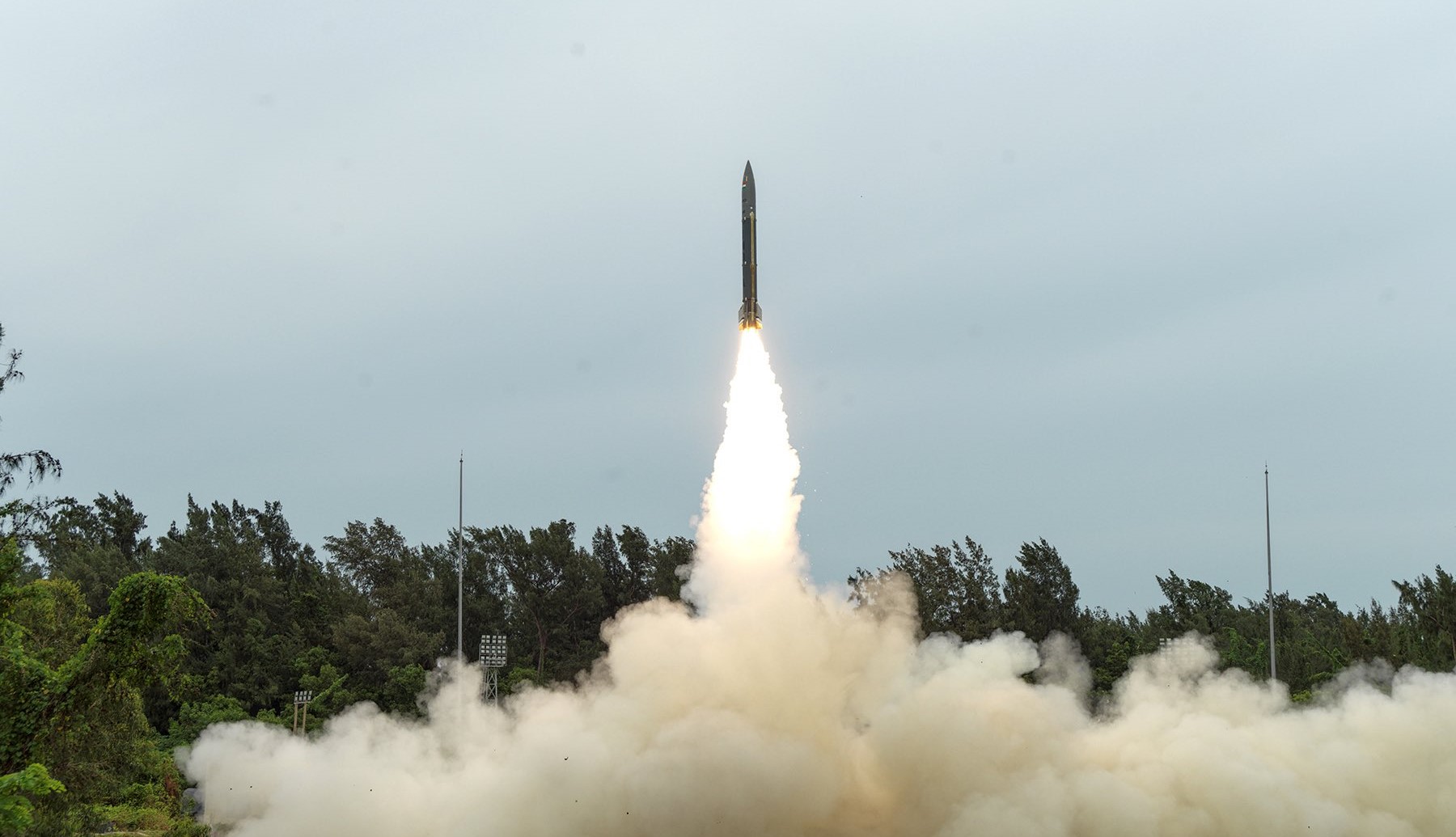
New Delhi: India on Friday successfully test-fired the nuclear-capable Agni-III ballistic missile from Chandipur off the Odisha coast. The surface-to-surface missile has a strike range of over 3,000 kilometres.
The launch was carried out by personnel of the Strategic Forces Command (SFC) from a mobile launcher as part of a routine user training exercise.
Officials said the missile was randomly selected from the production lot for the test, underlining its operational readiness. The SFC is responsible for the management and operation of India’s strategic weapons systems.
“The launch validated all operational and technical parameters,” officials confirmed.
Following the auto-launch command, the two-stage, solid-fuel missile lifted off along a predetermined flight path and accurately struck its pre-designated target area in the Bay of Bengal. Sources from the Defence Research and Development Organisation (DRDO) stated that all mission objectives were successfully achieved.
The 17-metre-long missile’s trajectory and performance were continuously tracked and monitored in real time using radars deployed along the eastern coast, as well as telemetry and electro-optical systems. Two down-range ships positioned near the impact point recorded the terminal phase of the flight.
Read also: India tests Agni-5 missile days before PM Narendra Modi’s China visit
About the Agni-III Missile System
Agni-III is one of the most sophisticated and accurate missiles in its class. Classified as an intermediate-range ballistic missile (IRBM), it was inducted into the Strategic Forces Command in 2011.
The missile is capable of delivering a payload of up to 1.5 tonnes over a distance of 3,000–3,500 kilometres. It measures 17 metres in length, has a diameter of 2 metres, and a launch weight of approximately 50 tonnes.
Read also: India enters elite club with historic rail-based Agni-Prime ballistic-missile test
Powered by a two-stage solid propellant system, the nuclear-capable Agni-III is protected by a carbon all-composite heat shield. It features advanced hybrid navigation, guidance, and control systems, along with a state-of-the-art onboard computer. Its electronic systems are designed to withstand extreme vibration, thermal, and acoustic stresses.
Developed by DRDO’s Advanced Systems Laboratory (ASL), Agni-III -- third in the Agni missile series -- was first tested on 9 July 2006 from Wheeler Island off the Odisha coast, though that launch was unsuccessful. Subsequent tests on 12 April 2007 and 7 May 2008 were successful.
With a circular error probable (CEP) of around 40 metres, Agni-III ranks among the most accurate strategic ballistic missiles in its range category globally.
Read also: Agni V -- India successfully test-fires intercontinental ballistic missile with MIRV capability