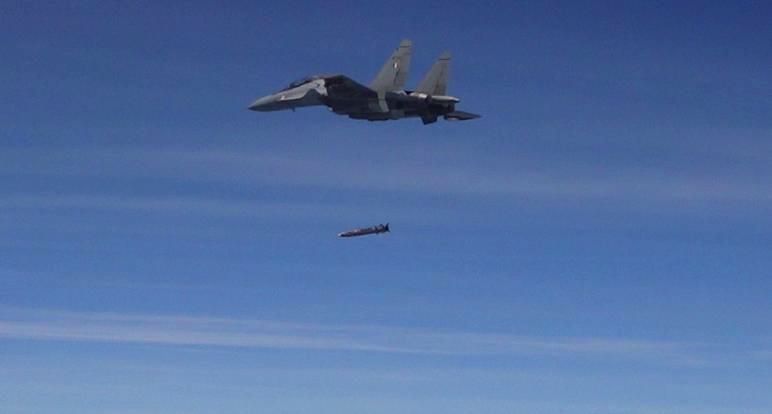
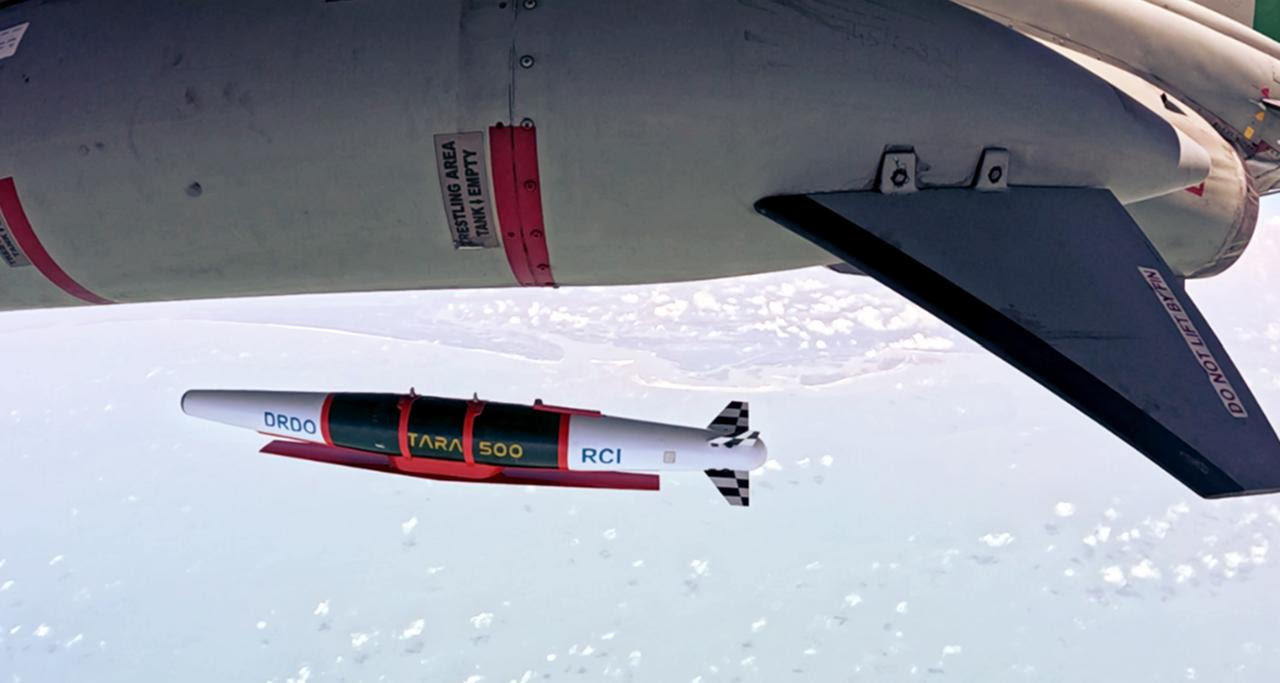
New Delhi: The Defence Research and Development Organisation (DRDO) and the Indian Air Force (IAF) on Thursday successfully conducted the maiden flight-trial of the tactical advanced range augmentation (TARA) weapon system off the coast of Odisha.
Marking a defining moment in the country’s pursuit of self-reliance or “Atmanirbharta” in cutting-edge military technology, the TARA test was specifically carried out using the IAF’s Jaguar fighter aircraft.
The modular kit is also designed for integration with other fighter aircraft, including the Sukhoi-30MKI, Mirage 2000, and LCA Tejas.
What Is Tactical Advanced Range Augmentation?
TARA –tactical advanced range augmentation – is a modular range extension kit designed to transform conventional, unguided warheads into precision-guided munitions.
In simpler terms, it is a smart glide add-on that can be fitted onto existing “dumb” bombs, dramatically enhancing their reach, accuracy, and lethality without requiring an entirely new weapon.
India’s first indigenous glide weapon system of its kind, TARA represents a cost-effective solution to one of modern air warfare’s most critical challenges: striking ground-based targets with pinpoint accuracy while keeping pilots and aircraft out of harm's way.
How does it work?
Working on the principle of a glide weapon, the tactical advanced range augmentation once released from an aircraft at altitude, using aerodynamic lift to travel extended distances towards its target, guided by state-of-the-art navigation systems.
By converting low-cost, unguided warheads into precision-guided munitions, the kit dramatically multiplies the effectiveness of India’s existing aerial arsenal at a fraction of the cost of developing entirely new standoff weapons.
The system is designed to neutralize ground-based targets with enhanced accuracy and lethality, giving the IAF a significant operational advantage in modern conflict scenarios.
Made in India, built for the future
TARA has been designed and developed by Research Centre Imarat (RCI), Hyderabad in collaboration with several other DRDO facilities.
What makes this programme particularly noteworthy is its strong industrial partnership: development was undertaken with Development cum Production Partners (DcPP) and other Indian private and public sector industries, who have already commenced production activity.
This integration of research laboratories with industry partners reflects the broader vision of Atmanirbhar Bharat (self-reliant India) in defence manufacturing – moving away from costly imports towards domestically designed, developed, and produced systems.
TARA is also notable for being the first Indian glide weapon to utilise state-of-the-art low-cost systems.
Defence minister applauds
The defence minister, Rajnath Singh, congratulated DRDO, the IAF, DcPP, and the industry partners, describing the milestone as “a significant development in advancing India's indigenous defence capabilities.”
Dr Samir VKamat, secretary of the Department of Defence (R&D) and chairman of DRDO, also extended his congratulations to the teams behind the successful flight-trial, underscoring the importance of collaborative research and development in delivering next-generation military systems.
Strategic significance
The successful trial of TARA comes at a time when India is rapidly modernizing its armed forces and reducing dependence on foreign military hardware.
Standoff precision weapons – those capable of hitting targets from a safe distance – are increasingly central to modern air power doctrine.
By giving the IAF the ability to convert its existing inventory of unguided bombs into precision weapons, TARA effectively multiplies India's strike capabilities without requiring a complete overhaul of its aerial arsenal.
The modular, kit-based approach also means rapid integration across multiple aircraft platforms, offering flexibility that is invaluable in operational planning.