
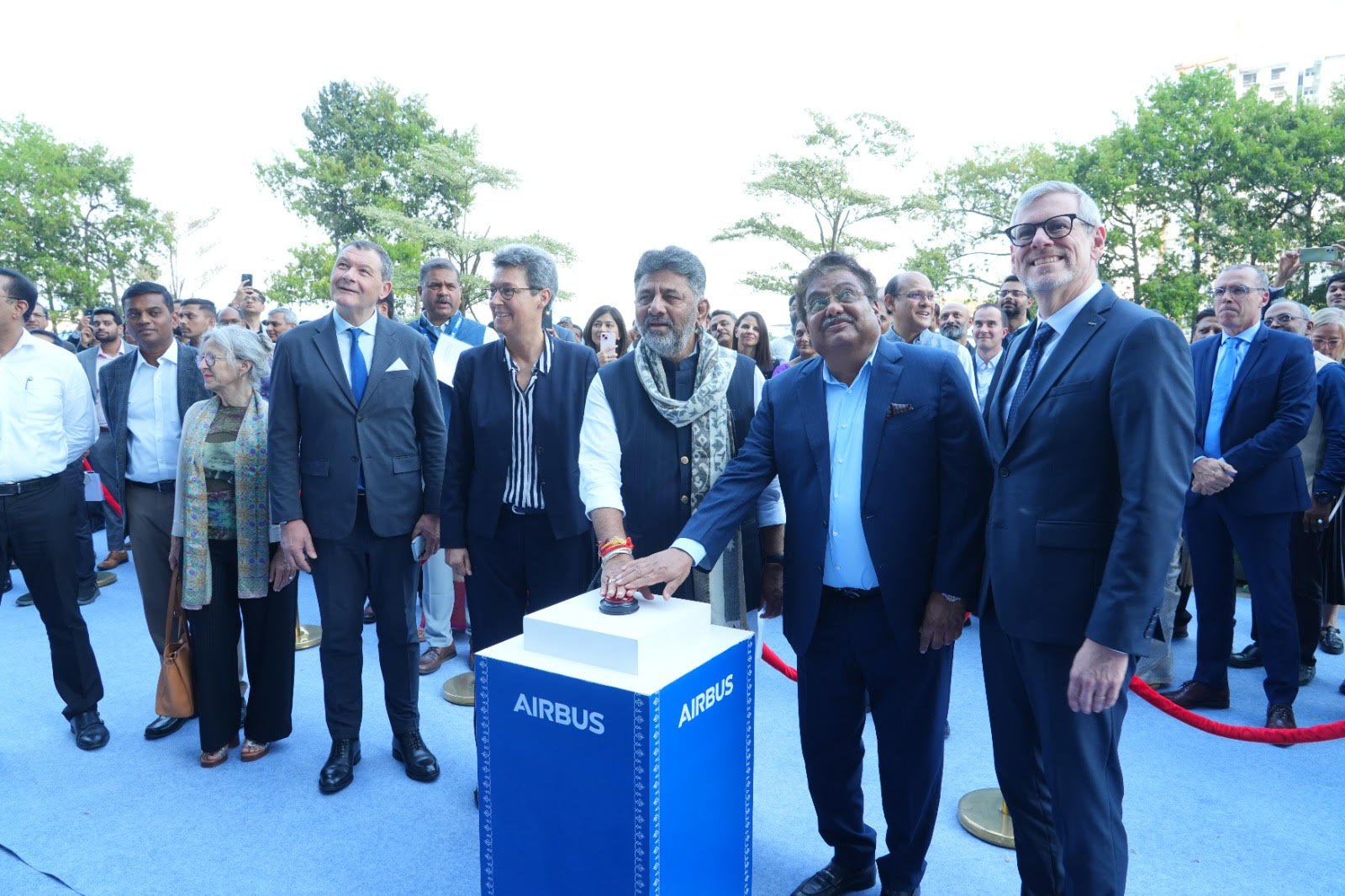
 Unveiling of the new Airbus centre in Bengaluru.
Bengaluru: Airbus has inaugurated a large technology campus in Bengaluru, consolidating its India operations into a single 880,000 sq ft facility that the company says is central to its expanded “Make in India” strategy and to meeting a $2 billion annual sourcing target from the country before 2030.
The “Airbus India Technology Centre” was inaugurated by the deputy chief minister of Karnataka, DK Shivakumar, and the state’s minister of industries and infrastructure, MB Patil. The Union minister of civil aviation, Rammohan Naidu Kinjarapu, attended virtually. Senior Airbus executives present included Catherine Jestin, executive vice-president, digital, and Jürgen Westermeier, president and managing director, India and South Asia.
Designed to accommodate around 5,000 employees, the campus brings together engineering, digital transformation, customer services and procurement – functions that were previously distributed across multiple locations in the city. Westermeier described it as “a strategic consolidation” rather than a relocation, saying it creates the “scale and headroom” needed for the company’s next phase of growth in the region.
“This centre will allow us to scale existing technological competencies and innovation ecosystems while also addressing the customer services and procurement dimensions of our ‘Make in India’ mission,” Westermeier said during the event.
The sourcing numbers are striking. Airbus says it has more than tripled its annual procurement from India – from $500 million in 2019 to over $1.5 billion today – and expects to cross the $2 billion mark well before the end of the decade. More than 100 Indian companies currently supply components for global Airbus programmes, including flap track beams, aircraft doors and helicopter fuselages.
The new campus also houses a dedicated customer services centre providing maintenance and technical support, as well as tailored flight-hour services, to Airbus operators worldwide. This complements Airbus’s growing manufacturing presence in India: the company supports final assembly lines for the C-295 military transport aircraft in Vadodara – a joint venture with the Tata Group – and the H125 single-engine helicopter in Vemagal, near Bengaluru.
The C-295 programme, launched under a $2.5 billion contract signed in 2021 between the Indian government and Airbus for 56 aircraft, represented the first time a military aircraft has been manufactured in India by a private company. The Vemagal facility for the H125 – a popular light utility helicopter used widely for civil and para-public missions – was inaugurated in 2023 and is expected to eventually produce helicopters for export markets as well.
India is among the world’s fastest-growing aviation markets. The country is projected to need over 2,200 new commercial aircraft over the next two decades, according to Airbus’s own forecasts, driven by a rapid expansion in domestic air travel and the emergence of new regional routes. IndiGo, Air India and the newly launched Akasa Air have collectively placed orders for several hundred Airbus aircraft in recent years, making India one of the planemaker’s most consequential growth markets outside China and the United States.
The Bengaluru campus adds to an already significant footprint. Airbus employs thousands of engineers and digital professionals in India through its engineering centre and subsidiaries, which contribute to aircraft design, systems development, and digital tools used across its global programmes. The consolidation into the new campus is expected to improve collaboration across these disciplines while also making India a more prominent node in Airbus’s global supply chain management.
The inauguration comes at a moment of intense competition – and considerable production strain – for Airbus. The company has been grappling with supply chain bottlenecks and engine shortages that have slowed aircraft deliveries globally, and its India investment signals a longer-term bet on diversifying its sourcing base away from traditional European and North American suppliers. Deepening ties with Indian industry fits into that broader strategy.
Karnataka, which hosts India’s largest aerospace and defence industrial cluster in and around Bengaluru, has positioned itself as the preferred destination for global aerospace companies seeking to expand in India. Hindustan Aeronautics Limited (HAL), the state-owned defence manufacturer, has its headquarters in the city, as do facilities for Boeing, Safran and several other international firms.
For Airbus, the new centre represents the latest step in a relationship with India that has deepened considerably since the mid-2010s. Whether the company can hit its $2 billion sourcing target on schedule will depend partly on the pace at which Indian suppliers can scale up to meet the quality and volume requirements of global aerospace production – a challenge that has historically constrained ambitions in the sector, but one that both government and industry say is increasingly being overcome.