
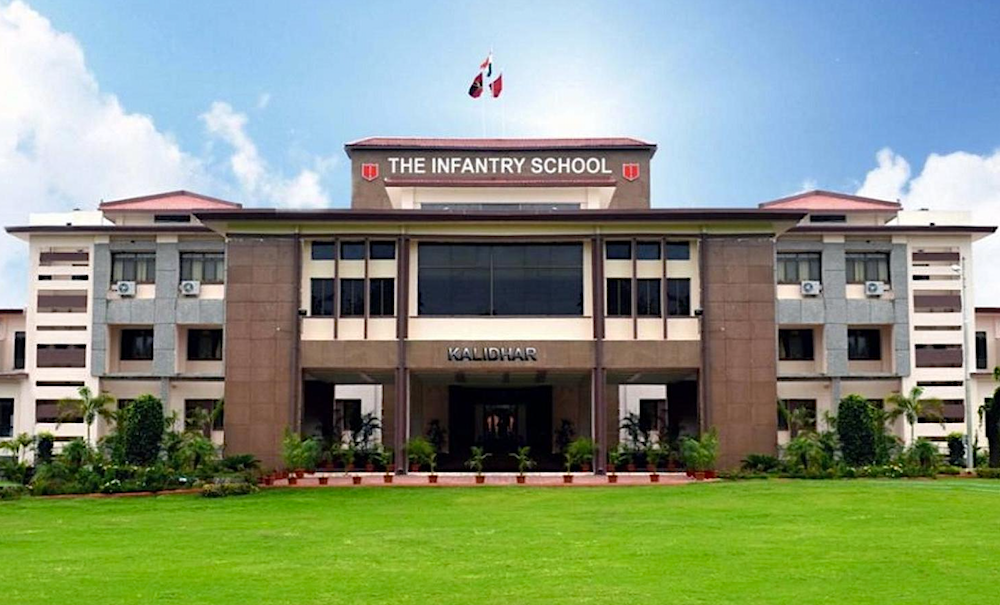
 The Infantry School, established at Mhow in April 1948, serves as the alma mater of the Indian Army’s infantry arm.
New Delhi: The Ministry of Defence has awarded Hyderabad-based Zen Technologies a contract worth ₹120 crore to establish India’s first combat training node at the Infantry School in Mhow, Madhya Pradesh. The facility will comprise more than 60 simulators and training solutions designed to enhance infantry combat readiness through simulation-based training.
The project represents a significant step in implementing the ministry’s simulation framework, introduced in September 2021, which identified simulation-based training as a strategic priority for force modernisation and cost reduction. The framework emphasised indigenous design, development and maintenance by Indian companies.
The combat training node will integrate live-virtual-constructive training systems with live firing range solutions, enabling infantry personnel to train for various combat scenarios including marksmanship, urban warfare, counter-insurgency and counter-terrorism operations, counter-drone responses and mission command exercises. The system will provide advanced after-action review capabilities and analytics to complement training programmes while reducing costs.
According to defence sources, the facility will train infantry personnel across individual, section, platoon and company levels without requiring live ammunition expenditure. The training ecosystem will include small-arms simulators such as anti-tank guided missile trainers, infantry weapon training simulators and tactical engagement systems for realistic marksmanship drills.
The node will also feature smart target systems with hit-sensor feedback, pop-up and moving targets, and scenario-driven threat simulations for live firing ranges. A central battle management system will network all simulators into a unified virtual battlefield, allowing infantry to train alongside simulated armour, artillery and air support. Virtual reality and augmented reality modules will enable training for urban combat, night fighting and chemical, biological, radiological and nuclear scenarios.
The Infantry School, established at Mhow in April 1948, serves as the alma mater of the Indian Army’s infantry arm. The institution, which has its origins in the School of Musketry established in 1888, trains over 7,500 personnel annually, including officers from more than 30 countries. The school conducts various courses including the young officers course, platoon weapons course and numerous specialist programmes.
Mhow has maintained a military presence since 1818 and currently houses three premier Indian Army training institutions: the Infantry School, the Military College of Telecommunication Engineering and the Army War College. The town also briefly hosted the army training command headquarters from 1991 to 1994 before it relocated to Shimla.
Speaking about the contract, Ashok Atluri, chairman and managing director of Zen Technologies, highlighted the project’s significance for indigenous defence capabilities. He referenced the vision of the late Manohar Parrikar, former defence minister, who advocated for recognising companies with research and development capabilities and combat-proven systems as strategic national assets rather than mere vendors.
Atluri emphasized that the facility would demonstrate the advantages of prioritizing intellectual property development over simple manufacturing. He noted that Indian companies could provide faster feedback cycles and iterate based on operational lessons, an advantage foreign vendors face constraints in matching due to International Traffic in Arms Regulations restrictions and commercial considerations.
The 2021 simulation framework aimed to transform training across all military domains for combatants, leaders, maintainers, administrators and procurement agencies to achieve cost-effective, efficient and safe training. The policy applied to all types of simulators in use or planned for future procurement by the armed forces.
Zen Technologies, compliant with the indigenously designed, developed and manufactured category, has supplied various training systems to the Indian armed forces, including anti-tank guided missile simulators, smart target systems, infantry combat vehicle driving simulators and crew gunnery simulators for T-72 and T-90 tanks. The company has applied for over 155 patents and delivered more than 1,000 training systems globally.
The success of the Mhow combat training node could lead to similar installations at other premier military institutions, including the College of Military Engineering in Pune, the Armoured Corps Centre and School in Ahmednagar, and eventually at command and corps battle schools across India. Defence analysts suggest this represents a shift from importing foreign training systems to developing indigenous capabilities that could potentially be exported internationally.
The training node forms part of India’s broader Atmanirbhar Bharat initiative, which promotes self-reliance in defence manufacturing and technology development. The initiative has gained momentum since its launch, with the government introducing various measures to boost indigenous defence production, including revised procurement policies and increased allocations for domestic manufacturers.
The contract award comes at a time when India’s defence exports have shown unprecedented growth, with the United States emerging as a major destination. Indian defence technology exports to the US exceeded $2.8 billion over the past five years, driven by demand for counter-drone systems, artificial intelligence-driven platforms and advanced simulation technologies.
The Infantry School’s selection as the pilot site stems from its role in training thousands of officers and soldiers annually. The institution’s motto, “Vijayen, Gyanen, Shouryen” (Victory Through Learning and Courage), reflects its emphasis on combining tactical knowledge with combat skills. The school maintains substantial training facilities at Mhow, along with a junior leaders wing in Belgaum and a non-commissioned officers academy in Binaguri, West Bengal.
Field Marshal Sam Manekshaw served as the first Indian commandant of the Infantry School from 1955 to 1956 when he held the rank of brigadier. The school has produced numerous military leaders who have risen to senior ranks in India and abroad, establishing its reputation as one of the world’s leading military training institutions.
The combat training node project addresses a fundamental challenge in infantry training: the impossibility of conducting realistic force-on-force exercises with live ammunition. Traditional training methods limit the ability to replicate actual combat conditions, while simulation-based training enables realistic combat scenarios in compressed timeframes without safety risks or ammunition expenditure.
Defence experts note that modern military training increasingly relies on simulation technology to maintain operational readiness while preserving equipment life cycles and reducing training costs. The technology allows forces to rehearse complex scenarios repeatedly, improving combat efficiency without risking personnel or wearing down military hardware.
The Indian Army has been progressively adopting simulation-based training following the introduction of the 2021 framework. Recent contracts include the development of an integrated air defence combat simulator prototype and the establishment of a wargame research and development centre in New Delhi, which uses virtual reality to develop tactical scenarios.
The defence ministry’s emphasis on indigenous development aligns with broader government efforts to reduce dependence on foreign military technology imports. India traditionally imported a significant portion of its defence equipment, but policy changes over recent years have sought to build domestic manufacturing capabilities and develop an ecosystem supporting indigenous innovation in defence technology.