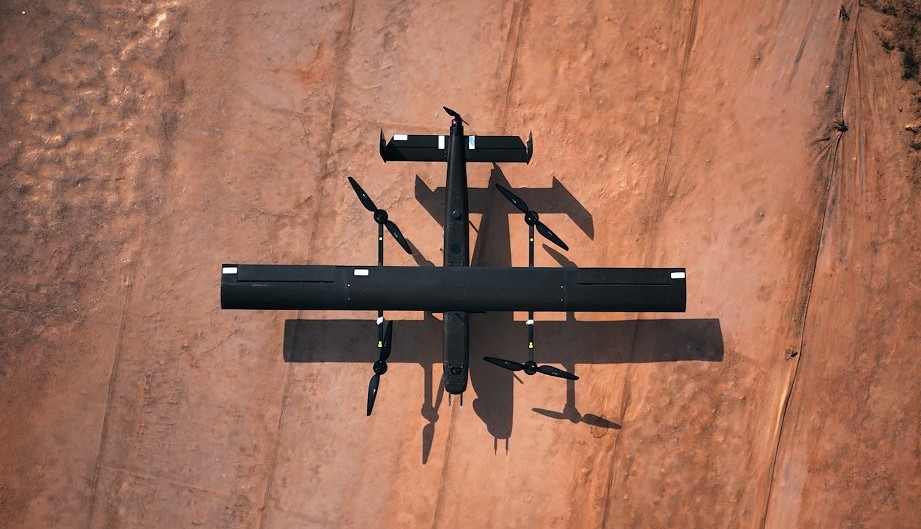
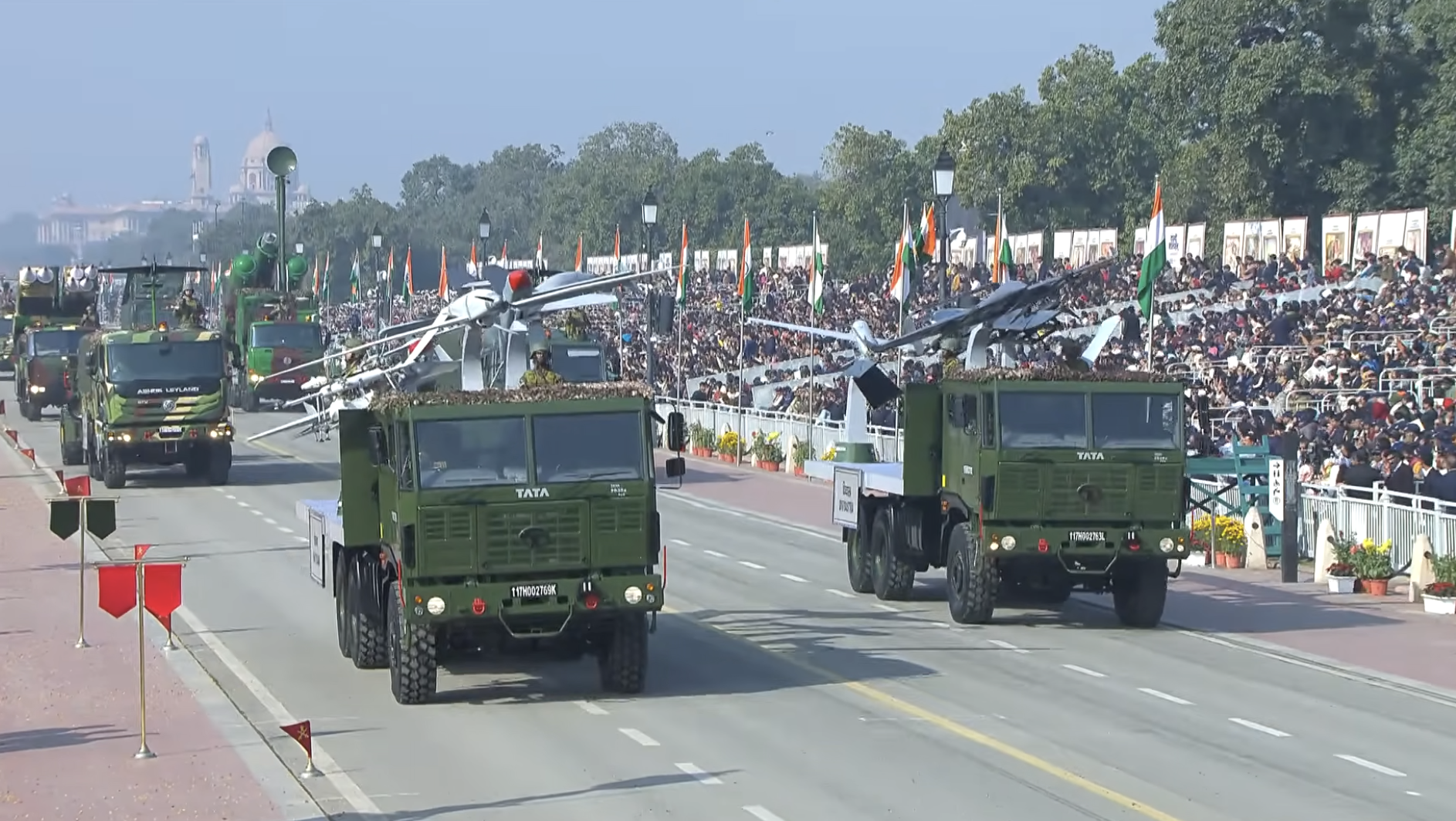
 Shaktiban and Divyastra systems on Kartavya Path during the Republic Day parade.
New Delhi: India’s 77th Republic Day celebrations on Monday, January 26, marked a deliberate institutional shift from ceremonial tradition to operational theatre. The main Kartavya Path parade here in the national capital presented a revised military doctrine centred on joint operations, indigenous weapons systems, and unmanned combat platforms.
The 90-minute ceremony, beginning at 10.30am, was presided over by the president, Droupadi Murmu, with the European Commission president, Ursula von der Leyen, and the European Council president, António Costa, serving as chief guests – the first time the Republic Day parade has hosted dual EU leadership. Their presence signalled India’s commitment to the India-EU Strategic Partnership while the parade itself demonstrated New Delhi’s defence self-reliance trajectory.
Battle format replaces ceremonial columns
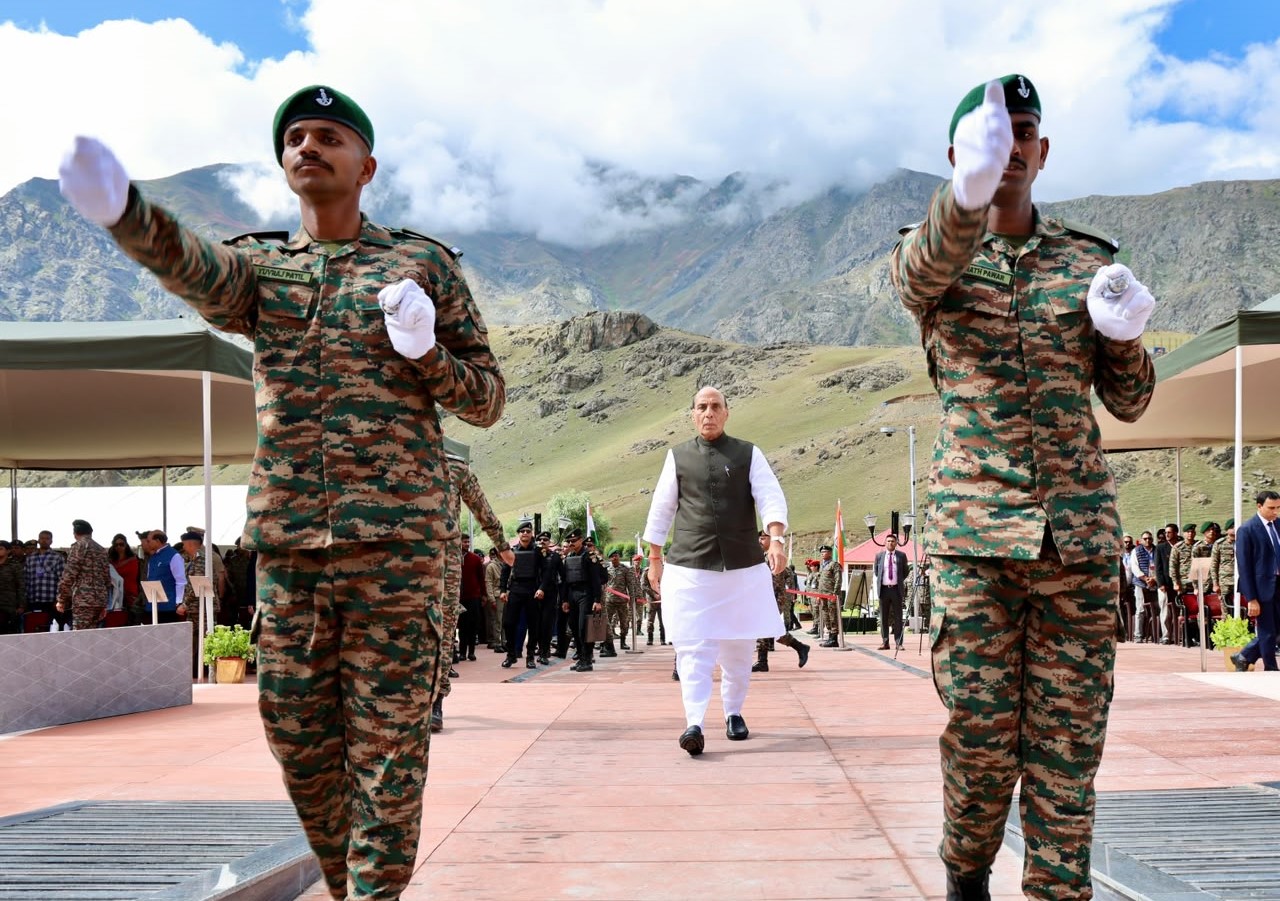
The Indian Army deployed a phased battle array format for the first time, incorporating live aerial components and moving away from purely ceremonial columns. This represented institutional evolution toward operationalized parade design, treating the event as a demonstrative rehearsal of integrated multi-domain warfare rather than hierarchical validation.
The 61 Cavalry, traditionally India’s premier ceremonial unit, appeared in battle dress instead of dress uniform – a rupture with convention that subordinated ceremony to operational readiness. Accompanying the cavalry were newly raised units: the Bhairav light commando battalion and the Shaktiban Regiment, an artillery unit equipped with drone, counter-drone, and loiter munition systems, reflecting institutional adaptation to hybrid warfare concepts.
The mechanized columns rolled past the saluting dais in deliberate phasing. HMRVs (high mobility reconnaissance vehicles) and anti-tank guided missiles led the formation, followed by India’s first indigenously designed ALSV (armoured light specialist vehicle). Dhruv ALHs (advanced light helicopters) and their armed variant, Rudra helicopters, flew in Prahar formation to simulate battlefield shaping, demonstrating rotary assets establishing fire superiority ahead of ground manoeuvre.
T-90 Bhisma and Arjun main battle tanks advanced with overhead support from Apache AH-64E and Prachand LCHs (light combat helicopters), visually enacting combined arms doctrine. BMP-II Infantry Combat Vehicles represented mechanised infantry anti-tank capability, while Nag missile system (Tracked) Mk-2 platforms showcased precision anti-tank strike systems.
Indigenous weapons systems take centre stage
The URLS (universal rocket launcher system) Suryastra made its parade debut, capable of surface-to-surface strikes to 300 kilometres – the first public display of a system extending India’s land-based precision strike envelope. ATAGSs (advanced towed artillery gun systems) and Dhanush artillery guns provided intermediate and tactical firepower respectively.
Robotic mules, unmanned ground vehicles, and swarm drones signalled institutional investment in autonomous systems for logistics and tactical reconnaissance, implicitly acknowledging labour constraints and force multiplication benefits in protracted operations.
The strategic weapons display presented India’s layered air and surface defence posture. BrahMos cruise missiles – the India-Russia co-developed supersonic system that achieved operational prominence during Operation Sindoor in May 2025 – were showcased alongside Akash air-defence systems and MRSAM (medium range surface-to-air missile) platforms. The Defence Research and Development Organisation’s LRASHM (long-range anti-ship hypersonic missile) and Divyastra battery additions projected India’s trajectory toward indigenous hypersonic systems.
The ceremony opened with constitutional ritual: the prime minister, Narendra Modi, laid a wreath at the National War Memorial before proceeding to Kartavya Path, where Murmu unfurled the national flag to the national anthem, followed by a 21-gun salute fired by indigenously developed 105mm Light Field Guns.
Also, this is the first time trained black kites and Bactrian camels, along with indigenous dog breeds debuted in the main Republic Day parade at Kartavya Path. The animal warriors, under the Remount Veterinary Corps, enthralled the audience during the parade, including the chief guests.
Air Force executes 29-aircraft display
The Indian Air Force conducted a choreographed aerial display of 29 aircraft – 16 fighters, four transports, and nine helicopters – organized into eight distinct formations.
The opening Dhwaj (Flag) formation featured four Mi-17 IV helicopters carrying the national flag and service flags while showering flower petals over Kartavya Path. Subsequent formations included the Vijay (Victory) formation of six Rafale jets executing high-precision aerobatic manoeuvres, and the Vic, Trishul, and Vertical Charlie formations demonstrating tactical air combat geometry.
The operational highlight was the Sindoor Formation – a dedicated configuration featuring Rafale, Su-30 MKI, MiG-29, and Jaguar fighter aircraft flying in close formation to honour Operation Sindoor, the four-day air and ground operation conducted in May 2025 following the Pahalgam terror attack on April 22, 2025. This formation transformed the parade into a direct tribute to recent operational success, reinforcing messaging that military institutions had proven their ability to execute swift, decisive, joint operations.
C-130 Hercules and C-295 Airlifters demonstrated strategic and tactical airlift capability, while the Navy’s P-8I maritime patrol aircraft symbolised tri-service integration. Attack helicopter participation by the Air Force’s ALH Mk IV, the Army’s ALH WSI, Apache, and LCH Prachand helicopters articulated multi-domain integration – the seamless coordination of air, ground, and rotary-wing assets.
The Air Force’s 144-strong marching contingent, commanded by Squadron Leader Jagdesh Kumar, reflected institutional efforts toward gender integration in ceremonial roles. The Air Force Band of 72 musicians – comprising 57 Agniveervayu (regular air warriors) and nine Agniveervayu women, plus three drum majors – marked the first time women musicians participated in a Republic Day band, performing the composition “Sound Barrier” as the band passed the presidential dais.
150 Years of Vande Mataram
The overarching theme commemorated the sesquicentennial of Bankim Chandra Chattopadhyay’s composition. Visual reinforcement came through 1923 paintings by Tejendra Kumar Mitra, originally published in the Bande Mataram Album and displayed as view-cutters along Kartavya Path, linking contemporary nationalism to the independence movement’s cultural foundations.
Approximately 2,500 performers from across India executed choreographed sequences organised under two parallel motifs: “स्वतंत्रता का मंत्र – वंदे मातरम्” (Freedom’s Mantra) and “समृद्धि का मंत्र – आत्मनिर्भर भारत” (Prosperity’s Mantra – Self-Reliant India). This duality articulated the government’s positioning of cultural patriotism and economic nationalism as complementary narratives.
Inclusive representation
Approximately 10,000 special guests from diverse backgrounds – including Olympic medallists, Isro scientists involved in Gaganyaan and Chandrayaan missions, innovators from Atal Tinkering Laboratories, beneficiaries of welfare schemes ranging from PM Mudra loans to Jal Jeevan Mission connectivity, tribal representatives, Border Roads Organisation construction workers, and National Disaster Management Authority personnel – were seated at Kartavya Path.
The 30 tableaux – 17 from states and union territories, 13 from central ministries and services – encapsulated this inclusive vision. The tri-services tableau showcased Operation Sindoor with glass-cased integrated operational centre displays, while the Ministry of Culture’s centrepiece tableau anchored the Vande Mataram theme. State tableaux ranged from Assam’s Asharikandi terracotta craft tradition to Gujarat’s focus on tribal heritage.
NCC expands institutional role
The National Cadet Corps fielded 2,406 cadets (including 898 girls) drawn from 30 states and union territories, with notable regional representation: 127 cadets from Jammu & Kashmir and Ladakh, and 131 from the northeastern states. International participation came from 25 friendly nations under the Youth Exchange Programme, transforming the NCC contingent into micro-diplomatic representation of India’s defence partnerships.
NCC strength has grown from 1.7 million to 2 million cadets nationally, with girls now constituting 40 percent. The deployment of 75,000 NCC cadets during Operation Sindoor underscored the corps’ expanding role in civil-military integration and disaster management.
Celebrations across states
Beyond Kartavya Path, Republic Day unfolded as decentralized national observance, with state capitals, district headquarters, schools, and civil institutions replicating the ceremonial template while adapting themes to regional contexts.
Andhra Pradesh hosted its state-level ceremony in Amaravati, the newly constructed capital, signifying institutional transition and governmental relocation. Gujarat’s celebration in the newly formed Vav-Tharad district, under the governor, Acharya Devvrat, represented the first state-level Republic Day parade following the district’s formation.
The Pradhan Mantri Rashtriya Bal Puraskar was conferred on 20 children from 18 states and union territories for exceptional achievements across seven categories – Bravery, Art and Culture, Environment, Innovation, Science and Technology, Social Service, and Sports. Child awardees participated in the Kartavya Path parade and attended subsequent engagements with Modi.
Project Veer Gatha 5.0 mobilized approximately 19.2 million school students nationwide in essay, poetry, and multimedia competitions honouring armed forces gallantry and freedom fighters. One hundred students were declared winners and invited to New Delhi to witness the parade and attend Modi’s subsequent NCC rally on January 28.
The National School Band Competition drew 763 school bands from 33 states and union territories (approximately 18,013 student participants), with finalist bands performing at Kartavya Path, embedding musical training into the ceremonial narrative.
At district and municipal levels, deputy commissioners and collectors conducted flag hoisting ceremonies, distributed service medals and citizen recognition awards, and organised scaled-down parades featuring district police, home guards, Scouts and Guides, and ex-servicemen contingents. Many districts launched infrastructure projects – school buildings, health centres, roads, bridges – on Republic Day, aligning developmental accomplishments with patriotic commemoration.
Takeaway from Republic Day 2026 parade
The 77th Republic Day represented institutional evolution beyond ceremonial nationalism. The battle array format signalled movement toward operationalised military doctrine; EU leaders’ presence projected India’s strategic autonomy within the Western alliance system; showcasing of indigenous precision systems (BrahMos, URLS Suryastra, LRASHM affirmed Atmanirbhar Bharat commitments; and participatory scope – from 10,000 special guests to 19.2 million school students in Project Veer Gatha – institutionalised inclusive nationalism extending beyond elites to developmental beneficiaries and youth.
The integration of women in band, NCC, and ceremonial roles projected gender integration as institutional norm rather than exception. Collectively, the celebrations articulated a republic that is constitutionally anchored, militarily confident, technologically advancing, diplomatically assertive, and institutionally committed to inclusive representation – a complex institutional narrative requiring sustained performance to validate.