New Delhi: In a significant push to enhance the Indian Navy’s long-range offensive capabilities, the defence ministry has come out with a request for information (RFI) for the acquisition of land-attack cruise missiles (LACMs) to arm its conventional submarine fleets.
These missiles are intended to strike land-based targets with high precision, boosting the Navy’s ability to conduct long-range attacks while maintaining a strong technological advantage in modern missile warfare.
The RFI does not indicate the quantity to be procured but asks vendors to clarify whether the proposed or comparable systems are already in service with other clients.
As part of India’s defence procurement framework, the contract will carry a 30 per cent offset requirement, obligating vendors to reinvest a portion of the deal’s value into the Indian defence ecosystem.
The specifications outlined in the RFI set clear technical parameters. The missile, including its launch capsule, must weigh under 1,500kg and deliver a strike range of minimum of 50km and maximum of over 500km.
It should be compatible with 533mm submarine torpedo tubes, launched via guide rails, and measure no more than 6.4 metres in length.
Operational requirements stipulate that the missile must be capable of being launched from periscope depth between 15 and 100 metres, while the submarine is travelling at speeds of up to 6 knots in standard conditions and up to 8 knots during emergency ejection.
The system must also allow the firing of two missiles in quick succession without interference between their homing systems.
Further, the missile must endure submarine roll and pitch angles of up to 45 degrees for durations of 8–10 seconds.
It should use geographic coordinate-based targeting and remain effective in heavily contested electronic warfare environments.
The LACM is required to carry an insensitive high-explosive warhead, available either as a single unit or fitted with sub-munitions, and optimised for air-burst and pre-fragmented impact. The stipulated warhead reliability must be at least 0.99.
Additionally, manufacturers must commit to a long-term upgrade roadmap, ensuring the system remains supportable and technologically relevant for a minimum of 25 years.
It must be noted that based on Nirbhay platform, the DRDO is advancing its own indigenous cruise missile, being designed for launch from standard 533mm torpedo tubes and has a projected range of 1,000–1,500km.
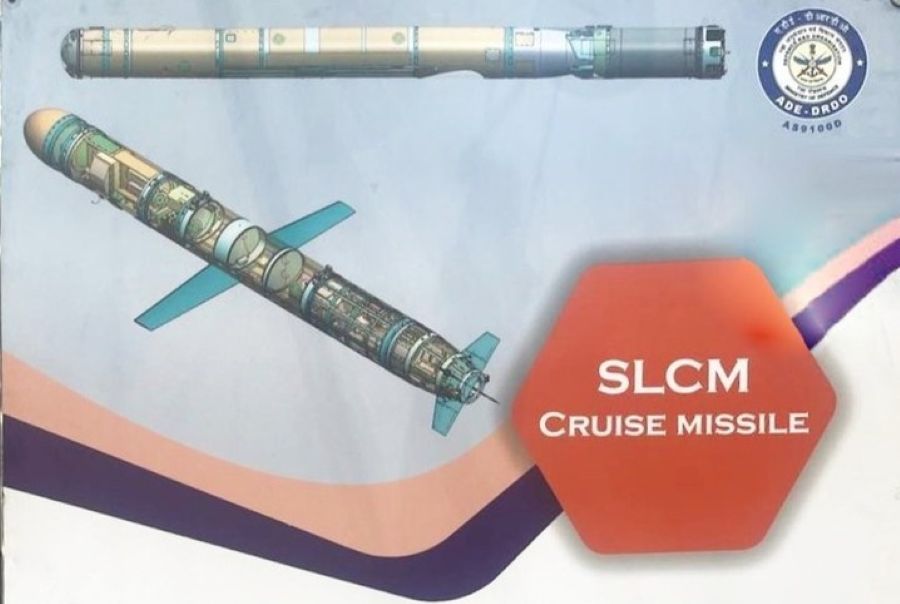
The DRDO’s submarine-launched cruise missiles (SLCM) was successfully tested from an underwater pontoon, including a 402km flight in November 2024.
It has been learnt that the DRDO’s SLCM would be ready for deployment in the Navy not before 2030 as extensive user trials are yet to be carried out.
It has also been learnt that the Navy is exploring foreign alternatives to ensure its new P-75I submarines, expected to enter service around 2031, are equipped with a credible land-attack cruise missile capability from day one.
DRDO's submarine-launched cruise missiles programme
DRDO’s SLCM will be developed in two versions – land-attack cruise missile (LACM) and anti-ship cruise missile (ASCM).
The SLCM will feature technologies like thrust vector control to turn the missile into and onto the target plane, in-flight wing deployment and in-flight engine start have been proved. It is being developed to have a range of 500km.
The length of the missile will be 5.6m and diameter of 505mm.
In comparison to Nirbhay missile, the SLCM is slightly shorter and also less in diameter.
The missile will have all up weight of 975kg which is almost two-thirds of the weight of Nirbhay cruise missile.
It will have speed of 0.7 Mach and will carry 250kg of PCB & airburst warhead.
For navigation, the missile will use INS/GPS in mid-course and RF-seeker at the terminal stage. It will be a two-stage missile, like Nirbhay, with first phase powered by solid rocket booster and the second phase powered by a turbofan sustainer.
The successful test of ITCM missile with indigenous turbofan engine – Manik, will further boost the development process of SLCM. The missile will carry 165kg jet A1 fuel.