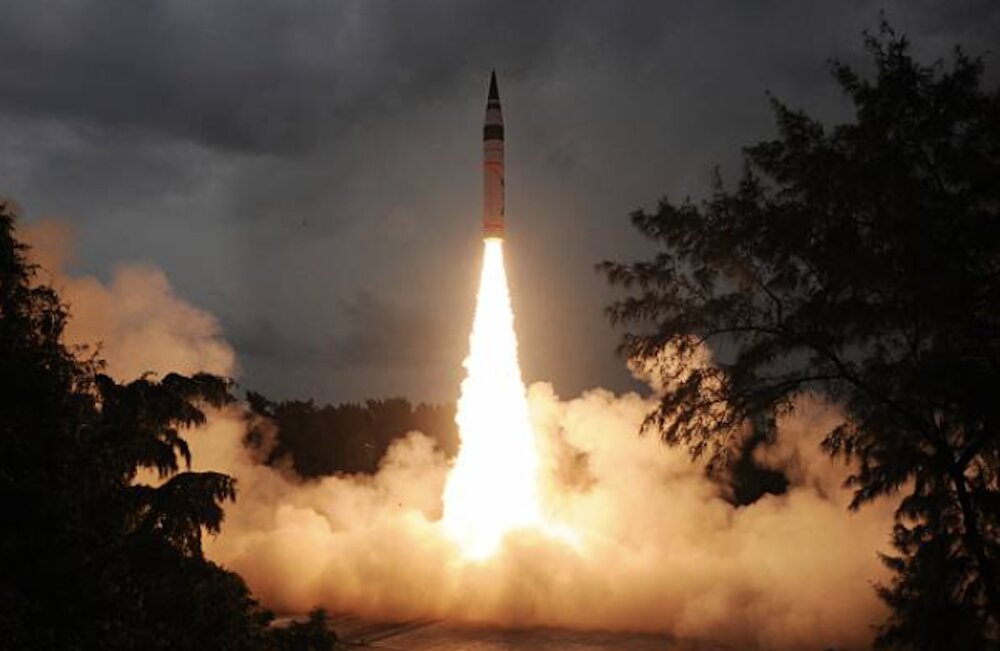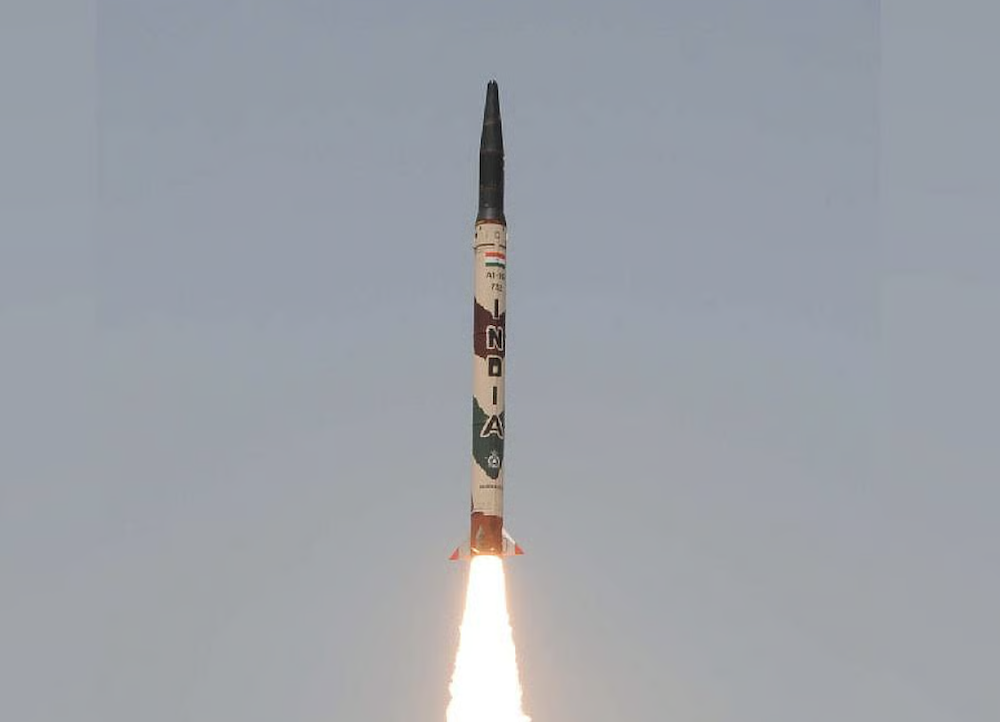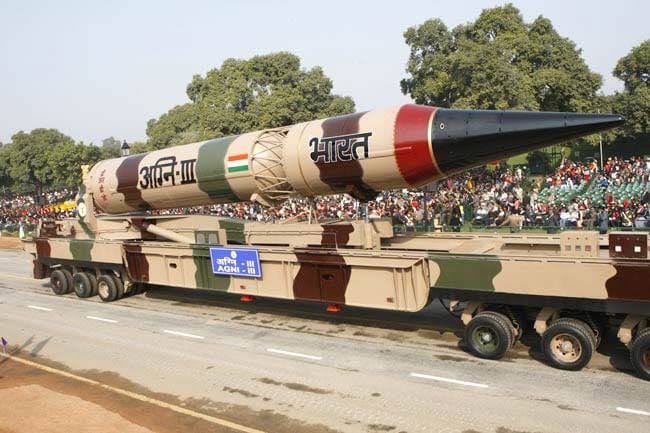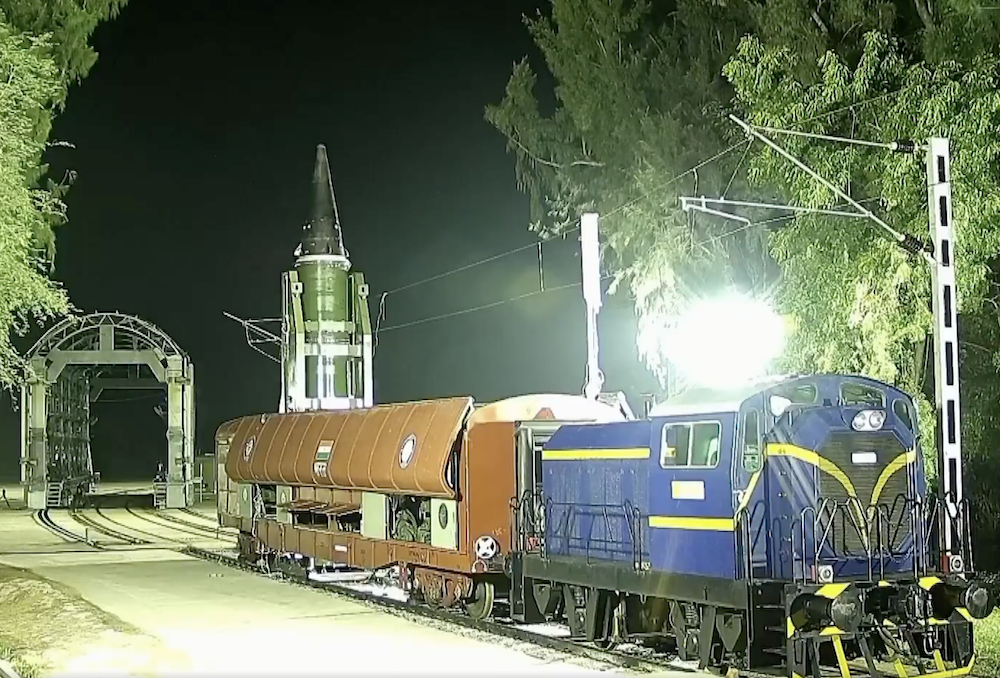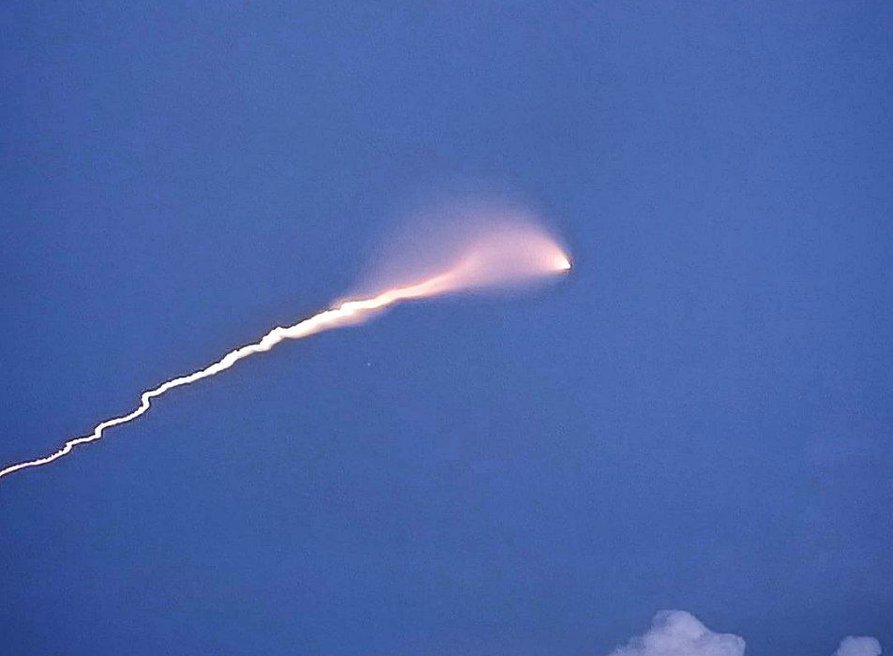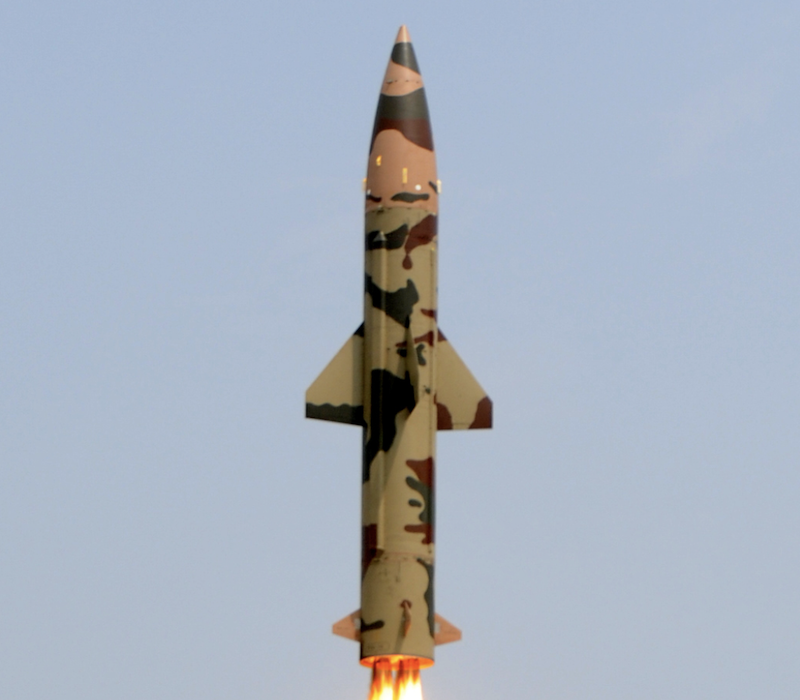
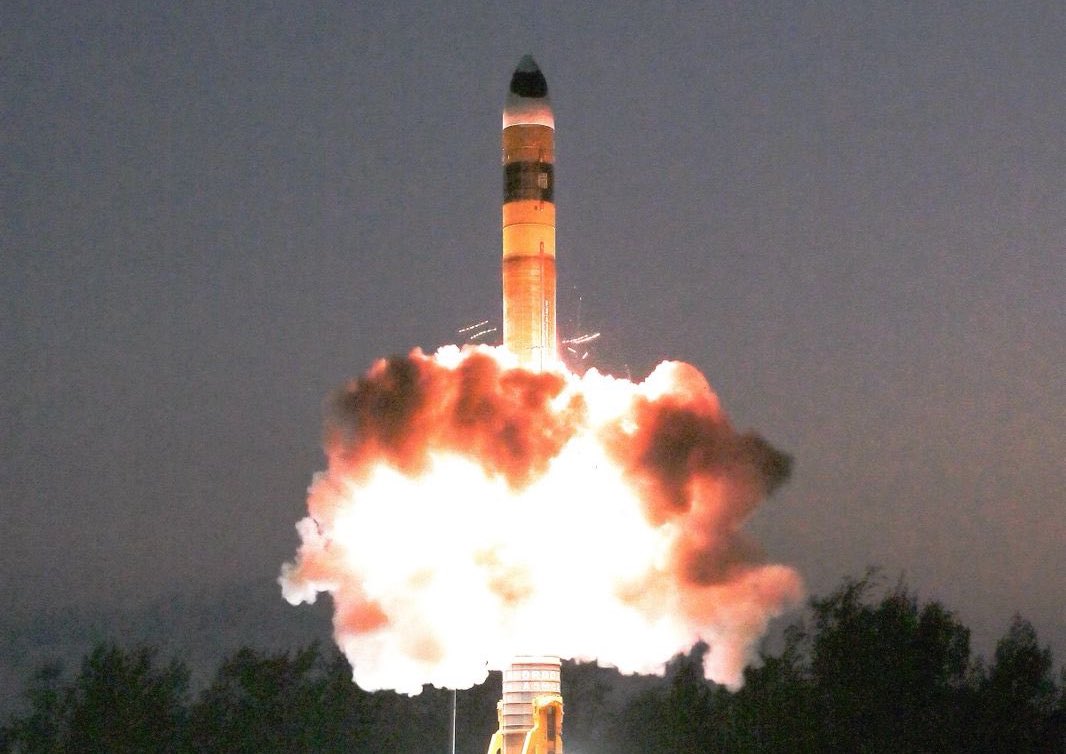
 The Agni missile with MIRV that was tested, on May 8, 2026. (Photo: MoD)
New Delhi: Shortly after sunset on Friday, residents across coastal Odisha and as far as Cox’s Bazar in Bangladesh looked up to see a luminous, comet-like trail streaking across the darkening sky. What they were watching was the latest and probably most consequential missile test to emerge from the Integrated Test Range on Dr APJ Abdul Kalam Island – a low-lying barrier island off the Odisha coast that has become the launch pad for the country’s most sensitive strategic programmes. Eyewitness accounts and video footage, corroborated by multiple media reconstructions, placed the launch window between roughly 6.30pm and 7.30pm IST.
Soon, speculations started to circulate, with several media outlets reported it as an “Agni-6 ICBM with 12,000km range). No statement from the government or its agencies, like the Defence Research and Development Organisation (DRDO) also fuelled the speculations and pushed analysts, open-source intelligence (OSINT) researchers, and journalists into a fevered exercise of deduction.
Video of unknown missile test carried out by DRDO recorded from all weather situation monitor in Bangladesh pic.twitter.com/qNV3by5Z43
— TIGER SHARK ? (@defnthusiast) May 8, 2026
However, on Saturday, the Ministry of Defence posted on social media that it was an “MIRV-capable advanced Agni missile”. It said: “India conducted successful Flight trial of an Advanced Agni missile with MIRV (Multiple Independently Targeted Re-Entry Vehicle) system from Dr APJ Abdul Kalam Island, Odisha on 08th May 2026. The missile was flight tested with Multiple payloads, targeted to different targets spatially distributed over a large geographical area in Indian Ocean Region. [sic]” The MoD further said that the defence minister, Rajnath Singh, has complimented the DRDO, the Army, and the industry for the successful test.
Still, there is no official statement on exactly what variant of the Agni missile was tested and what its range was.
Breaking: Unknown missile test activity spotted over the Bay of Bengal.#India had earlier issued a NOTAM restricting airspace from May 6–9 over a 3,560 km corridor linked to Abdul Kalam Island off the Odisha coast, a key site for strategic missile launches, fueling speculation… pic.twitter.com/jCv4GUYk8e
— Wolverine Update (@W0lverineupdate) May 8, 2026
NOTAM gave the game away
Before a single frame of video emerged, aviation trackers had already spotted the clue hidden in plain sight. Authorities issued a notice to airmen (NOTAM) from May 6 to May 9, closing a corridor roughly 3,560 kilometres long over the Bay of Bengal, stretching from Abdul Kalam Island deep into the southern Indian Ocean. The corridor was more than double the 1,680km zone India had declared for a separately reported test of the long-range anti-ship missile (LRAShM), a hypersonic sea-strike weapon, from the same general area earlier in the month. Defence watchers were unequivocal: a 3,500-plus-kilometre exclusion zone is the signature of a strategic ballistic system, not a naval strike weapon.
India issues a notification for a likely long range missile test, the range is near 3,560-km
— Damien Symon (@detresfa_) May 4, 2026
Date | 06-09 May 2026 pic.twitter.com/JcPJYgWphP
Context from the preceding months reinforced that reading. In October 2025, a NOTAM initially declared at roughly 2,530 kilometres was subsequently extended to approximately 4,795 kilometres for what analysts broadly interpreted as an advanced Agni-series trial. In August 2025, a separate long-range alert also touched the 4,790km mark. Taken together, the record shows a pattern of India using the same Bay of Bengal corridor for progressively longer-range tests – and using the NOTAM length as an involuntary signal of escalating ambition.
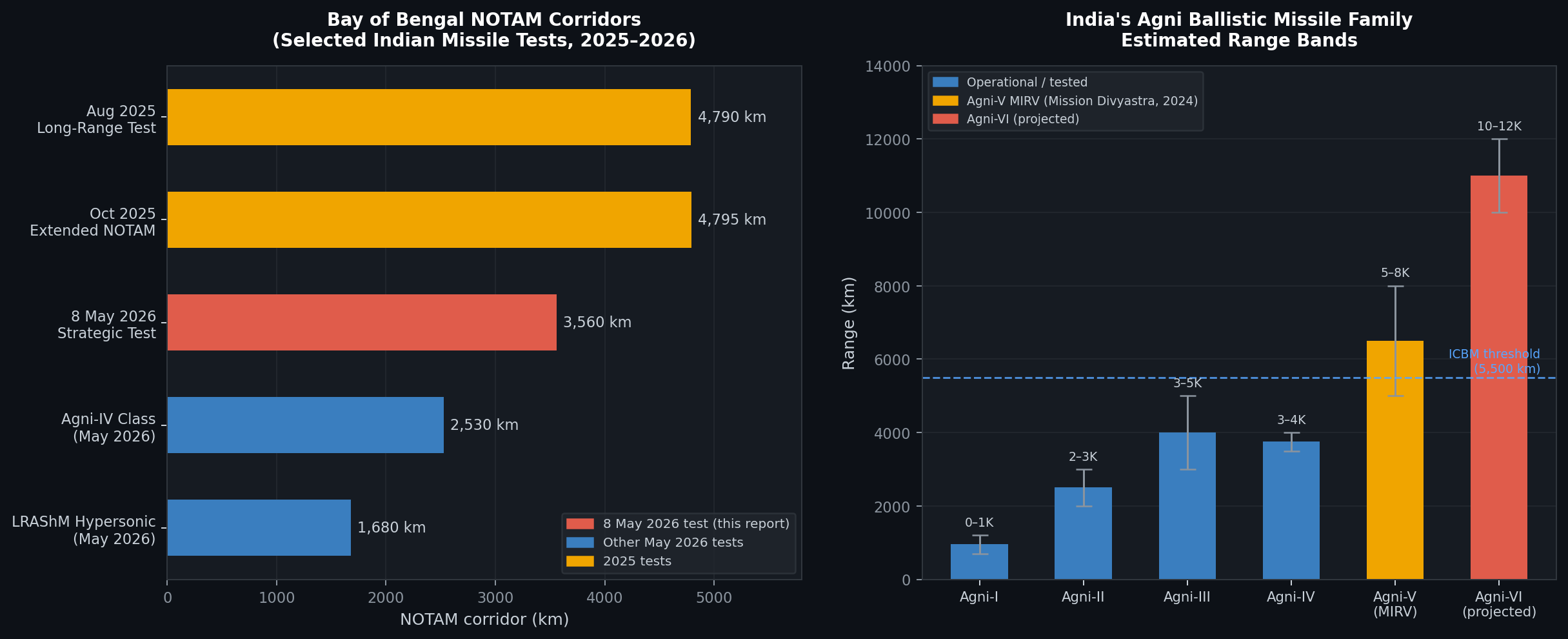 NOTAM corridor lengths for selected Indian missile tests (L) and estimated range bands across the Agni family (R). Agni-6 specifications remain projected; no official technical data has been released.
Mission Divyastra and MIRV
The analytical debate about what precisely was tested on May 8 centres on two possibilities: an advanced variant of the Agni-5 (also spelled as Agni V) – India’s current long-range workhorse – now equipped with multiple independently targetable re-entry vehicle (MIRV) technology, or an early technology demonstrator for the next-generation Agni-6 intercontinental ballistic missile (ICBM).
The MIRV angle is far from speculative. In March 2024, DRDO publicly announced Mission Divyastra – the first confirmed flight test of an indigenously developed Agni-5 fitted with MIRV payloads. The agency confirmed that multiple re-entry vehicles had been tracked and monitored during the test, delivering separate warheads to distinct aimpoints.
It was a landmark moment: India became only the sixth country, after the United States, Russia, China, France, and the United Kingdom, to demonstrate that capability operationally. Subsequent testing and user trials through 2025 have continued to refine MIRV integration on the Agni-5 platform, meaning that, by May 2026, an Agni-5 MIRV test would be a plausible, even routine, next step in the system’s development cycle.
What shifts the argument toward Agni-6, however, is the political signalling that preceded and accompanied the May 8 launch.
In early May 2026, the DRDO chairman, Samir V Kamat, was reported as confirming that the organization was ready to conduct a 10,000km-plus Agni-6 test and was awaiting government clearance. Within days, The ruling BJP’s official account on social media amplified that message with a post declaring that “Agni-6 – with a strike range of over 10,000 kilometres and MIRV technology – is ready to make history.” Political messaging of that kind, combined with the timing of the NOTAM, convinced many observers that May 8 was either the authorised Agni-6 debut or a closely related pathfinder test.
Why 3,560 kilometres is not the ceiling
A common misreading of NOTAM data treats the declared corridor length as a proxy for the missile’s maximum range. It is not. Aviation and defence analysis consistently distinguishes between the safety corridor – designed to warn aircraft and shipping away from potential debris and re-entry vehicle impact zones – and the actual design range of the system under test.
In practice, India’s test geometry is constrained by geography. The Bay of Bengal and southern Indian Ocean offer a relatively clear over-water range that avoids overflying sovereign territory, but the corridor can only be extended so far before logistical and airspace-management considerations become prohibitive. The practical consequence is that even tests involving systems designed for 8,000 kilometres or more are routinely conducted under NOTAMs in the 3,500-to-4,800-kilometre band, using lofted or partial-range trajectories.
The lofted-trajectory principle is well established. A ballistic missile fired at a steep angle will achieve a higher apogee and a shorter ground range than the same missile fired on the flatter, “minimum energy” trajectory that maximizes surface distance. Testing on lofted trajectories allows engineers to subject the re-entry vehicle and guidance systems to the thermal and deceleration stresses of a long-range mission without the missile’s warhead actually landing 10,000 kilometres away.
North Korea demonstrated this principle vividly in 2017, when Hwasong-12 tests over the Sea of Japan, flown on steep angles to avoid overflying Japan with a full-range profile, were calculated by external analysts to represent missiles capable of reaching 4,500 kilometres to 6,000 kilometres on a standard trajectory. The same logic applies, proportionally, to India’s Bay of Bengal tests.
Taken together, these factors mean the 3,560-kilometre NOTAM of May 8 is entirely consistent with a test of a system whose true design envelope extends to 8,000-to-10,000 kilometres – and possibly beyond.
Agni-6, ICBM threshold
The Agni-6 programme occupies a peculiar position in India’s strategic discourse: widely discussed, officially unacknowledged in its full scope, and subject to a wide range of attributed specifications. DRDO and government statements have consistently pointed to a 10,000km-plus design range with MIRV capability from the outset.
That figure, if realized, would carry India firmly into ICBM territory – the internationally accepted threshold for which is 5,500 kilometres – and bring not only the whole of China but also parts of Europe and North America within theoretical reach.
Some open-source analyses go further, arguing that either a future Agni-6 block upgrade or a parallel programme – sometimes referred to as “Surya” in defence forums, although the name has no official standing – could target 12,000 kilometres by exploiting first-stage propulsion technology derived from the Indian Space Research Organisation’s (Isro) Polar Satellite Launch Vehicle (PSLV). The same strand of analysis notes that Chinese experts have repeatedly suggested that India has understated Agni-5’s real range, arguing it may already be capable of reaching 8,000 kilometres rather than the officially stated 5,000-kilometre class.
If that is correct, it would substantially narrow the gap between the current Agni-5 and the projected Agni-6 envelope.
Caution is warranted, however. The 10,000-plus figure for Agni-6 rests on statements by DRDO leadership and political messaging rather than published technical specifications. The 12,000-kilometre “Surya” concept remains speculative, with no official acknowledgement from either DRDO or the defence ministry.
The May 8 test, conducted with a belated and unclear government media release and under a 3,560-kilometre NOTAM, cannot by itself be treated as confirmation of any specific capability – even if it is manifestly part of the same development trajectory.
Deterrence maths
The timing of the May 8 test was not incidental. Several analysts noted that the May 6-to-9 window coincided with the first anniversary of Operation Sindoor – a major Indian military operation whose political resonance the government and the ruling party have been careful to sustain. Whether or not the date was chosen for that reason, the effect was to situate the test within a broader narrative of national security resolve.
The geopolitical backdrop is equally significant. China’s nuclear modernisation drive – including new MIRV-capable intercontinental ballistic missiles, expanded silo fields, and a growing sea-based deterrent – has steadily increased the capability gap that India’s strategic planners are tasked with managing. Pakistan’s continued development of low-yield tactical nuclear weapons and new delivery systems adds a separate, shorter-range layer to the deterrence equation.
Meanwhile, Turkey’s announced entry into the ICBM arena with a system of purported 6,000km range, reported in May 2026, underscored that the club of states pursuing long-range nuclear-capable missiles is no longer limited to the five permanent members of the United Nations security council.
The Strategic Forces Command, the triservice body responsible for managing the country’s nuclear arsenal, has been progressively integrating Agni-5 into its operational inventory over the past several years. The shift toward MIRV-capable variants and, ultimately, toward an ICBM-class system represents both a qualitative upgrade in deterrence credibility and a significant increase in the demands placed on command, control, and communications infrastructure.
Whether the May 8 test advances that integration – or whether it was a more experimental pathfinder – remains, in the absence of official disclosure, an open question.
How the test was read – and misread
The country’s media responded with a mixture of excitement and appropriate epistemic caution. One reported the launch as an “unidentified missile” test, highlighting the visual spectacle and the unusually large NOTAM while acknowledging the absence of any official designation. Others moved further along the inference chain, explicitly linking the event to an Agni-5 evolution or an Agni-6 technology demonstrator and emphasizing that the NOTAM profile was incompatible with the LRAShM hypersonic system tested earlier in the month.
Internationally, defence-focused OSINT communities and specialist outlets picked up the same signals, contextualising the test within DRDO’s stated readiness to trial a 10,000km-plus system and the BJP’s social-media messaging. The more rigorous analysts consistently flagged a critical caveat: without access to telemetry data or any official disclosure, precise claims about the missile’s configuration, trajectory, or range remain inferential – however well-grounded those inferences may be in prior Agni performance data and India’s publicly stated deterrence requirements.
That caveat matters. The history of strategic missile programmes – not only in India but globally – is littered with confident external assessments that proved partially or wholly incorrect. What can be stated with confidence about May 8 is narrower: a long-range, strategic-class ballistic missile was tested from Abdul Kalam Island; the NOTAM corridor, at 3,560 kilometres, was the longest declared for a May 2026 Indian test; and the launch belonged to the Agni family.
Everything beyond that is, at present, analysis rather than fact.
What May 8 means
Assembling what is known, a coherent picture emerges: India conducted a long-range “advanced” Agni missile test on May 8. The lofted or partial-range trajectory, the 3,560-kilometre NOTAM, the strategic and political timing, and the context of Mission Divyastra and pre-test DRDO statements all point toward a system whose true design range substantially exceeds what the NOTAM suggests – most plausibly in the 8,000-to-10,000-kilometre bracket, consistent with either an operationally refined MIRV Agni-5 or an early Agni-6 demonstrator.
What the test emphatically does not do, absent any official disclosure, is prove that India has an operational ICBM ready for deployment. The gap between a successful flight test and an operational system integrated into the Strategic Forces Command’s arsenal involves years of additional testing, reliability trials, command-and-control integration, and political decisions about nuclear posture. India is clearly closing that gap with deliberate speed, and May 8 was another increment in that progression.
But incrementalism is not the same as arrival.
The government has chosen, consistently and strategically, to say very little. That silence is itself a form of signalling – one that keeps adversaries uncertain, preserves negotiating flexibility, and allows domestic political narratives to fill the void. The fuller story will emerge only when New Delhi decides to tell it – or when the next NOTAM appears over the Bay of Bengal.
Key facts at a glance
Date of launch: May 8, 2026
Launch site: Dr APJ Abdul Kalam Island, Odisha
NOTAM corridor: ~3,560km over the Bay of Bengal (May 6–9, 2026)
Official confirmation: MoD just said it was an advanced Agni missile tested with MIRV
Most likely system: MIRV-capable Agni-5 variant or Agni-6
Agni-6 projected range: Over 10,000km (government/DRDO statements); 12,000km speculative
Mission Divyastra: March 2024 – India’s first confirmed MIRV Agni-5 test
ICBM threshold: 5,500km (international definition)
DRDO chairman: Samir V Kamat confirmed readiness to test Agni-6 in early May 2026
Follow us on social media for quick updates, new photos, videos, and more.
X: https://x.com/indiasentinels
Facebook: https://facebook.com/indiasentinels
Instagram: https://instagram.com/indiasentinels
YouTube: https://youtube.com/indiasentinels
© India Sentinels 2026-27