
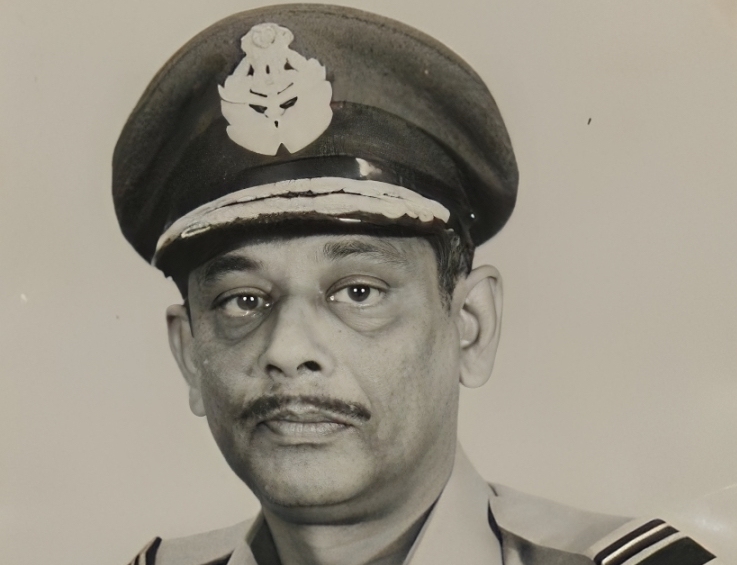
 Air Vice Marshal Cecil Vivian Parker.
On a December morning in 1971, four Hawker Hunters of the Indian Air Force’s 20 Squadron thundered 120 kilometres into Pakistani territory to strike an airbase most commanders would have judged beyond safe reach. Leading them was Wing Commander Cecil Vivian Parker, a fighter pilot whose composure under fire that winter would earn him the Maha Vir Chakra, India’s second-highest wartime gallantry award.
As Bishop Westcott Boys’ School marks its centenary, Air Vice Marshal Parker stands among the alumni it is proudest to claim. His story begins nowhere near an airfield – in a modest, well-travelled Indian household, where a small boy’s fascination with aircraft overhead would quietly harden into a lifelong calling.
Childhood Between Three States
Cecil Vivian Parker was born in 1932 in Anand, in present-day Gujarat, to a Bengali mother who taught school and a father from Bilaspur, in present-day Chhattisgarh, who worked as a government engineer. The family’s official postings kept them on the move, and by 1941 they were settled in Calcutta, where nine-year-old Cecil spent a year at St James’ School.
That year proved transitional. His father was transferred to Tokyo on a government supply mission, and with the family bound for Japan, his parents began looking for a boarding school that could take their son in their absence. Their choice was Bishop Westcott Boys’ School, in Ranchi.
The Westcott Years
Parker joined Westcott in 1942, only for World War II to catch up with the school itself soon after. In January 1943, with its Ranchi campus needed for the war effort – the building would later be requisitioned as a makeshift hospital for wounded servicemen – Westcott relocated wholesale to Allahabad, where it remained for the rest of the war.
It was there, a Westcott schoolboy far from parents posted in Tokyo, that Parker’s fascination with flight took hold. The wartime airbase at nearby Bamrauli kept aircraft moving in and out at all hours, and their engines and silhouettes became a fixture of his boyhood – the same dream, sparked at the same airfield, that a young cadet would one day carry into a cockpit of his own.
By the time Parker completed his schooling in 1948, India had won independence and Westcott had returned home to Ranchi. He left with his ambition intact and enrolled at St Xavier’s College, Calcutta, to read for an Economics Honours degree. He never finished it: partway through, his selection for the Indian Air Force came through, and he left college to answer it.
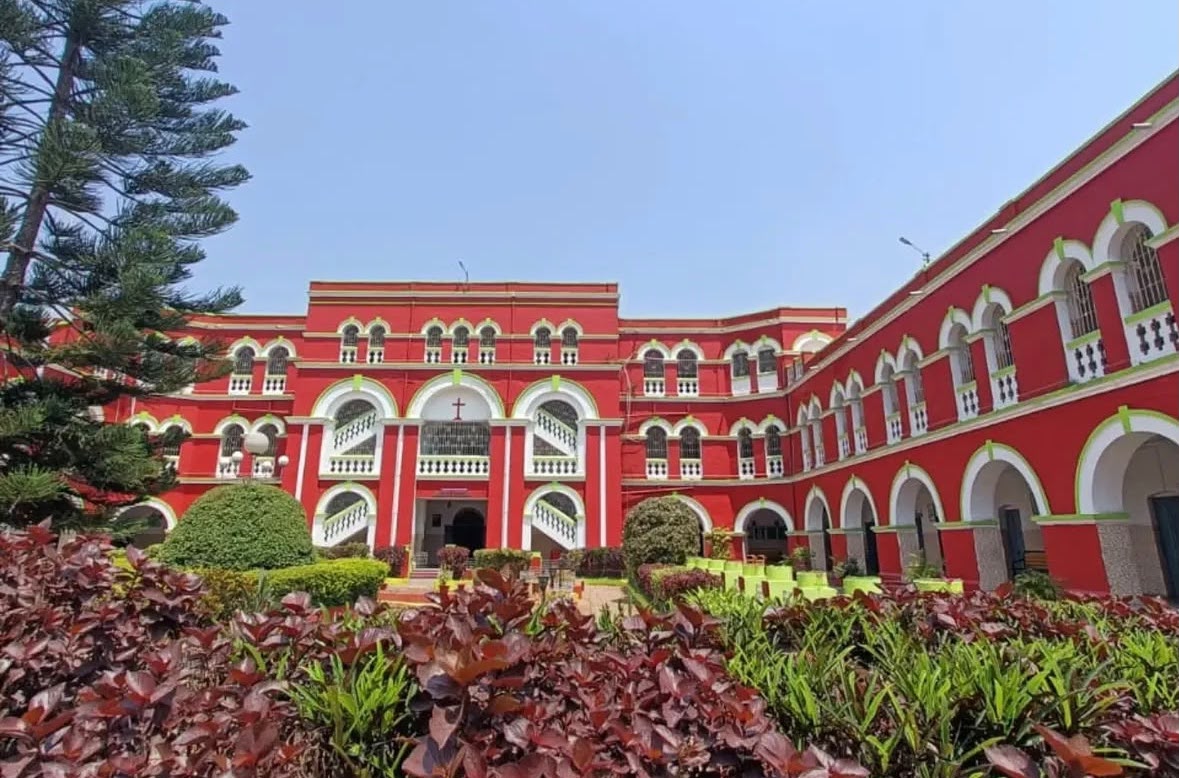 The Bishop Westcott Boys’ School, Ranchi. (Photo: Instagram/@gangs_of_westcott)
Wings, Marriage and Rising rank
In 1951, Parker enrolled as a flight cadet at No. 1 Air Force Academy, Ambala, which relocated south to Hyderabad soon after; he completed his flying training at Begumpet. It was there, at a church youth social, that he met Shirley, a Secunderabad-raised schoolgirl at St Anne’s Convent with a singing voice she put to use in the church choir. Their courtship lasted five years, sustained largely by post – over a thousand letters exchanged between them.
Parker was commissioned into the IAF’s flying branch as a pilot officer on August 31, 1952. Barely eight weeks later, he became the youngest Indian member of the Caterpillar Club, bailing out of a Tempest aircraft that had caught fire mid-air – a brush with disaster that did nothing to dim his enthusiasm. He went on to fly the Vampire, the IAF’s first jet aircraft, and qualified as a flying instructor.
He married Shirley on February 14, 1956, at St John’s Church, Marredpally. Over the next 30 years, she built a parallel life of her own as an air force wife – teaching and running family-welfare work at every base the family was posted to, through 14 house moves between operational stations in the west and training establishments in the south. Their son was born in 1958 and their daughter in 1960.
From 1962, rising from flight lieutenant to air vice marshal, Parker commanded six operational and training units, stations and areas. In 1966 he raised and commanded the IAF’s first Operational Training Unit on Hunter aircraft, work recognized in 1969 with the Vayu Sena Medal.
His only non-flying postings came at the Defence Services Staff College, Wellington, first as a student, later as directing staff. Even near the end of his flying days the itch never left him: in 1980, while attending a year-long course at the Royal College of Defence Studies in London, he used his Easter break to test-fly and familiarize himself with the Hawk, an aircraft the IAF would induct only years later and still flies today. By his retirement on August 31, 1986, he had logged 3,850 hours flying 22 types of aircraft across a 35-year career.
No. 20 Squadron Over Pakistan
That career’s defining chapter came in December 1971. As war broke out, Wing Commander Parker commanded No. 20 Squadron, the “Lightnings”, flying Hawker Hunters out of Pathankot. He led the squadron on repeated deep-penetration missions into Pakistani territory, striking airfields, an oil refinery and targets in support of the Army, often flying at ranges that gave more cautious commanders pause.
The raid that made his name targeted the Pakistan Air Force base at Murid, some 120 kilometres inside enemy territory. It would be nearly half a century before its full impact was acknowledged from the other side: in 2018, retired Pakistan Air Force officer Air Commodore M Kaiser Tufail credited the strike with destroying five Sabre jets on the ground – a rare admission of the scale of an IAF operation.
Parker also led the squadron’s raid on the Attock oil refinery, pressing home the attack through intense anti-aircraft and small-arms fire to leave one of the biggest blazes South Asia had seen. On a separate mission, returning from a strike, his formation was intercepted by Pakistani F-86 Sabres; in the dogfight that followed, Parker shot one down and badly damaged another. For gallantry and leadership across these operations, he was awarded the Maha Vir Chakra, gazetted on February 12, 1972.
The war was not fought only in the air. With families evacuated from forward bases, Shirley chose to remain in Pathankot, leaving only when asked to escort a bereaved squadron family to Delhi – a quieter courage running alongside her husband’s.
Ninety-four and Celebrating 70 Years
Parker took premature retirement in 1986, at 53, and spent a few years in Bombay’s corporate sector before he and Shirley returned to Hyderabad, where he joined the faculty of Ignou and sat on a college’s governing board. He turned to writing, publishing a memoir, “Airlooms – Random Recollections of an Ancient Aviator”, and over a hundred pieces of aviation writing under the title “Ancient Aviator Anecdotes”. In the mid-1970s, the couple built a home of their own in the newly formed Air Force Officers Cooperative Housing Society in Vayupuri, Secunderabad – “Parkhaven”, designed by Shirley herself – and it is there they still live.
Now in his 94th year, and by his own account partially blind and partially deaf, Air Vice Marshal Parker remains, in his family’s words, as active as he can be. Weeks before Valentine’s Day this year, he hosted a lunch to mark Shirley’s 90th birthday, which falls on December 16 – Vijay Diwas, the anniversary of India’s 1971 victory. Asked about his own place in that history, he responds, his children say, with humility, service pride and no small amount of humour.
On February 14, 2026, Cecil and Shirley Parker completed 70 years of marriage, marked by a tribute their two children, Kevin Sunil Parker and Shalini Avril Lobo, titled “Valentine@70”. They live quietly in Vayupuri’s greenery, visited daily by their son nearby and, each year and every night on a video call, by their daughter in the United Kingdom.
Follow us on social media for quick updates, new photos, videos, and more.
X: https://x.com/indiasentinels
Facebook: https://facebook.com/indiasentinels
Instagram: https://instagram.com/indiasentinels
YouTube: https://youtube.com/indiasentinels
© India Sentinels 2026-27