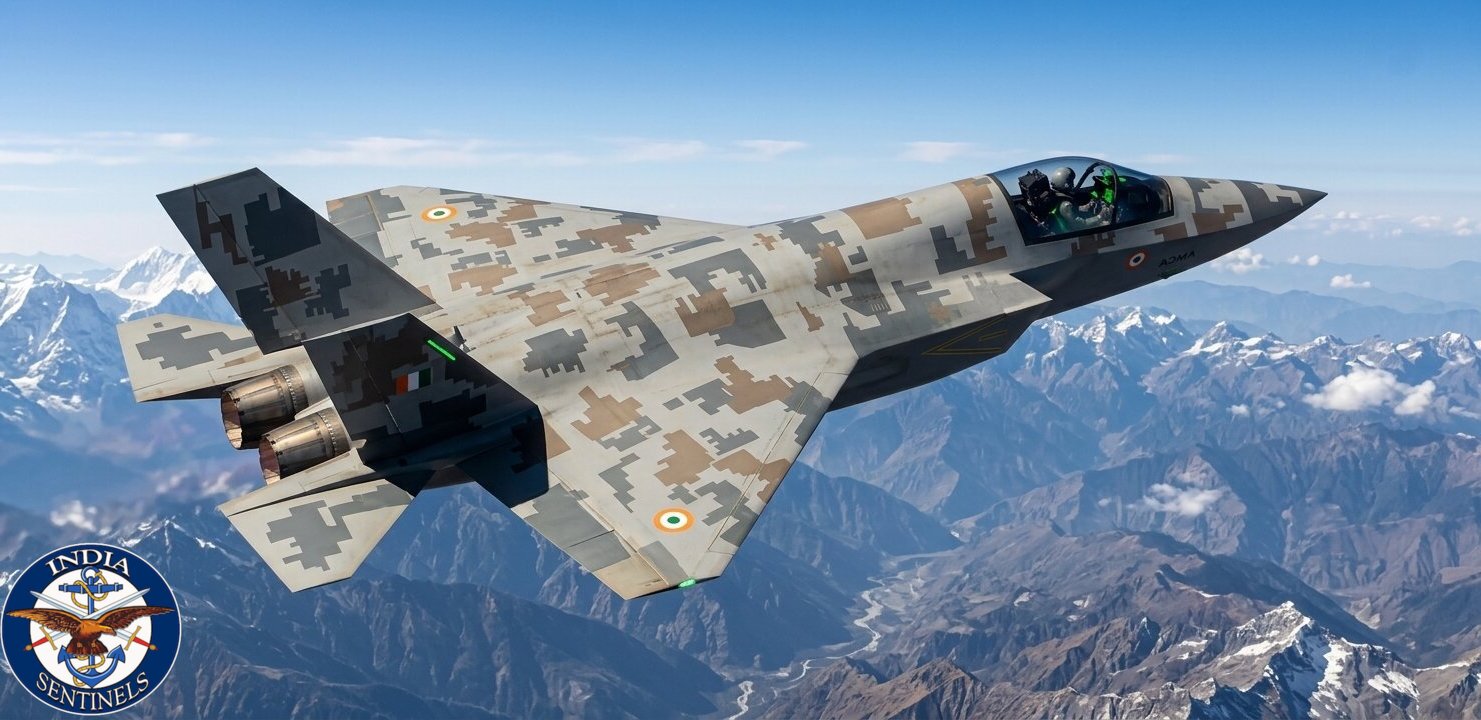
 Illustration for representation. (© India Sentinels 2026–27)
New Delhi: The Ministry of Defence formally issued a request for proposals (RFP) on Wednesday to three shortlisted private-sector parties to manufacture five flying prototypes and one structural test specimen of the advanced medium combat aircraft (AMCA). The AMCA project is India’s first attempt at an indigenous fifth-generation stealth fighter jet.
As India Sentinels had reported earlier, India opened its AMCA programme to private companies in May 2025.
The three groups in contention are Tata Advanced Systems Limited, bidding as an independent entity; a consortium led by Larsen & Toubro in partnership with Bharat Electronics Limited; and a consortium led by Bharat Forge alongside BEML. The move marks a watershed in Indian defence procurement: for the first time, a project of this scale and strategic consequence is being opened exclusively to private industry, bypassing Hindustan Aeronautics Limited (HAL), which has historically been the sole manufacturer of Indian military aircraft.
HAL was reportedly disqualified during the financial assessment phase of the bidding, with officials expressing concern over the state-owned firm’s operational bandwidth. Its current order backlog is reportedly nearly eight times its annual revenue, and it is already grappling with delays on the Tejas-Mk1A programme, where deliveries have slipped to mid-2026 – bottlenecks attributed partly to supply chain constraints and a shortfall in F404 engine deliveries from GE Aerospace.
The disqualification of HAL represents a notable shift in defence policy. According to officials, a specific clause in the expression of interest assessed bidders’ order-book load, designed to ensure the selected partner could allocate adequate capacity to the AMCA programme without disruption.
The RFP was issued by the Aeronautical Development Agency (ADA), a Bengaluru-based laboratory under the Defence Research and Development Organisation (DRDO), which has led the AMCA’s design. The same agency developed the Tejas LCA (light combat aircraft), although that programme was manufactured by HAL.
What winner must deliver
The scope of the contract is considerable. The selected firm will be responsible for manufacturing aerostructures; assembling and integrating avionics, propulsion, hydraulic, fuel, electrical, and flight control systems; and establishing test facilities and ground support infrastructure. The programme spans 14 mandatory and indicative milestones over 84 months – seven years – from the date of the purchase order.
Structural modules of the first prototype and its maiden flight are to be completed within 30 months. All five prototypes are to be airborne by month 64, with 1,800 flight-test sorties completed by month 84. The bid submission deadline is July 27. Notably, the winning bidder will be required to incorporate an entirely new company within three months of being declared the winner – a condition that underscores the government’s intent to create a dedicated, ring-fenced industrial entity for the programme.
What AMCA means for India
The AMCA is a twin-engine, medium-weight, multi-role, low-observable platform designed to meet Indian Air Force requirements for deep-strike and air-superiority missions. Its defining features include an internal weapons bay – which reduces radar cross-section by keeping ordnance concealed – radar-absorbing materials, supercruise capability, and advanced sensor-fusion systems.
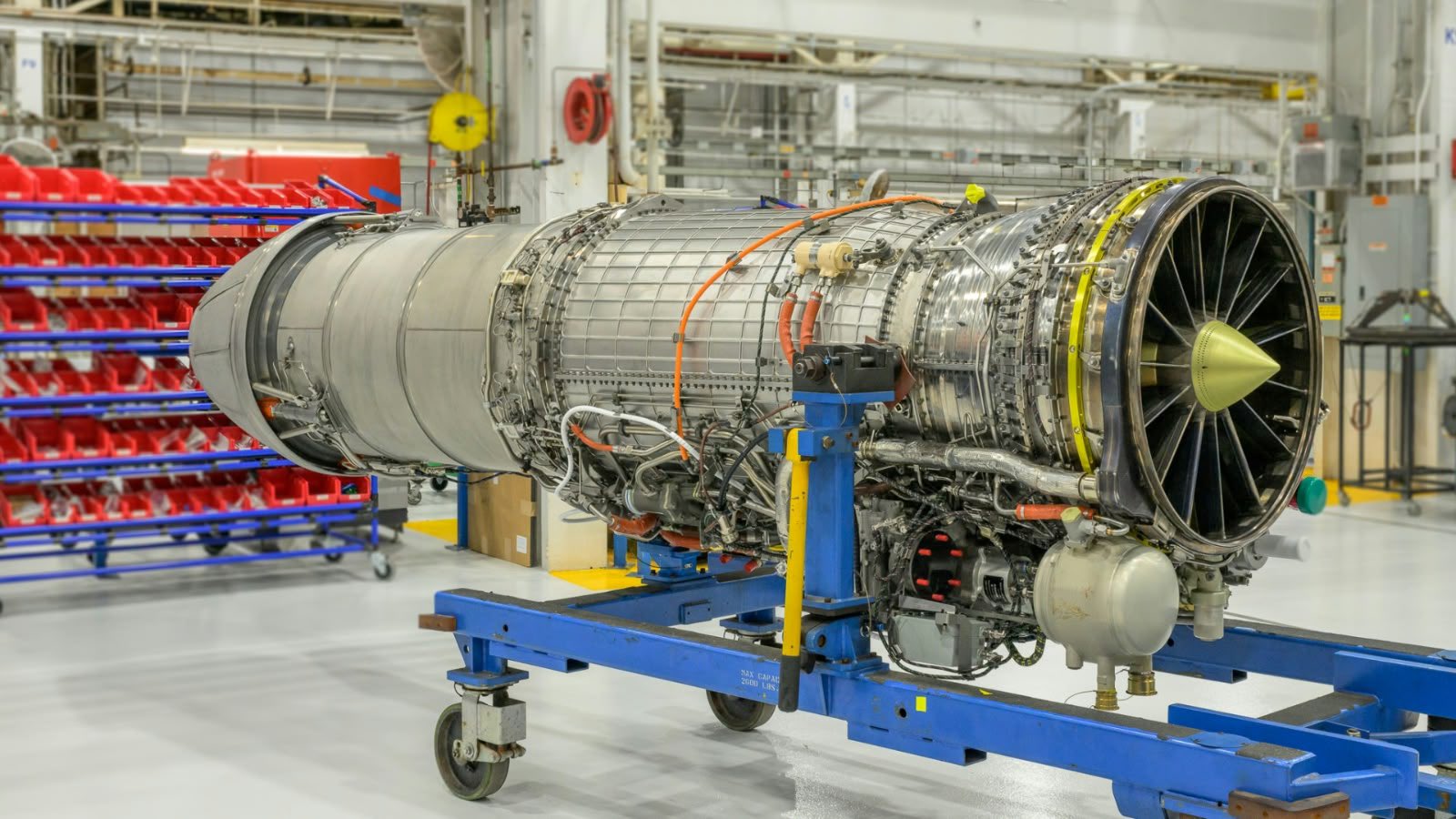
ADA has laid out a 10-year development roadmap, with the first prototype roll-out planned for late 2026 or early 2027, followed by first flight in 2028, certification by 2032, and induction by 2034. The initial prototypes are expected to use the GE F414 engine.
If successfully developed and inducted, the AMCA would place India in a small group of countries – currently including the United States, China, and Russia – capable of designing and producing fifth-generation combat aircraft domestically. The F-35 and the F-22 Raptor represent the American standard; China fields the J-20 and the carrier-borne J-35; Russia has the Su-57. India’s programme, if it holds to its timeline, would deliver its first production aircraft roughly two decades after the F-35 entered service.
IAF fleet depletion
The Air Force has long flagged the erosion of its squadron strength. Against a sanctioned strength of 42 fighter squadrons, the service currently operates roughly 30 – a gap it has sought to address through inductions of the Rafale, incremental orders for the Tejas-Mk1A, and eventually the AMCA. The ageing MiG-21 has been retired; the MiG-29s and Mirage 2000s that remain in service are approaching the end of their operational lives.
The AMCA is envisioned as the core of the Air Force’s future strike capability, complementing the Rafale and the Tejas LCA family. Series production is planned to begin around 2035, with the service planning to induct up to seven squadrons.
The Cabinet Committee on Security granted approval in March 2024, sanctioning roughly ₹15,000 crore for the prototype development phase. The RFP issuance comes exactly a year after the defence minister, Rajnath Singh, approved the AMCA execution model, which offered equal opportunities to both the private and public sectors.
Private sector’s moment
The defence secretary, Rajesh Kumar Singh, speaking at a Confederation of Indian Industry summit earlier this month, said the shortlisting process had produced three private-sector-led consortiums – two blending private and public companies, and one entirely private – and that they would receive RFPs “in the next month or so”. That timeline has now been met.
Singh said the aim was to create an additional production line alongside what HAL already has, generating “the kind of healthy combination the country needs to build its air power”. The framing is significant: rather than replacing HAL, the government appears to be constructing a parallel industrial capability – one that could eventually give the Air Force a degree of supply-side resilience it has historically lacked.
The AMCA is expected to define India’s air power architecture well into the 2040s. Whether the private sector can deliver a fifth-generation fighter on schedule – a challenge that has defeated far better-resourced programmes elsewhere – remains the central question the next seven years will answer.
Follow us on social media for quick updates, new photos, videos, and more.
X: https://x.com/indiasentinels
Facebook: https://facebook.com/indiasentinels
Instagram: https://instagram.com/indiasentinels
YouTube: https://youtube.com/indiasentinels
© India Sentinels 2026-27