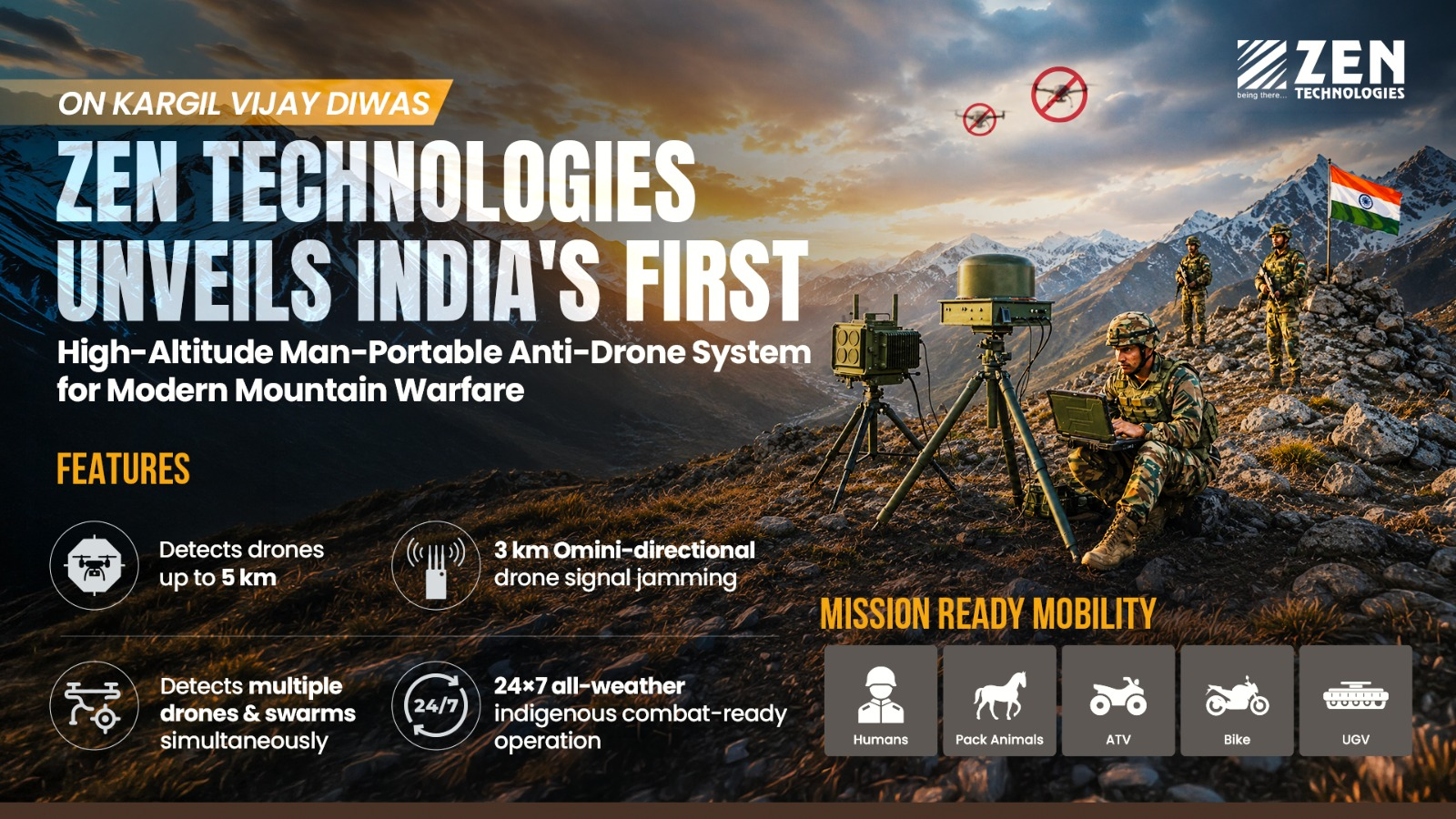
New Delhi: Marking the 27th anniversary of Kargil Vijay Diwas, Hyderabad-based defence technology firm Zen Technologies Limited has unveiled a high-altitude man-portable anti-drone system (MPADS), billed as the first of its kind developed in India for troops operating in mountainous and remote terrain.
The timing of the launch is deliberate. Kargil Vijay Diwas commemorates the conclusion of Operation Vijay on July 26, 1999, when the Army recaptured strategic heights along the Line of Control in the Kargil, Dras and Batalik sectors after Pakistani soldiers and irregulars had infiltrated Indian positions overlooking National Highway 1A.
The 1999 war was fought largely above 16,000 feet, in conditions that punished equipment and soldiers alike, and it remains the reference point for Indian military planners thinking about combat at altitude.
Modern high-altitude warfare, however, now has to reckon with a threat that did not exist in any meaningful sense in 1999: the drone. Cheap, expendable unmanned aircraft have reshaped several recent conflicts, from the Caucasus to eastern Europe, and closer home, the four-day exchange with Pakistan in May 2025 – marked in India as Operation Sindoor – underlined how quickly first-person-view drones and coordinated swarms can be pressed into service along contested borders.
Zen Technologies pointed to this shift as the rationale behind its new system, describing portable counter-drone capability as an increasingly essential element of frontline force protection in high-altitude and contested border areas.
Built for terrain vehicles cannot reach
Conventional counter-drone systems tend to be vehicle-mounted, which makes them of limited use on the kind of terrain the Army traverses in Ladakh, Siachen and other high-altitude sectors. The MPADS is intended to fill that gap. It is compact enough to be carried by soldiers, pack animals, all-terrain vehicles or unmanned ground vehicles, giving units the flexibility to deploy counter-drone cover wherever a mission takes them, rather than only where a road exists.
According to the company, the system combines radio-frequency detection, data fusion and omni-directional jamming in a single lightweight package. It scans continuously across a wideband spectrum of 400 megahertz to 6 gigahertz and can detect hostile drones at ranges of up to 5 kilometres.
Once a threat is identified, the system can jam it – disrupting both the drone's command link and its GNSS navigation signal simultaneously – at ranges of up to 3 kilometres. It is also designed to handle multiple simultaneous targets, including coordinated swarm attacks, and to run continuously in all weather conditions.
The detection function rests on what Zen calls its RF-Based Drone Detector, which uses correlative interferometry and digital beamforming to work out the bearing of an incoming drone with precision.
This feeds into a Data Fusion and Command Centre, which pulls together inputs from various sensors into a single tactical picture, allowing an operator to monitor a threat zone, classify what is approaching, read spectrum activity, and decide how to respond, all from one interface.
Part of a wider push into counter-drone technology
The high-altitude system follows an AI-powered, fully integrated anti-drone platform that Zen Technologies launched in May 2026 at the North Tech Symposium in Prayagraj, on the anniversary of Operation Sindoor. That earlier system was pitched as a larger, more heavily networked solution, offering detection beyond 15 kilometres, simultaneous tracking of over 100 drones, and both soft-kill and hard-kill response options across a wider frequency band of 70 megahertz to 12 gigahertz.
The MPADS unveiled now appears to be a lighter, man-portable complement to that system, built specifically for the mobility constraints of high-altitude terrain rather than for large-scale, fixed or vehicle-borne deployment.
Taken together, the two launches point to a company positioning itself as a broad-based counter-drone supplier to the Indian armed forces, rather than a maker of a single flagship product.