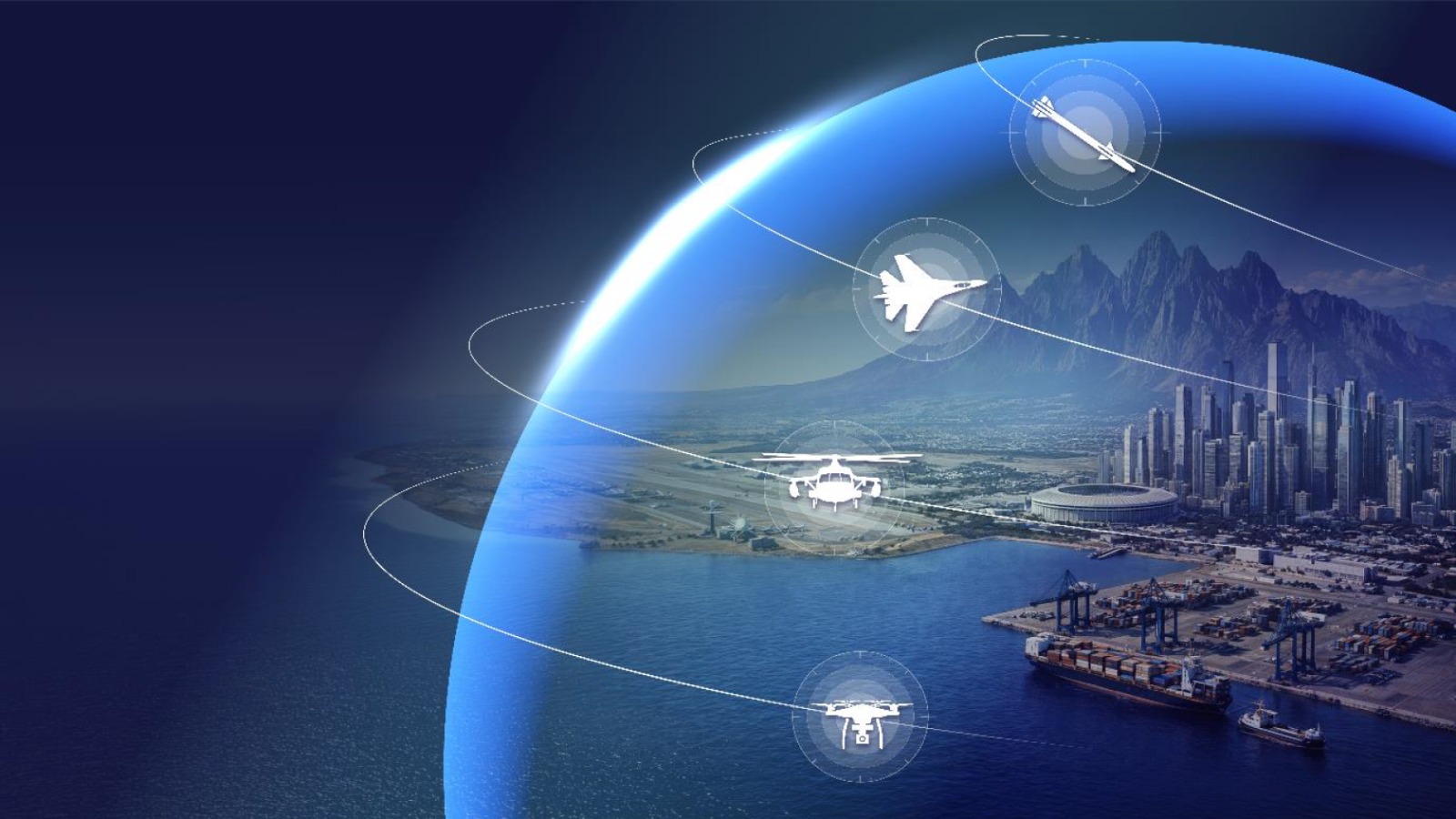
 A representative image for SkyDefender provided by Thales.
New Delhi: French defence and technology group Thales has launched SkyDefender, an integrated air- and missile-defence system designed to counter threats across land, sea, and space domains. This comes at a time when the ongoing US-Israel military aggression against Iran is forcing a fundamental reassessment of air-defence doctrine worldwide.
The system brings together advanced sensors and effectors under a unified command and control (C2) architecture and is built for compatibility with existing air-defence platforms. Thales says SkyDefender is available for immediate global deployment.
The launch comes at a pointed moment. Iran’s sustained waves of ballistic missiles and drones against Israel – and the retaliatory US and Israeli strikes on Iranian territory – have exposed significant vulnerabilities in layered air-defence structures. Interceptor stockpiles have been depleted at an alarming rate, and command and control systems across the theatre have been strained to their limits.
The conflict has demonstrated, more clearly than any prior engagement, that a single-tier defence is inadequate against simultaneous multi-vector aerial saturation attacks. This is precisely the strategic gap SkyDefender is designed to address, the company said.
A three-tier architecture
According to a release by Thales, the system is organized across three operational layers. At short range, the ForceShield component provides a protective envelope against lower-layer threats, including unmanned aerial systems, covering forces, vital assets, and sensitive installations.
At medium range, the SAMP-T NG system – developed in partnership with Eurosam – delivers theatre-level defence with an engagement range of up to 150 kilometres, supported by the “Ground Fire” radar, which provides coverage out to 350 kilometres across a full 360-degree azimuth.
At long range, Thales deploys its SMART-L MM and UHF radars, capable of detecting threats at distances of up to 5,000 kilometres. These provide early-warning capability against ballistic missiles and combat aircraft while also supporting space domain awareness – an increasingly consequential requirement as adversaries exploit orbital assets for targeting and communications.
Thales Alenia Space extends the architecture further through a satellite-based early-warning solution operating from geostationary orbit. Using infrared sensors, it can detect missile launches and identify their origin before ground-based radars acquire a track.
That capability mirrors the kind of strategic early-warning advantage that proved critical during Iranian ballistic salvoes against Israeli territory in 2024, when the limited window between launch detection and impact tested the response times of both Israeli and US systems.
Interoperability and AI
All components are managed through the SkyView C2 system. A companion platform, SkyView Alliance, enables interoperability with Nato and allied multi-domain networks. The open, modular architecture supports integration with sensors and weapons from multiple manufacturers, including legacy platforms – making it suitable for coalition environments such as the US-led force posture currently deployed across the Middle East.
Artificial intelligence runs through the system via Thales’s cortAIx accelerator, enhancing threat assessment and proactive cyberdefence. Electronic warfare and cyberattacks have become standard tools in modern air campaigns; the AI layer is intended to reduce response times and limit the vulnerability window during high-tempo engagements.
India’s interest
India has a long-standing defence relationship with Thales, which supplies key avionics for the Indian Air Force’s Mirage 2000 fleet and has been involved in radar programmes for the Indian Navy. The launch of SkyDefender is likely to draw interest from New Delhi, particularly as India continues to build out its own layered air-defence architecture – which includes Israeli Barak-8 systems, Russian S-400 batteries, and indigenous Akash missiles – amid heightened tensions on both its western and northern borders.
Hervé Dammann, executive vice-president for land and air systems at Thales, said the company was “proud to contribute to the sovereignty of our nations with SkyDefender,” and described the system as “combat-proven, easy-to-integrate and available today”.
However, it must be noted that Thales has not disclosed pricing or named prospective customers. That claim to combat-proven status rests partly on the performance of SAMP-T NG and related Thales’s components that have been used by European militaries supporting Ukraine’s air defence, as well as on the broader operational record of its sensor systems in active theatres.