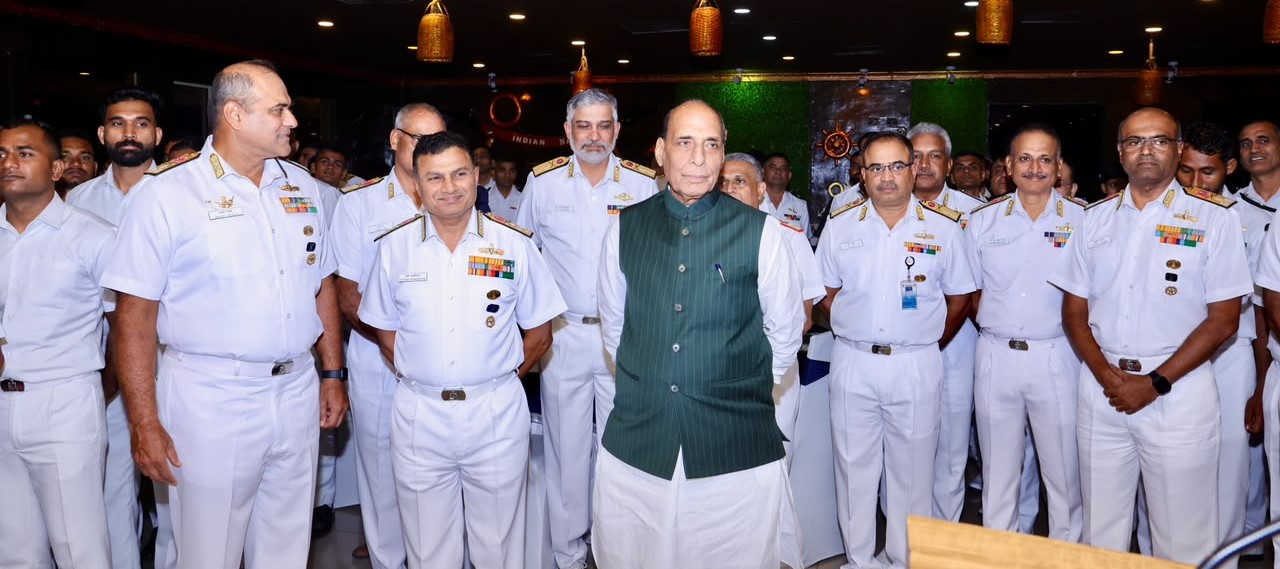
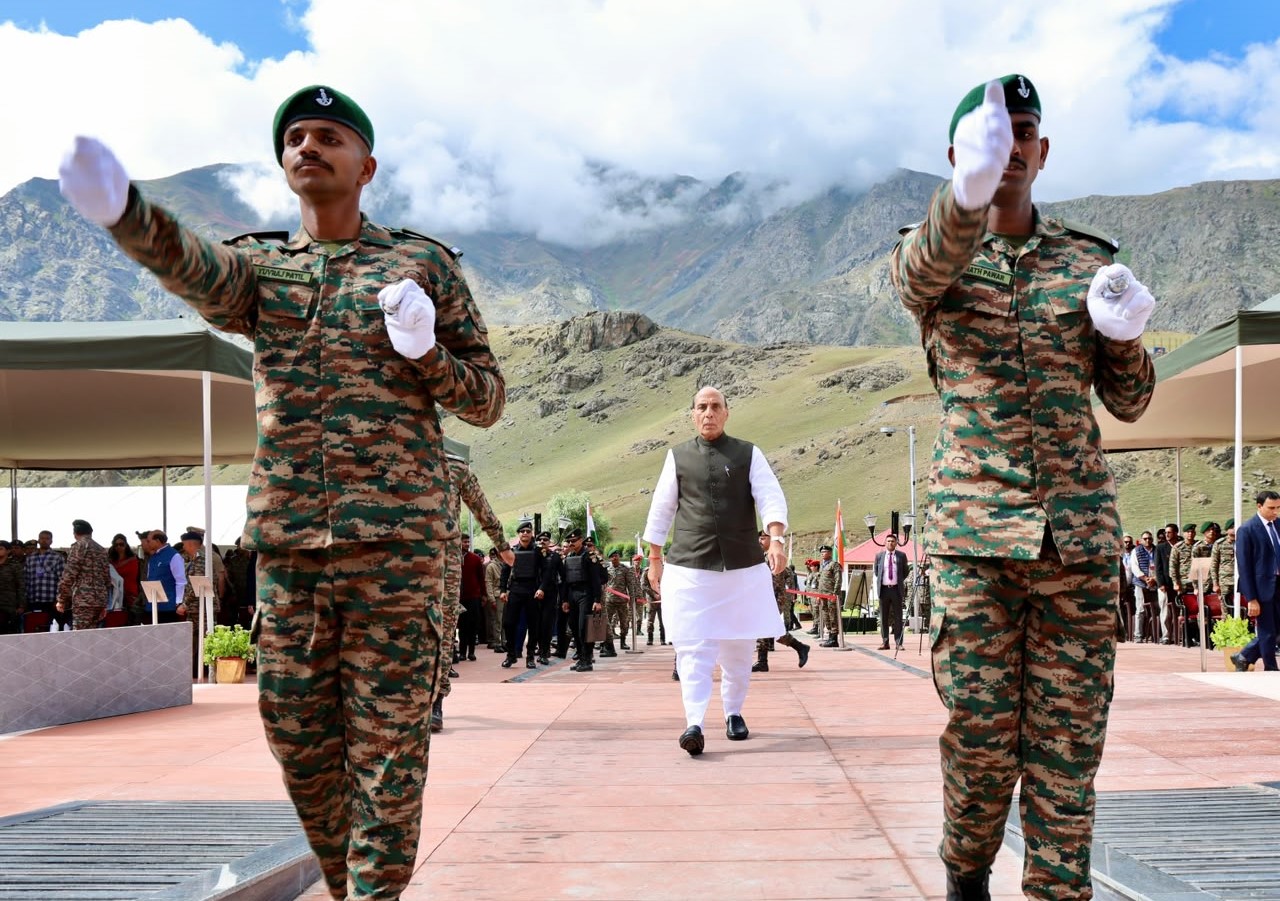
 Rajnath Singh at Kargil War Memorial. (Photo: Ministry of Defence)
Dras: Operation Sindoor stands as evidence that India can meet Pakistan’s provocations with a force “far beyond its imagination,” the defence minister, Rajnath Singh, declared on Sunday, ruling out any dialogue with Islamabad except on the return of Pakistan-occupied Kashmir - territory he described as India’s own, held illegally by its neighbour.
Speaking at the national homage ceremony marking the 27th Kargil Vijay Diwas at Dras, Singh told the gathering that any hostile act against India’s sovereignty would draw the same uncompromising response the armed forces delivered against terrorists and their backers during Operation Sindoor.
The remarks came at the Kargil War Memorial, where Singh was chief guest at a ceremony organized to mark 27 years since the end of the 1999 Kargil War, fought between India and Pakistan over the Kargil district's heights along the Line of Control.
Singh laid a wreath at the Cenotaph and observed a moment of silence for the soldiers who died during Operation Vijay, the campaign that recaptured the peaks from Pakistani intrusion.
Singh argued that Pakistan’s army and the militant groups it hosts had become indistinguishable, with terrorism effectively woven into state policy. He said Pakistan’s military did not merely shelter terrorist outfits but actively collaborated with them, adding that Operation Sindoor was built on the premise that India would no longer treat terrorists and the governments sponsoring them as separate targets.
Operation Sindoor was the code name for the strikes India launched in early May 2025 against terrorist infrastructure inside Pakistan and Pakistan-occupied Kashmir, in retaliation for the April 22, 2025 attack at Pahalgam in Jammu and Kashmir that killed 26 civilians. The four-day exchange that followed – among the most serious military confrontations between the two countries since the 1971 war – drew in air strikes, drone salvoes and missile fire on both sides before a cessation of hostilities was reached.
Drawing a sharper contrast between the two neighbours, Singh offered a rapid-fire list of divergent trajectories: India, he said, was building chip-design capacity while Pakistan built terror networks; India was expanding its start-up economy while Pakistan expanded radicalization; India was launching satellites while Pakistan pushed infiltrators across the border. Should Islamabad attempt to obstruct India’s path to prosperity, he said, the country’s defence forces stood ready with a fitting reply.
He credited the government with giving the armed forces the political latitude to act decisively, saying no adversary would risk testing India while its soldiers held the frontier.
Tribute to the fallen
Much of Singh’s address was given to remembering the Kargil War bravehearts, among them Param Vir Chakra recipients Captain Vikram Batra and Captain Manoj Kumar Pandey, whom he held up as enduring examples for India’s youth.
Kargil Vijay Diwas, he said, was a reminder that sacrifice and service underpin nationhood, and that the war memorial's roll of honour – drawing soldiers from every part of the country – embodied a unity that stood firm against those seeking to fracture it.
Singh also invoked the conflicts in West Asia and between Russia and Ukraine as evidence that modern warfare tests not just militaries but the patience and resolve of entire nations, arguing that national security in India rested on citizens as much as soldiers. While he stopped short of calling for universal conscription, he said Indians should carry a soldier's discipline and readiness within them, prepared to support the country directly or indirectly if the need arose.
Push for self-reliance in defence production
Invoking Vikram Batra’s wartime catchphrase “Yeh Dil Maange More,” Singh said India’s defence-manufacturing base had been transformed since his government took office, when the country imported 65 to 70 per cent of its military hardware.
India now manufactures roughly 65 per cent of its defence equipment domestically, he said, pointing to platforms including the indigenous Akash-Teer air defence control system, a next-generation Akash missile, the aircraft carrier INS Vikrant, the Tejas light combat aircraft, the Prachand light combat helicopter, the Dhruv advanced light helicopter, the Arjun main battle tank, the Pinaka multi-barrel rocket launcher, the Astra air-to-air missile, and a growing range of drones and counter-drone systems.
Singh said the government intended to keep building toward more advanced fighter aircraft, submarines and missiles manufactured on Indian soil.
Ceremony and commemorations
Singh was joined at Dras by the lieutenant governor of Ladakh, Vinai Kumar Saxena; the chief of the army staff, General Dhiraj Seth; the general officer commanding-in-chief of Northern Command, Lieutenant General Pratik Sharma; the GOC of 14 Corps, Lieutenant General Madanraj Pande; and the GOC of 8 Mountain Division, Major General AP Singh, along with veterans, gallantry award recipients, Veer Naris and local residents at the “Shradhanjali Samaroh.”
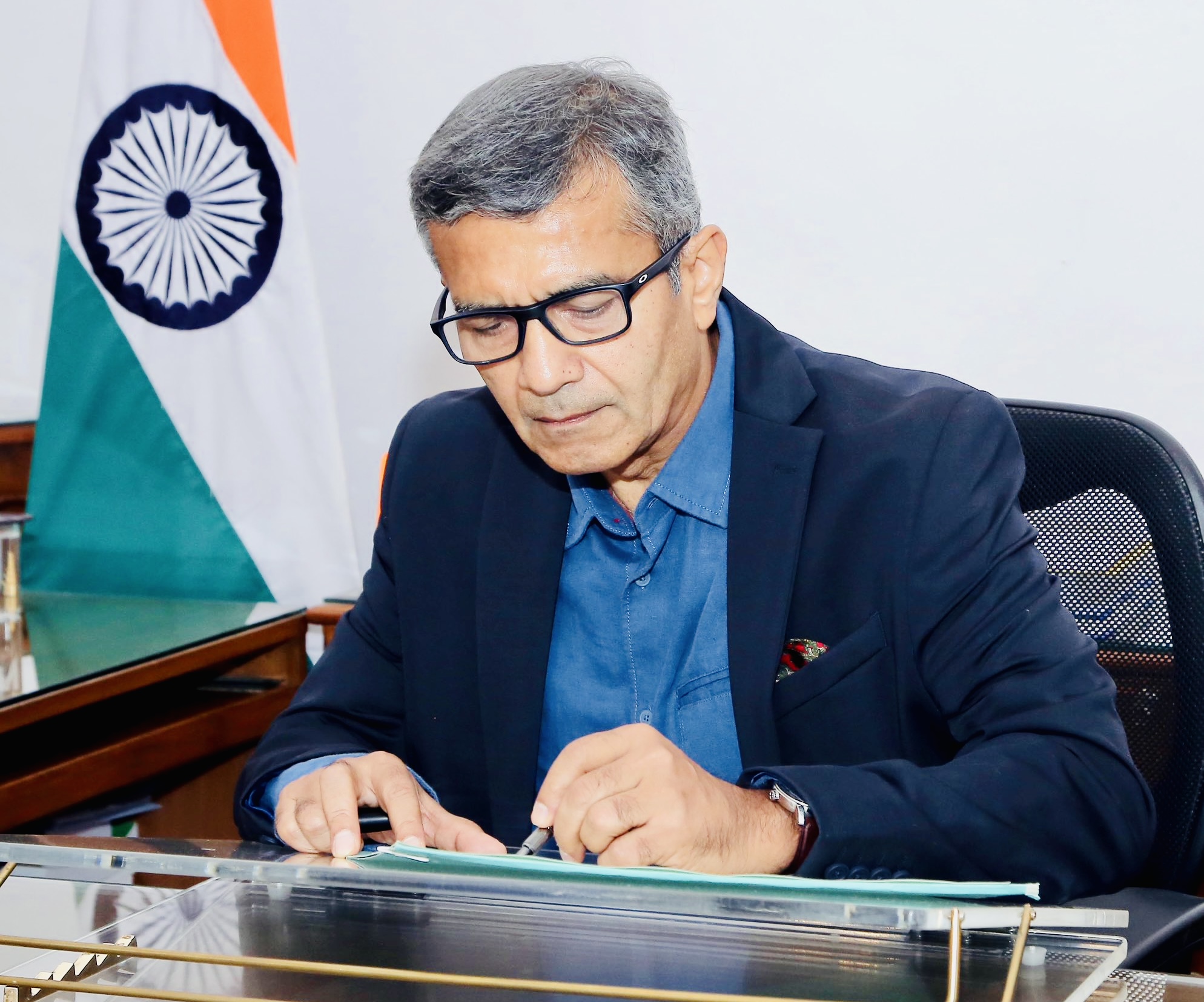
He signed the visitors’ book, watched a “Gaurav Gatha” narration on the Kargil campaign performed by two non-commissioned officers, and inaugurated a Virtual Walkthrough Portal intended to widen public access to the war’s history.
He went on to visit the Hut of Remembrance and Veer Bhoomi, before taking tea with soldiers, veterans and families of the fallen.
Singh then flagged in the “Shaurya Vijay Yatra,” a motorcycle rally he had flagged off from the National War Memorial in New Delhi on July 14, 2026. The 13-day, roughly 1,900-kilometre expedition, undertaken by 28 riders drawn from serving and retired personnel and their families, carried an urn of soil from the National War Memorial to be offered at Dras in tribute to the war dead.
In Delhi, the minister of state for defence, Sanjay Seth, laid a wreath at the National War Memorial as parallel tributes were paid by the chief of defence staff, General NS Raja Subramani; the chief of the air staff, Air Chief Marshal AP Singh; the chief of the naval staff, Admiral Krishna Swaminathan; the defence secretary, Rajesh Kumar Singh; and the vice chief of the army staff, Lieutenant General Sandeep Jain.