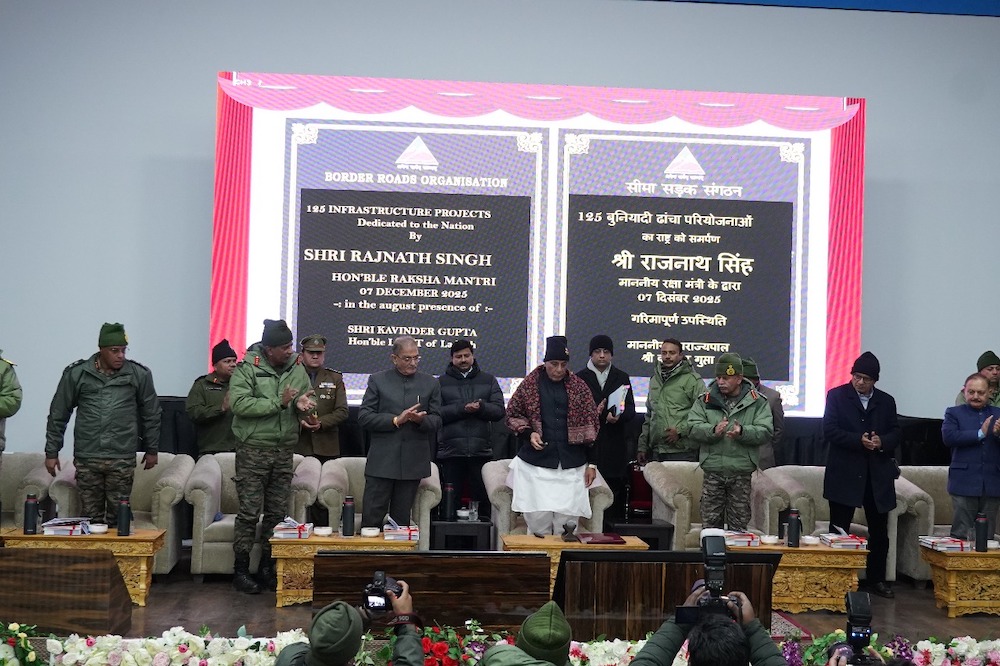
 Rajnath Singh during the launch of the BRO projects in Ladakh. (Photo: BRO)
New Delhi: The defence minister, Rajnath Singh, inaugurated 125 strategic infrastructure projects on Saturday. This marks a significant expansion of the country’s border connectivity network across some of its most geographically challenging regions.
The projects, executed by the Border Roads Organisation (BRO), comprise 28 roads, 93 bridges, and four miscellaneous infrastructure works spread across seven states and two Union territories. The inauguration ceremony was held at the newly completed Shyok Tunnel in Ladakh, a 920-metre cut-and-cover structure designed to ensure year-round connectivity through avalanche-prone terrain.
The infrastructure push spans the union territories of Ladakh and Jammu & Kashmir, and the states of Arunachal Pradesh, Sikkim, Himachal Pradesh, Uttarakhand, Rajasthan, West Bengal and Mizoram. The geographical diversity of these projects – ranging from high-altitude snowbound passes to desert and flood-prone areas – underscores the technical challenges involved in their execution.
#125BROInfrastructureForNation#BROForTheNation
— ?????? ????? ???????????? (@BROindia) December 7, 2025
Hon’ble Raksha Mantri Shri Rajnath Singh today inaugurated 125 strategic infrastructure projects @BROindia from Leh including the iconic 920m Cut & Cover Shyok Tunnel (12,523 ft) on the strategic road in Ladakh.
These include 28… pic.twitter.com/km5A0nELeI
In the northeastern states, which received a substantial portion of the projects, infrastructure development has focused on improving access to forward military positions and remote border villages. In Arunachal Pradesh, roads such as the Se-la-Chabre-la-BJG Road and bridges including the Lum-la I and II have enhanced connectivity to Tawang, a strategically sensitive district near the line of actual control (LAC) with China.
The Kalep-Gaigong Road in Sikkim and associated bridges like Rabam Chu and Sanklang have strengthened post-disaster connectivity in an earthquake-prone region. In Mizoram, infrastructure along the Lawngtlai-Diltlang-Parva axis, including the Tuichanglui and Gausan bridges, has improved access to areas bordering Myanmar and Bangladesh.
Among the notable projects is a 3D-printed heavy artillery depot complex in Chandigarh, showcasing the nation’s adoption of advanced construction technologies in defence infrastructure. The use of 3D printing in military construction is relatively nascent globally and represents an attempt to reduce construction timelines and costs in remote locations.
The project count of 125 adds to the 50 infrastructure works inaugurated by Singh virtually on May 7, during the BRO’s 66th raising day. Over the past two years, the organization has completed 356 infrastructure projects, a pace that reflects increased budgetary allocation – the BRO’s budget has risen from ₹6,500 crore to ₹7,146 crore.
Speaking at the event, Singh emphasized the role of border infrastructure in operational preparedness and regional development. The director general of border roads, Lieutenant General Raghu Srinivasan, noted that the BRO has become the preferred agency for several central ministries, including the Ministry of Home Affairs, Ministry of External Affairs, and the Ministry of Road Transport and Highways, for executing infrastructure projects in difficult terrain.
The BRO, established in 1960, operates under the Ministry of Defence and is responsible for developing and maintaining road networks in border areas and friendly neighbouring countries. The organization’s mandate has expanded over the decades to include not only military logistics but also socio-economic connectivity for remote civilian populations.
India’s border infrastructure development has accelerated notably since the 2020 military standoff with China in eastern Ladakh, which exposed gaps in road connectivity and logistics capabilities along the disputed frontier. The government has since prioritised the construction of all-weather roads, tunnels and bridges to facilitate rapid troop movement and reduce dependence on air transport in forward areas.
The projects inaugurated on Saturday are expected to reduce travel time to forward posts, improve supply chain reliability and provide economic opportunities for border communities through enhanced market access. However, the maintenance of these infrastructure assets in extreme climatic conditions remains an ongoing challenge, requiring sustained investment and technical innovation.