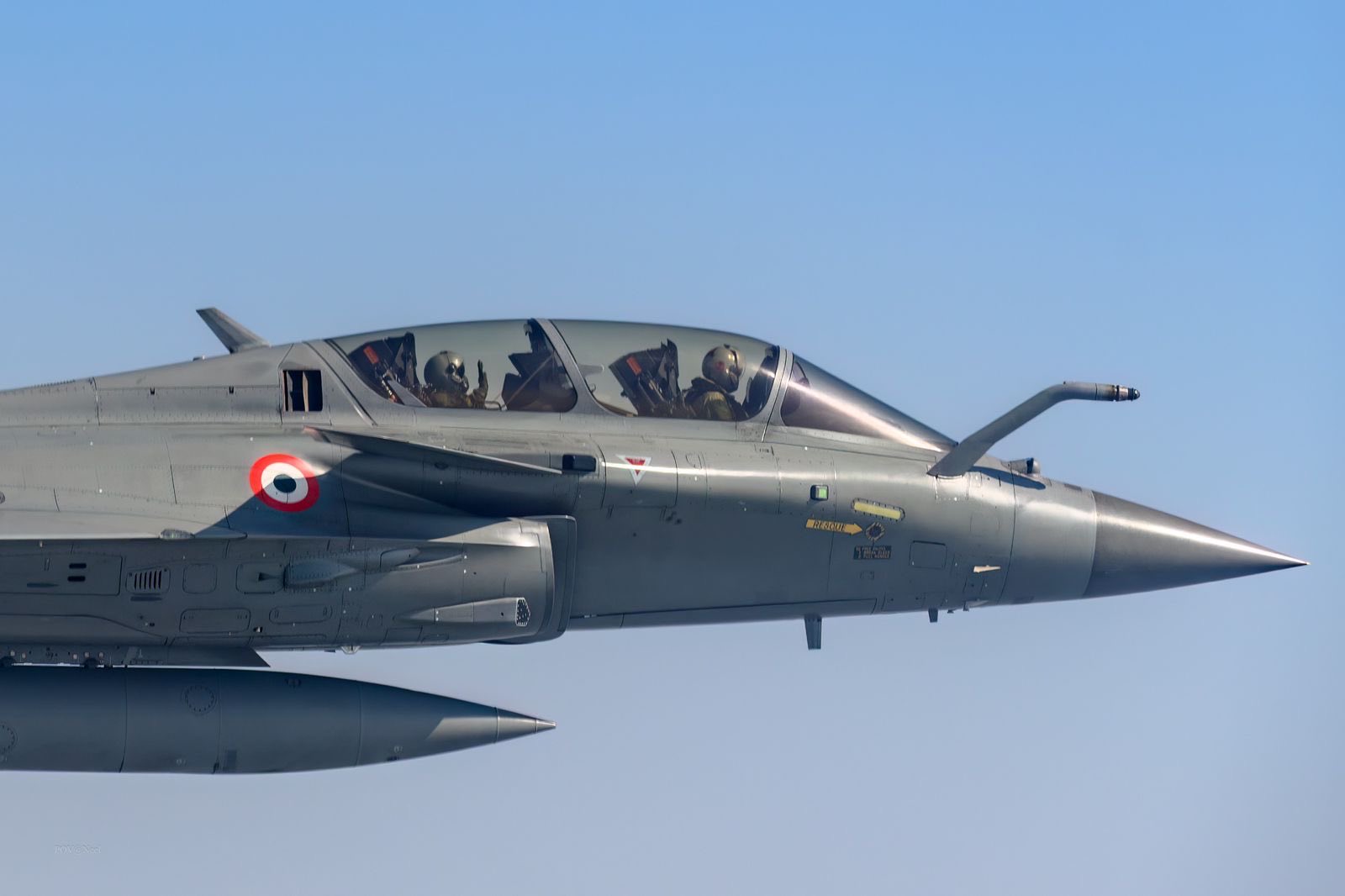
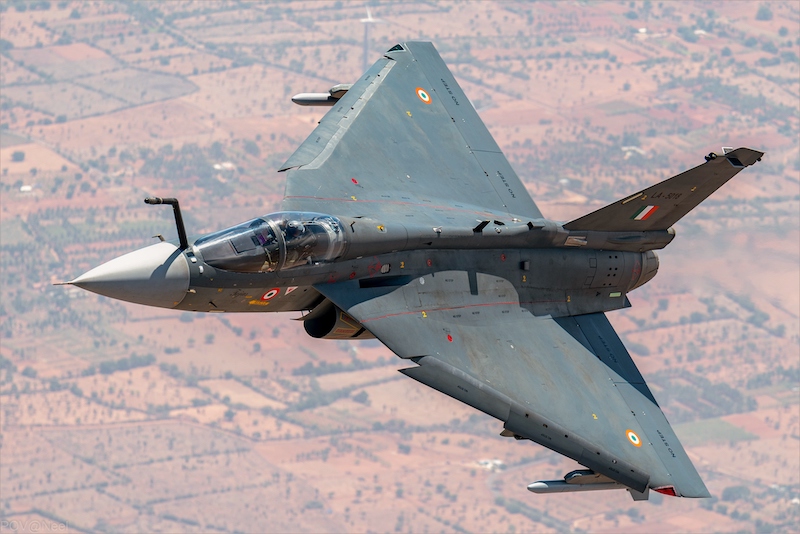
 An IAF Tejas. (File photo)
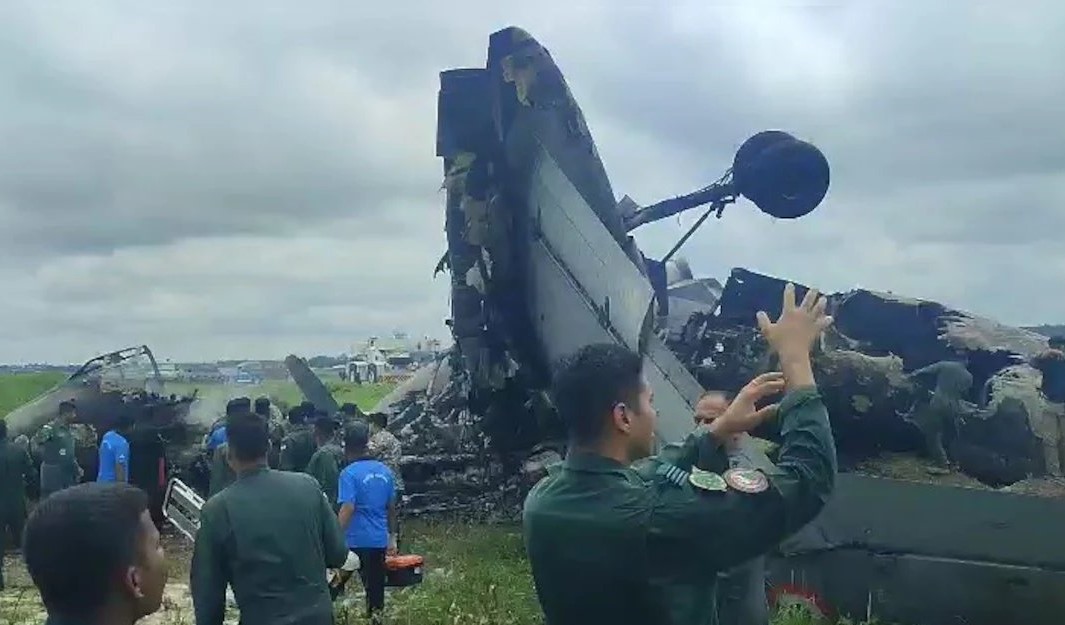
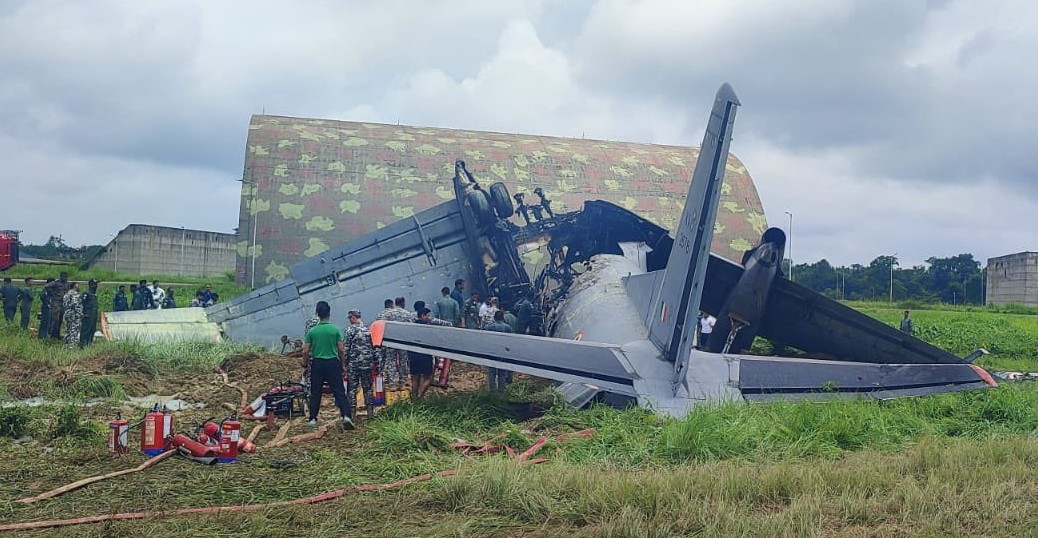
New Delhi: Earlier this month, on the morning of February 7, a Tejas-Mk1 single-seat fighter of the Indian Air Force came to grief at a forward base along the country’s western front. The aircraft – returning from a training sortie, according to multiple credible accounts – overshot the runway and plunged into a mud ditch running alongside it. The pilot ejected while the jet was still in motion, survived, and was injured.
The airframe sustained damage severe enough that defence sources and several mainstream outlets consider it effectively a write-off. A court of inquiry has been ordered, as is standard practice after any serious air accident.
By any plain reading, that is a crash. Hindustan Aeronautics Limited, the state-owned plane manufacturer, disagrees. In a formal clarification issued to Indian stock exchanges, the company stated that there had been no reported crash of the Tejas LCA and that the event was a minor technical incident on the ground.
The IAF, for its part, has not issued any public statement – a striking contrast to the official acknowledgements that followed both the 2024 Jaisalmer accident and the catastrophic November 2025 Dubai Airshow crash. Into that institutional silence, HAL has moved decisively to shape the narrative. Whether its chosen framing survives scrutiny from the IAF, from parliament, or from international buyers evaluating the Tejas LCA for export, is a separate question.
February 7 Incident: What Sources Say
The most detailed public account of the February 7 event comes from The Tribune [archived link], which cited sources within the IAF and the broader defence establishment. According to that account, the Tejas was in the process of taking off when it veered off the runway into an adjoining mud ditch, forcing the pilot to eject while the aircraft was still moving.
Other outlets broadly corroborate the outline while differing on one detail: News18, citing defence sources, reported that the aircraft was returning from a sortie [archived link] and overshot the runway following a suspected brake failure, rather than departing on a take-off run. Economic Times similarly described [archived link] the event as a runway overshoot at a frontline base with the pilot ejecting safely. Deccan Herald reported [archived link] that the accident left the pilot injured and led to checks on more than 30 Tejas aircraft in the days that followed.
None of these accounts were based on an official IAF briefing; all drew on anonymous sources within the defence establishment. The precise trigger – brake failure, an undercarriage fault, a software malfunction, or some combination – remains unconfirmed by any authority. What is not in dispute is the broad picture: a Tejas LCA left a runway it had no business leaving, the pilot ejected, and the aircraft suffered extensive damage.
HAL’s Language and What It Reveals
HAL’s exchange filing was directed squarely at investors. The company trades on Indian stock exchanges, and the Tejas programme sits at the heart of its order book and its public identity as a serious defence manufacturer. Its language was clinical and carefully chosen. HAL acknowledged the incident but asserted that no crash had occurred, that the event was ground-level in character, and that the Tejas LCA maintains one of the world’s best safety records among contemporary fighter aircraft.
It added that the issue was being analysed in depth with the IAF.
What the statement did not say is as important as what it did. HAL made no mention of the pilot’s injuries. It offered no comment on whether the airframe would be written off. It said nothing about fleet-wide grounding or inspections, even as multiple outlets reported precisely that. And it provided no technical explanation for what caused the incident. In a filing designed to reassure investors, those silences are deliberate.
The distinction HAL draws between a ground incident and a crash has some basis in aviation taxonomy. Investigators do differentiate between events occurring during a ground phase and those occurring in flight: a runway excursion during a take-off or landing roll can, under certain classificatory frameworks, be recorded as a ground incident rather than an in-flight accident.
HAL appears to be reaching for exactly that narrow, legally careful definition. The difficulty is that for a pilot who ejected from a moving aircraft and sustained injuries in the process – and for a programme already under parliamentary and public scrutiny following two previous losses – the terminological fine print does not meaningfully change the gravity of the event.
A Grounded Fleet
The operational consequence of the February 7 incident reached well beyond the single damaged aircraft. Multiple mainstream outlets, citing IAF and defence ministry sources, reported that the IAF grounded its entire operational Tejas fleet for inspections in the days following the accident.
The Tribune stated explicitly that all 35 Tejas fighters in the IAF’s inventory were not flying and were undergoing exhaustive maintenance checks. Economic Times reported that the grounding affected roughly 30 operational aircraft, noting that the precise number depends on whether two-seat trainers, aircraft in deep overhaul, and two as-yet-undelivered airframes from the original order of 40 are included. News18 described the inspections as comprehensive technical checks on critical systems, including landing gear, brakes, hydraulics, and relevant flight-control software.
Grounding a fleet type after a serious accident when a systemic cause cannot immediately be ruled out is standard practice in modern air forces. It is not a drastic measure; it is a prudent one. The IAF has done it with other types before. What makes the disruption significant in this case is the operational context: India currently fields approximately 31 fighter squadrons against an authorized strength of 42, and the two Tejas squadrons based at Sulur in Tamil Nadu carry some of the weight left by the gradual retirement of the MiG-21.
Keeping those aircraft on the ground, even temporarily, is not operationally trivial.
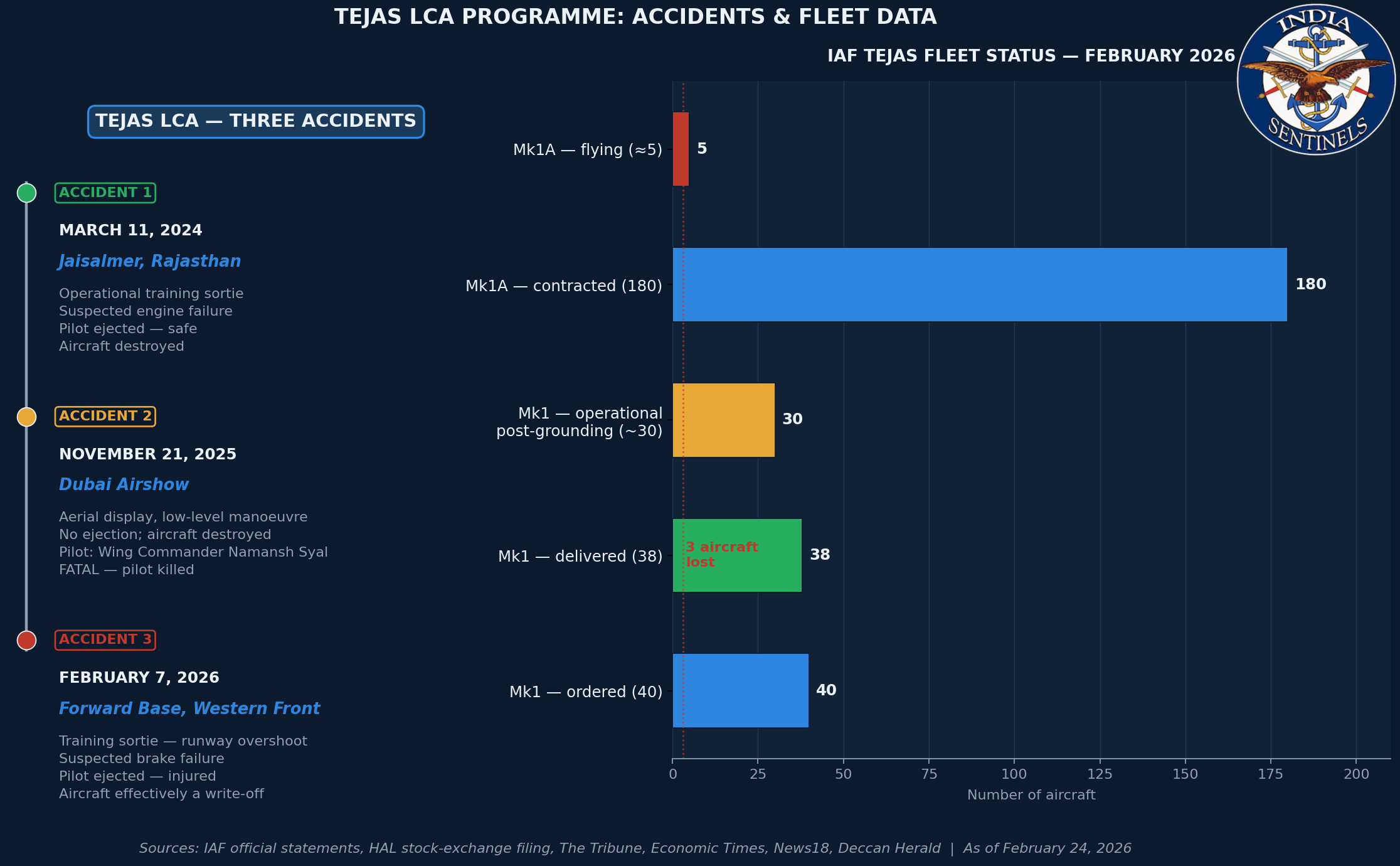
Three Losses: Jaisalmer, Dubai, Western Front
The February 7 incident is the third occasion since the Tejas LCA entered IAF service in 2016 that the type has suffered what multiple outlets and defence analysts describe as a hull loss – that is, damage so severe that repair is not economically or practically viable.
As India Sentinels had reported, the first came on March 12, 2024, near Jaisalmer in Rajasthan. An IAF Tejas LCA on an operational training sortie crashed, and the Air Force confirmed the accident publicly, stating that a court of inquiry had been constituted. Initial leaks from government sources pointed to suspected engine failure as the cause. The pilot ejected and survived. The aircraft was destroyed.
At that time that it was the first-ever crash of the Tejas LCA since its maiden flight in 2001.
The second loss was incomparably more visible. On November 21, 2025, a Tejas performing an aerial display at the Dubai Airshow crashed at Al Maktoum International Airport during a low-level manoeuvre, as India Sentinels had reported. Amateur video footage, circulated widely on social media, showed the aircraft losing altitude with no ejection visible before impact.
The IAF confirmed the pilot’s death in an official statement. Indian media identified the pilot as Wing Commander Namansh Syal. The IAF, to its credit, said so plainly: it acknowledged an accident, announced a court of inquiry, and did not hide behind euphemism.
Each of the three losses occurred in a different operational context – a training sortie inland, an international airshow display, and a forward-base operation on the western front – and involved different suspected failure modes: engine failure at Jaisalmer, apparent loss of control at Dubai, and a brake or undercarriage failure on February 7. The variety of contexts argues against any single, glaring design defect spanning all three.
However, it raises an uncomfortable question: were the lessons drawn from Jaisalmer in 2024 and Dubai in 2025 formally cross-referenced with the systems and procedures in use at forward Tejas LCA bases before February 7?
Orders, Deliveries, and the Mk1A Delay
To understand the programme implications of the February 7 incident, the numbers matter. The IAF originally ordered 40 Tejas-Mk1 aircraft: six two-seat trainers and 32 single-seat fighters. HAL had delivered 38 of the 40 before the latest accident. With three now effectively lost, the IAF has roughly 35 Tejas LCA platforms remaining in inventory, translating to approximately 30 operational single-seat fighters at the time of the grounding.
The programme’s future, however, rests almost entirely on the Tejas-Mk1A, a substantially upgraded variant carrying an active electronically scanned array radar, improved electronic warfare systems, and an air-to-air refuelling probe. In February 2021, the defence ministry signed a contract worth approximately ₹48,000 crore for 83 Tejas-Mk1A jets. A subsequent order for 97 additional Mk1A aircraft, signed in 2023–24, brings the total planned fleet of the upgraded variant to 180 aircraft. A further evolution – the Tejas-Mk2, designed around a more powerful engine with a significantly greater weapons payload – remains a longer-term planning objective.
Those Mk1A deliveries are running late. The defence secretary, Rajesh Kumar Singh, said in February 2026 that five GE F404 engines for the Mk1A were available, and five aircraft were flying, but that engine supplies from GE Aerospace had repeatedly missed deadlines, holding up production.
Media reported that Mk1A delivery timelines were approximately two years behind schedule, largely owing to delays in GE’s F404 engine supply chain – a dependency that the February 7 incident does nothing to resolve. Singh said that production at HAL and among Indian sub-vendors had largely stabilized and that weapon trials had been successful, though some of the IAF’s operational requirements still needed work.
Real Questions Investigations Must Answer
HAL’s claim that the Tejas LCA maintains one of the world’s best safety records among contemporary fighter aircraft is not statistically preposterous. Three losses over a decade of service with a fleet of roughly 40 aircraft is a lower accident rate than several legacy platforms the IAF has operated. The MiG-21’s record in Indian service earned it a grim popular reputation over four decades.
Against that benchmark, Tejas LCA’s numbers look considerably better.
But the claim requires qualification. The IAF does not publicly disclose Tejas LCA sortie rates or total flying hours, making a rigorous comparison with contemporary international types impossible from open sources. Two of the three losses occurred within a compressed window of less than 15 months. And the Dubai crash of November 2025, playing out in front of international cameras at one of the world’s premier airshows, inflicted reputational damage on both the type and the programme that raw accident statistics do not capture. Neither does the statistic capture the human cost: Wing Commander Syal did not come home.
The contrast in institutional communication between the 2024 and 2025 events and the February 7 incident is difficult to overlook. After Jaisalmer, the IAF used the word “accident”, confirmed a court of inquiry, and took public ownership of the event. After Dubai, it did the same. After February 7, the IAF went quiet, and HAL rushed to fill the vacuum with language calibrated to minimize the incident’s severity. Whether that reflects a coordinated communications strategy, an ongoing internal investigation that requires silence, or a deliberate decision to let HAL manage its own stock-price exposure is not publicly known.
Several important questions remain unresolved. The formal classification of the February 7 event – whether the IAF will eventually designate it an accident, as it did with Jaisalmer and Dubai – has not been settled. The root cause has not been officially confirmed. The scope and duration of the fleet grounding carry no official timeline. If investigators identify a discrete and rectifiable fault – a faulty batch of brake components, or a correctable software logic error – the fleet could return to flying status relatively quickly.
If the investigation uncovers a deeper structural problem, the implications for delivery schedules and operational readiness become considerably more serious.
The broadest question is whether the cumulative safety lessons from three accidents across three different operational contexts are being formally integrated at the programme level. This is also the question that institutions are least comfortable answering in public. The concern is that findings may instead be handled as isolated investigations whose conclusions remain permanently classified, never coalescing into shared institutional knowledge.
A mature safety culture demands exactly that: each court of inquiry feeding into a programme-wide review of human-machine interface design, training protocols, display authorization limits, and the failure history of specific components across the fleet. Without that cross-referencing, each accident risks being treated as unique rather than as data.
The political commitment to the Tejas LCA is not in question. The government signed large follow-on contracts for the Mk1A variant even after the 2024 and 2025 crashes, and no official voice has suggested any reduction in orders. The aircraft is central to India’s fighter force structure and to the government’s “Make in India” defence narrative, and those strategic necessities carry real weight.
However, strategic commitment is not a technical argument, and the IAF – whose pilots strap into these aircraft at forward bases on the western front – deserves rather more than a stock-exchange filing by way of institutional accountability.