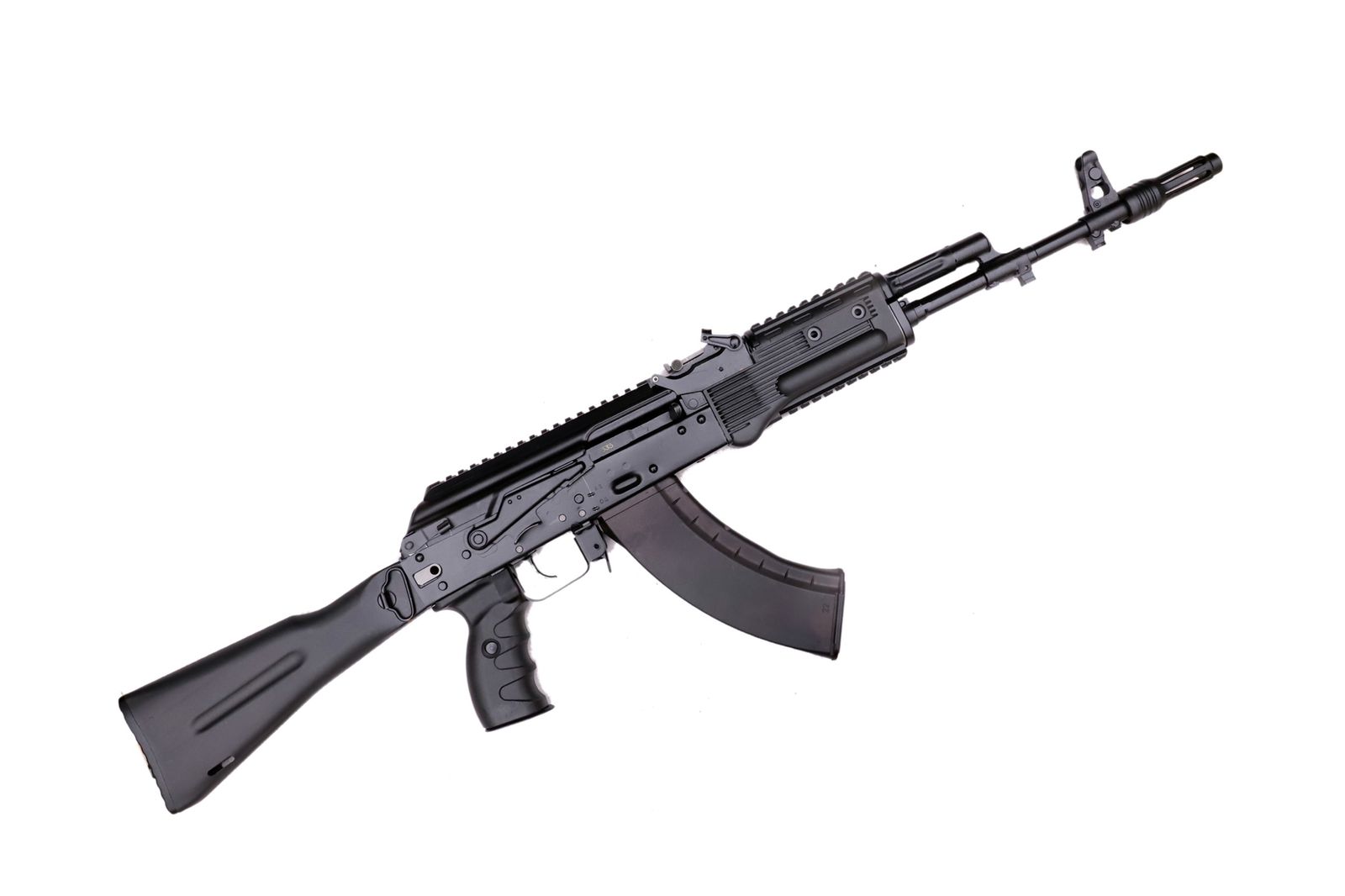
 AK-203 assault rifle (File photo)
New Delhi: Indo-Russian Rifles Private Limited (IRRPL) has manufactured and test-fired the first fully indigenous version of the AK-203 assault rifle at its Korwa ordnance facility in Amethi, Uttar Pradesh, a step the company describes as the completion of the weapon’s transition from licensed assembly to genuine local manufacture.
The rifle, which have been nicknamed as “Sher”, underwent firing trials, including burst firing, with the initial results described as encouraging by Major General S K Sharma, chief executive officer and managing director of IRRPL, who said every component and input material used in the rifle had been sourced from Indian industry.
The company is now preparing further prototypes built to the same indigenous specification for submission to the armed forces for formal evaluation.
Why it matters
The AK-203 is meant to replace the INSAS rifle, which has served as the Indian Army’s standard infantry weapon for more than three decades. Chambered for the 7.62×39mm round, the weapon offers a lighter build, improved ergonomics, Picatinny rails for modern optics and accessories and an effective range of about 300 metres.
Read also: Indian Army’s induction of assault rifle remains a never-ending nightmare
Until this trial, production had relied on a mix of imported and locally made parts as technology transfer from Russia progressed in stages; the latest test is the clearest evidence yet that the supply chain has been localised end to end.
The programme behind it
IRRPL was set up in 2019 as a joint venture between Indian and Russian state entities to manufacture the AK-203 in Indiaunder an inter-governmental agreement signed the previous year. On the Indian side, Advanced Weapons and Equipment India Limited and Munitions India Limited hold the majority stake, alongside Concern Kalashnikov and Rosoboronexport from Russia.
The venture was formally dedicated to the nation by the prime minister, Narendra Modi, at Amethi in March 2019, when a message from the Russian president, Vladimir Putin, read out at the event, spoke of eventual full localization of production.
A contract worth about ₹5,200 crore was signed for delivery of 601,427 rifles to the armed forces, with the production timeline since accelerated so that mass output is now targeted for completion by December 2030, nearly two years ahead of the original 2032 schedule.
Read also: India’s AK-203 ‘Sher’ production accelerates, 100% indigenized rifle by December 31
The Korwa plant has reportedly been engineered to turn out one rifle roughly every 100 seconds, translating to about 12,000 units a month once running at full capacity – a pace intended to allow a phased replacement of the INSAS without gaps in frontline readiness.
The bigger picture
For a programme that began as licensed production of a Russian design, full indigenization carries significance beyond one rifle. It reduces India’s exposure to supply disruptions of the kind that have periodically affected Russian-origin defence equipment and it gives the domestic small arms industry – vendors of steel, polymers, optics mounts and machined components – a large, sustained order book.
The government has separately noted that the share of defence spending going to foreign suppliers has been falling in recent years, with the AK-203 programme cited alongside projects such as the Tejas light combat aircraft and the Arjun tank as evidence of that shift.
Officials have also floated the possibility of the Korwa line eventually supplying state police forces and, in time, export markets, though neither has moved beyond preliminary discussion.
For now, the immediate task is straightforward: turning a successful trial into a steady, fully domestic production run large enough to re-equip the infantry.