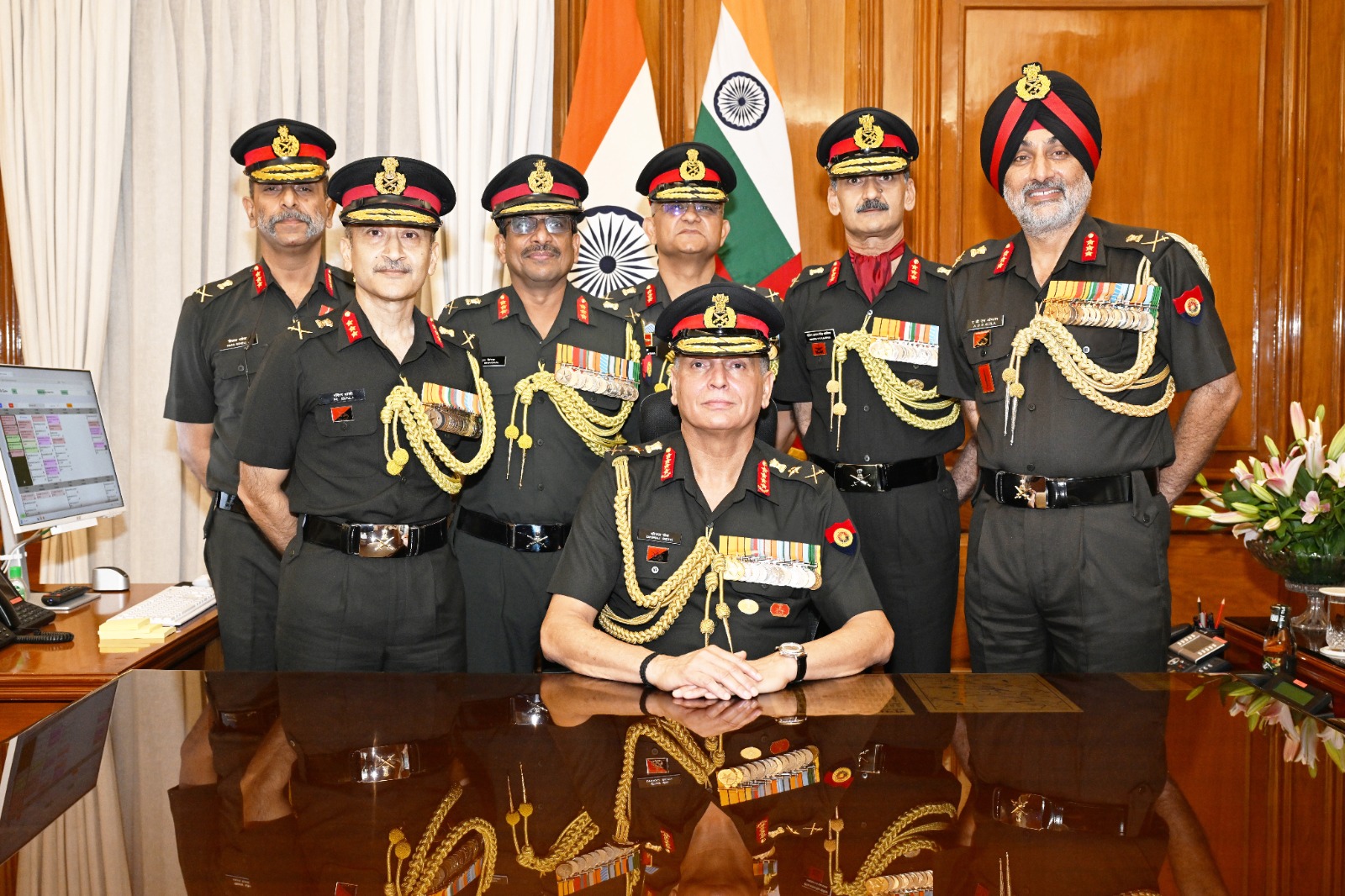
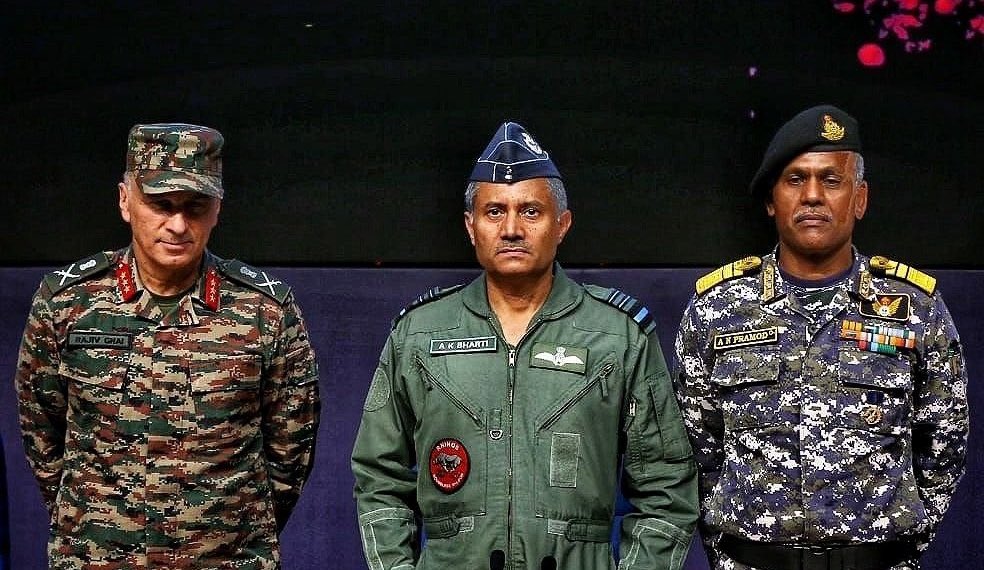
 From left: Lt Gen Rajiv Ghai, AM AK Bharti, and VAdm AN Pramod. (File photo)
Jaipur/New Delhi: Top military commanders in the country issued pointed warnings to Pakistan on Wednesday while outlining their preparedness for a complex security environment involving simultaneous adversaries, as the armed forces marked the first anniversary of Operation Sindoor. The three senior officers of the Indian armed forces made those remarks at a media interaction at the Sapta Shakti Hall, South Western Command HQ, in Jaipur, on Thursday.
The deputy chief of the Army, Lieutenant General Rajiv Ghai – who served as director general of military operations (DGMO) during last year’s operation – left little ambiguity about India’s current posture. “No sanctuary across the Line of Control is safe. We will hit everything,” he said, invoking the doctrine of what the government has described as a “new normal” in India’s approach to cross-border terrorism.
He made equally clear, however, that India retains discretion over its next move. “The conditions, the timing and the method will be ours,” Lt Gen Ghai said.
Speaking to journalists at a briefing, Lt Gen Ghai acknowledged the challenge posed by deepening military ties between Pakistan and China – a relationship both countries have publicly described as “deeper than the seas, higher than the mountains.” He noted that approximately 80 per cent of Pakistan’s military equipment is of Chinese origin, making the prospect of a two-front confrontation involving China, Pakistan, and potentially Turkey a scenario India’s armed forces are actively prepared for. “You play against the team that turns up on the park,” he said.
China-Pakistan military axis
The deputy chief of naval operations, Vice Admiral AN Pramod, elaborated on the strategic significance of that relationship by pointing to specific diplomatic signals. When the Pahalgam terror attack took place last year – the trigger for Operation Sindoor – China declined to condemn it. At the United Nations security council, Beijing is also said to have influenced deliberations so that references to the Resistance Front, which Indian agencies linked to the attack, were kept out of press statements.
VAdm Pramod noted that the China-Pakistan partnership extends well beyond arms transfers into what he described as an economic, military and strategic alignment. Crucially, he flagged the quality of hardware involved: Pakistan, he said, was not receiving second-tier equipment from China. “The best of the platforms are being given,” he said, pointing to a reported agreement under which Pakistan is to receive around 40 J-35 stealth fighter aircraft within the next two years – a development with direct implications for the air balance in the region.
The J-35 is China’s carrier-capable stealth aircraft, comparable in design intent to the American F-35, and its reported transfer to Pakistan would represent a significant upgrade to Islamabad’s air combat capabilities.
Air defence, indigenous systems, and missiles
The deputy chief of the Air Force, Air Marshal Awadhesh Kumar Bharti – who previously served as director general of air operations (DGAO) – addressed concerns about Pakistan and China testing new categories of missiles, saying the Air Force conducts a continuous assessment of the threat environment and acts to stay ahead of adversary capabilities.
He confirmed that remaining units of the S-400 long-range surface-to-air missile system, contracted from Russia, are now being inducted.
India signed the deal for the S-400 Triumf system in 2018, and while initial deliveries began in 2021, the process was disrupted by supply-chain constraints and geopolitical pressures stemming from Russia’s war in Ukraine.
AM Bharti also pointed to two indigenous air-defence programmes in the pipeline: Project Kusha, the DRDO-developed long-range surface-to-air missile system intended as a domestic alternative to foreign platforms, and Sudarshan Chakra, a programme the prime minister, Narendra Modi, has personally directed the defence establishment to pursue. Neither system has been formally commissioned yet, but both reflect India’s push to reduce dependence on imported air defence hardware.
“It is a continuous process,” Bharti said, while declining to detail specific capabilities in an open forum.
Operation Sindoor background
Operation Sindoor, launched on May 7, 2025, involved precision strikes by India against terror infrastructure in Pakistan and Pakistan-occupied Kashmir in response to the Pahalgam attack, in which 26 civilians – mostly tourists – were killed. The operation triggered a brief but intense military standoff before diplomatic back channels facilitated de-escalation. India maintained throughout that its strikes were targeted and non-escalatory; Pakistan denied the scale of damage claimed by New Delhi.
The anniversary briefing, with three of India’s most senior operational commanders speaking in unison, appeared calibrated to signal institutional readiness while reinforcing the government’s stated position that India will not revert to strategic restraint in the face of cross-border terrorism.
Follow us on social media for quick updates, new photos, videos, and more.
X: https://x.com/indiasentinels
Facebook: https://facebook.com/indiasentinels
Instagram: https://instagram.com/indiasentinels
YouTube: https://youtube.com/indiasentinels
© India Sentinels 2026-27