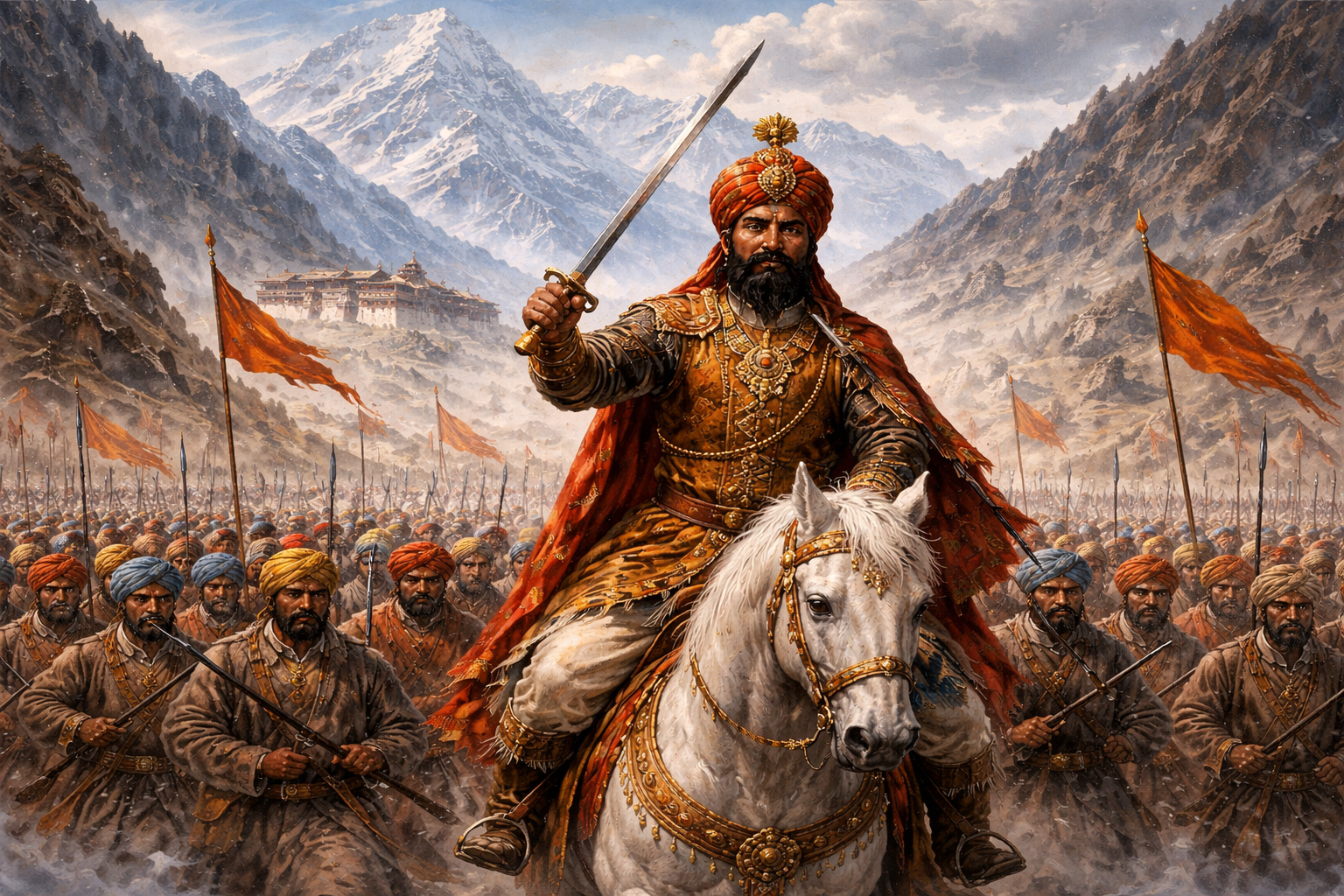
General Zorawar Singh Kahluria was one of the greatest military commanders in 19th-century India. Born in 1786 in the small hill kingdom of Kahlur in present-day Himachal Pradesh, he came from a Rajput family of the Kahluria clan – a lineage with deep roots in the warrior traditions of northern India.
The Rajputs were historically known for their bravery, martial skill, and fierce sense of honour, and Zorawar Singh embodied all of these qualities throughout his life. He rose from humble origins to become a legendary general – feared across the high-altitude frontiers of Ladakh, Baltistan, and Tibet.
Indians often call him the Napoleon of India for his daring campaigns in some of the world’s most hostile terrain.
He entered the service of Raja Gulab Singh of Jammu and quickly proved himself a brilliant soldier and strategist. His rise was fast – by the 1830s, he was the most powerful military commander in the Dogra forces of the Sikh Empire’s eastern frontier.
Conquest of Ladakh
Zorawar Singh’s greatest achievement on Indian soil was the conquest of Ladakh between 1834 and 1836.
Ladakh was a remote Buddhist kingdom sitting at an average altitude of 11,000 feet, separated from the plains by towering mountain ranges. Most commanders considered it nearly impossible to invade.
Zorawar Singh thought differently. He led his Dogra troops across the treacherous passes of Jammu and Zanskar, outmanoeuvred the Ladakhi forces, and captured the capital Leh.
The king of Ladakh was made a tributary of the Sikh Empire. He then secured Baltistan to the north in 1840, extending Dogra – and Sikh – influence over regions that had never been under Indian control before.
One of Zorawar Singh’s lesser-known strengths was his ability to win over local populations. Rather than ruling through fear alone, he treated the people of Ladakh with respect, allowed them to continue their religious practices, and worked with local chieftains rather than against them. This won him genuine loyalty in the region, and many Ladakhi soldiers even joined his forces for later campaigns.
The Road to Tibet
In 1841, emboldened by his successes in Ladakh and Baltistan, Zorawar Singh set his sights on western Tibet. The trigger was a long-standing border dispute between Ladakhi traders and Tibetan authorities over trade routes and grazing lands near the Indus river’s upper reaches. Zorawar Singh used this as justification to march eastward.
He led a force of around 5,000 soldiers over the formidable Himalayan passes – crossing altitudes that would cripple most armies – into the Tibetan plateau in the summer of 1841.
His troops carried lightweight supplies and moved fast, relying on the same mountain-hardened tactics that had worked so well in Ladakh. Along the route, he again tried to maintain good relations with local villagers and nomadic communities, purchasing supplies rather than simply seizing them, which helped keep his supply lines relatively stable in the early weeks of the campaign.
His forces captured large areas of western Tibet, including the important trade towns of Taklakot and Gartok. This was extraordinary – no Indian commander had ever pushed so deep into the Tibetan plateau.
Defeat and Death
However, the Tibetan winter proved a far deadlier enemy than any army. A large combined force of Tibetan and Chinese soldiers surrounded his troops as temperatures plunged. Cut off from supplies and shelter, his men suffered terribly. On December 11 or 12, 1841, Zorawar Singh was killed in the Battle of To-Yo.
He died fighting on the battlefield, sword in hand – true to his Rajput spirit until the very end.
Military Innovations That Endured
Zorawar Singh’s campaigns left behind more than territorial gains – they introduced military ideas that influenced how Indian armies thought about mountain warfare for generations.
He was among the first commanders to develop a dedicated doctrine for high-altitude combat: using small, lightly equipped units that could move quickly through narrow passes rather than relying on large, slow-moving armies.
He pioneered the use of local guides and scouts as an organised part of military planning, recognising that knowledge of the terrain was as valuable as weapons. He also built a network of small frontier forts across Ladakh to secure supply lines and maintain control over captured territory – a strategy later adopted by the British in their own frontier campaigns along the northwestern and northern borders of India.
His emphasis on winning local trust as a tool of military strategy, rather than relying purely on force, was far ahead of his time and is today considered a cornerstone of effective counter-insurgency and mountain warfare doctrine.
His Legacy
Zorawar Singh’s campaigns permanently shaped the map of northern India. The territories he conquered – Ladakh and Baltistan – became part of Jammu & Kashmir after the Anglo-Sikh Wars, and today form part of the Union Territory of Ladakh.
He is honoured as a national hero in the Jammu region, with a statue standing in Leh and his memory kept alive by the Indian Army’s Dogra Regiment. He proved that courage, local understanding, and bold strategy could conquer even the roof of the world.
Follow us on social media for quick updates, new photos, videos, and more.
X: https://x.com/indiasentinels
Facebook: https://facebook.com/indiasentinels
Instagram: https://instagram.com/indiasentinels
YouTube: https://youtube.com/indiasentinels
© India Sentinels 2026-27