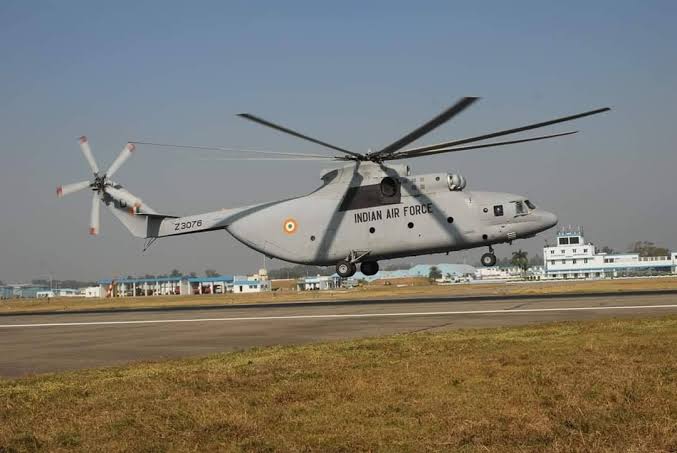
 Russian Mil Mi-26 helicopter (Photo: X)
New Delhi: The Ministry of Defence has begun the process to procure three of the world's most powerful cargo helicopters for the Indian Air Force (IAF) on the wet lease basis.
The ministry has issued a request for information (RFI) on April 28, the first formal step in inviting suppliers to submit bids before the full tender process begins.
As per the RFI, the helicopter must be capable of lifting up to 20 tonnes of cargo and operating at altitudes of up to 5,000 metres, or roughly 18,000 feet, above sea level in the Himalayas.
In practical terms, this points almost exclusively to the Russian-made Mi-26, the largest and most powerful production helicopter ever built, and the only machine currently capable of meeting such demands over high mountain terrain.
However, the US giant Boeing’s Chinook CH-47 which is already in service with the IAF and has partial capability to meet the 20 tonnes payload requirement as specified in the RFI. In 2015, India finalized a $1.1 billion agreement with Boeing for 15 Chinook helicopters, which included a provision to buy seven more at the same terms.
A Familiar Aircraft with a Troubled Past
India has operated the Mi-26 before. The IAF procured four of these helicopters in the late 1980s, but the fleet steadily declined over the years.
One crashed near Jammu in 2010, and the remaining three were progressively grounded by 2017 due to ageing and mounting maintenance challenges.
In October 2024, India signed a separate deal with Russia to overhaul and restore those older machines. The current leasing effort is entirely independent of that overhaul programme, meaning India is simultaneously working to revive its existing Mi-26s while seeking to add three more on lease.
What the IAF Is Looking For
The leased helicopters must meet a demanding set of operational requirements suited to the extreme conditions along India's northern borders.
Each helicopter must be able to carry at least 45 fully equipped soldiers in a single sortie and be convertible into a flying ambulance capable of accommodating at least 20 stretchers for casualty evacuation from remote mountainous areas.
The aircraft must also be able to airdrop supplies and personnel at high-altitude Himalayan outposts that are otherwise inaccessible by road or conventional aircraft.
Additionally, the helicopters must remain fully functional across a severe temperature range from minus 40 degrees Celsius in the depths of winter to 60 degrees Celsius in extreme heat.
Navigation and Crew Safety
Given the treacherous and rapidly changing weather conditions in the Himalayas, the IAF has specified that each helicopter be equipped with a weather radar and a digital moving map display.
The weather radar will help crews detect and navigate around storms, while the moving map display provides real-time positional awareness over detailed terrain maps, a critical tool when flying through narrow mountain valleys and passes where a navigational error can be fatal.
Armed for Hostile Skies
Because these helicopters are intended to operate in or near sensitive border regions, self-protection is a non-negotiable requirement. Each aircraft must carry a full electronic warfare (EW) suite, including a radar warning receiver (RWR) to alert the crew when enemy radar systems are tracking them, a missile approach warning system (MAWS) to detect and flag incoming projectiles, and a countermeasure dispensing system (CMDS) that can automatically deploy flares or chaff to deflect enemy missiles.
Lease Now, Buy Later
The ministry has structured the arrangement as a two-year lease, with an option to purchase the helicopters outright at the end of the lease period if they prove operationally suitable.
This approach gives the IAF the flexibility to evaluate the aircraft under real-world conditions before committing to a long-term acquisition, a procurement model that is increasingly common for high-value defence equipment.