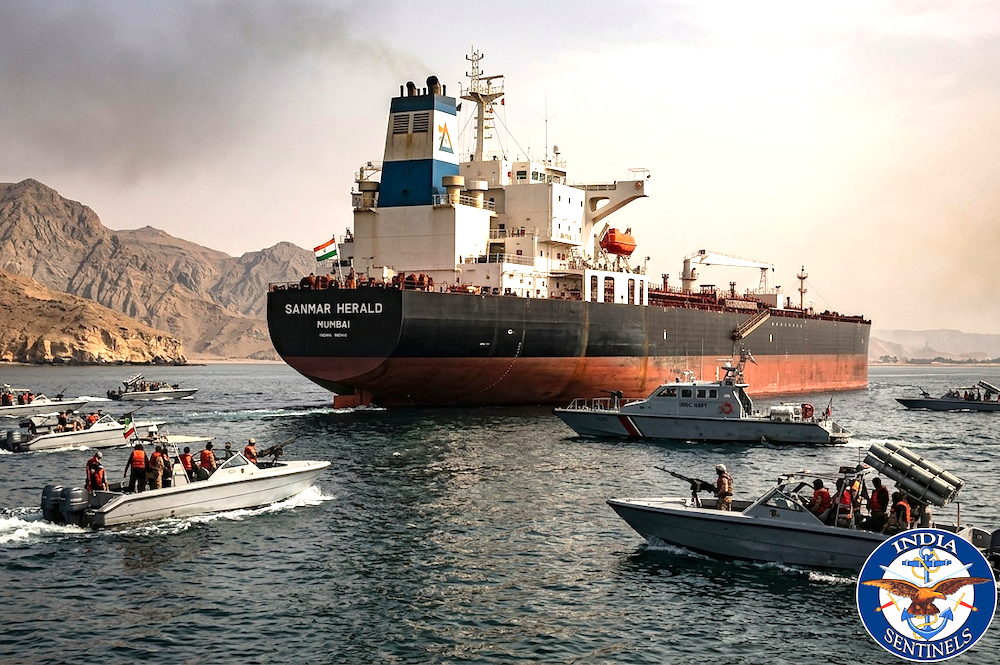
 Illustration for representation. (© India Sentinels 2026–27)
New Delhi: An Indian-flagged very large crude carrier, Sanmar Herald, was fired upon by armed gunboats in the Strait of Hormuz on Saturday. The incident forced the VLCC to abort its passage and turn back. This is seen as one of the most serious recent escalations involving Indian commercial shipping in the region.
According to advisories issued by the United Kingdom Maritime Trade Operations, the vessel came under fire from two fast-approaching craft assessed to be linked to Iran’s Islamic Revolutionary Guard Corps Navy. The incident occurred about 20 nautical miles northeast of Oman in a heavily trafficked corridor critical to global energy flows.
No injuries or major structural damage were reported, but the tanker immediately reversed course and withdrew westward into the Gulf rather than continuing its eastbound transit.
Audio of a distress transmission that surfaced subsequently indicates the crew believed they had prior clearance to pass. In the recording, the master is heard appealing to the attackers, stating that the vessel had been authorised and was “second on the list”, before requesting permission to turn back as firing continued.
The incident was not isolated. On the same day, at least two other merchant vessels reported security-related encounters in the vicinity, including one struck by a projectile and another that observed a near miss. The clustering of events has reinforced concerns over deteriorating maritime security conditions in the region.
The involvement of an Indian-flagged tanker has drawn particular attention in New Delhi, given India’s heavy dependence on Gulf energy routes. Officials have conveyed concerns through diplomatic channels while reviewing operational advisories issued to Indian shipping companies.
The episode underscores a growing unpredictability in Hormuz, where conventional naval threats now intersect with irregular tactics, including harassment, warning fire, and ambiguous enforcement measures.
Despite the firing, the vessel was neither boarded nor detained and remains operational in the Persian Gulf region.
Crypto ‘toll’ confusion adds to maritime risk
Parallel to the security incident, a separate but related concern has emerged involving fraudulent demands for cryptocurrency payments from ships attempting to transit the strait.
Maritime risk consultancy MARISKS has warned that unknown actors have been impersonating Iranian authorities, contacting shipping companies and offering “guaranteed safe passage” in exchange for payments in Bitcoin or Tether. These approaches reportedly include requests for vessel documentation followed by payment instructions routed through digital wallets.
The scam appears to exploit a broader and more opaque reality: Iran has, in recent months, signalled the use of alternative payment mechanisms, including non-dollar currencies and digital assets, for maritime-related transactions. This has created confusion among ship operators navigating compliance, security, and operational requirements.
However, the critical point remains that while the scam itself is credible and documented, its direct linkage to the Sanmar Herald incident has not been established.
Government rejects claims of crypto payment
Meanwhile, the speculation that the Sanmar Herald may have paid a cryptocurrency “toll” prior to the incident has been firmly rejected by Indian authorities.
On Wednesday, officials from the Ministry of Ports, Shipping and Waterways described such reports as “fake news”. It stated that neither the vessel nor its operators had made any payment – whether in cash or cryptocurrency – to secure passage.
The ship’s owner has also denied the claims, clarifying that no transaction was made with either legitimate or fraudulent entities. The company stated that it is coordinating with authorities to ensure the vessel’s safe operations.
There is likewise no official confirmation that India has entered into any arrangement with Iran involving payments for transit through Hormuz.
Narrative gap
The linkage between the firing incident and the crypto scam appears to have emerged from overlapping timelines rather than verified evidence.
While MARISKS indicated that at least one vessel targeted on April 18 may have fallen victim to such fraud, no ship has been publicly identified. In contrast, the Sanmar Herald incident is well documented, but without any substantiated financial transaction tied to it.
This gap has allowed an unverified narrative to gain traction, particularly across social media and some niche reporting platforms, where the two strands – armed interception and crypto fraud – have been merged into a single storyline.
The episode highlights a layered threat environment in the Strait of Hormuz. Commercial vessels now face not only traditional kinetic risks but also information and cyber-enabled vulnerabilities.
For ship operators, the challenge is twofold: navigating a militarised maritime corridor while also filtering out fraudulent communications that mimic official instructions. Payments made under such deception could result in financial loss and potential regulatory exposure, especially if linked to sanctioned entities.
From a policy standpoint, the incident reinforces the need for clearer communication channels, verified clearance mechanisms, and tighter coordination between governments and commercial shipping stakeholders.
Current status Sanmar Herald
As of late Wednesday, the Sanmar Herald remains active and afloat in the Persian Gulf, with no reports of damage, detention, or environmental impact. Tracking data indicates that the tanker is operating in regional waters rather than attempting another immediate transit through Hormuz.
The most substantiated report, as of now, is: an Indian tanker was fired upon and compelled to retreat despite believing it had clearance to proceed.
The crypto scam, while real and potentially dangerous, remains a parallel development. Its direct connection to this specific incident is unproven and explicitly denied by both the Indian government and the vessel’s owner.
Follow us on social media for quick updates, new photos, videos, and more.
X: https://x.com/indiasentinels
Facebook: https://facebook.com/indiasentinels
Instagram: https://instagram.com/indiasentinels
YouTube: https://youtube.com/indiasentinels
© India Sentinels 2026-27