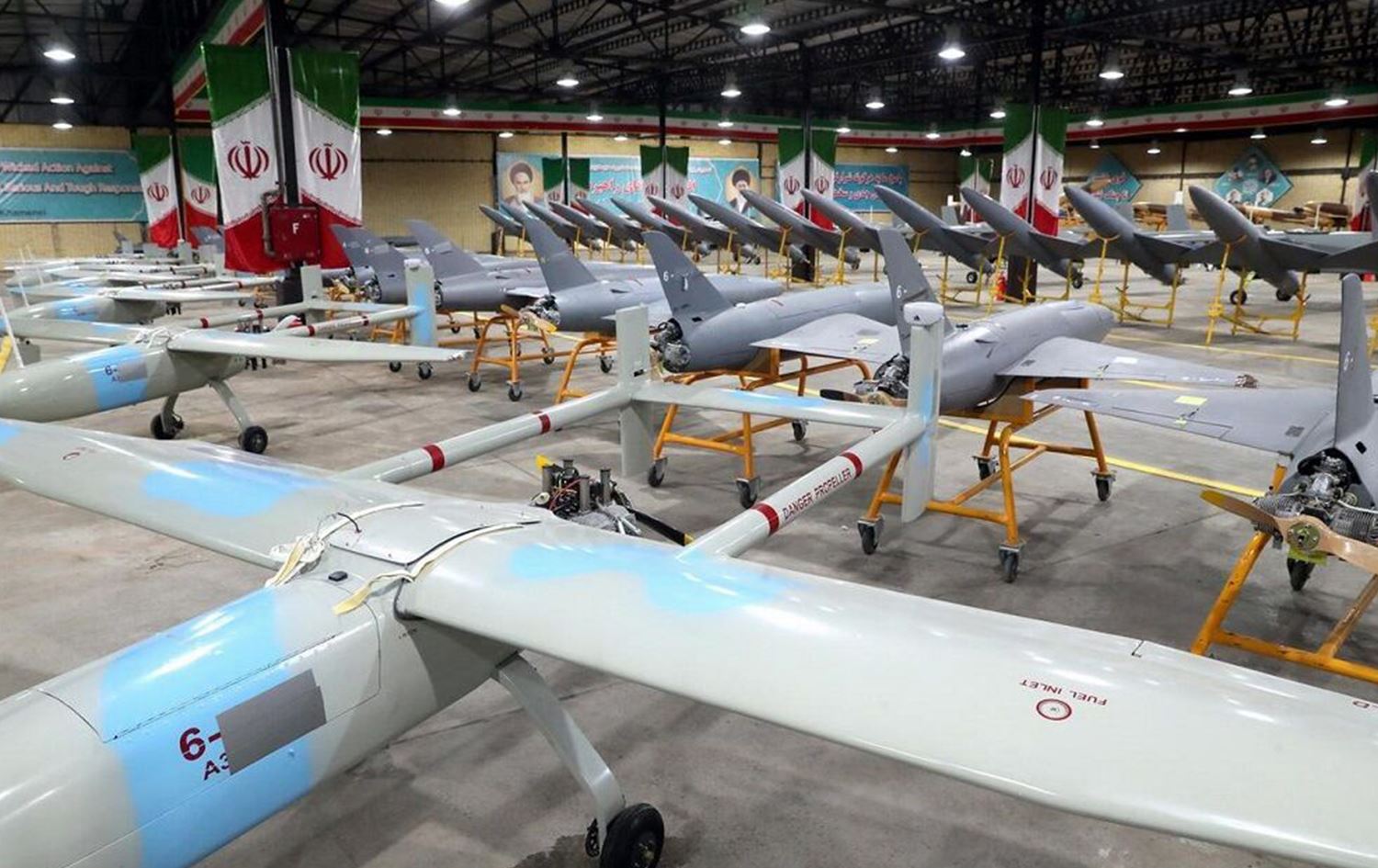
 Various types of Iranian drones in an underground facility. (Photo courtesy: IRNA)
New Delhi: The wars of the future will not be won by the nation with the most fighter jets or the largest fleet of surface warships. They will be won by those who can see first, decide fastest, and strike with precision at minimal cost. India, for all its military ambition and growing defence budget, risks entering the next conflict with the weapons of the last one.
The evidence from recent battlefields is unambiguous. In 2020, Azerbaijan dismantled Armenia’s Soviet-era armour within weeks, deploying Turkish Bayraktar TB2 drones and Israeli loitering munitions to neutralize tanks, artillery, and air-defence systems at a fraction of the cost of the assets destroyed. The message was stark: conventional platforms, no matter how well-crewed, are increasingly vulnerable to cheap, networked, and autonomous aerial systems. Armenia lost the war not because its soldiers lacked courage, but because its military doctrine was a generation behind.
The Ukraine-Russia conflict has reinforced this lesson on a larger canvas. Both sides have used drones – from commercial quadcopters modified to drop grenades to sophisticated long-range strike systems – to conduct reconnaissance, target artillery, and destroy armour. First-person-view (FPV) drones costing a few hundred dollars have disabled tanks worth millions. Electronic warfare, cyberoperations, and drone swarms have compressed the battlefield in ways no legacy platform can adequately counter. The side that adapts its networks and unmanned systems faster gains a decisive advantage.
More recently, the ongoing Iran-US and Iran-Israel confrontation has demonstrated how a mid-tier power can leverage drone and missile technology, combined with network-centric coordination, to challenge militarily superior adversaries. Iran’s layered use of drones, cruise missiles, and cyber disruption has forced the United States and Israel to expend costly interceptors against inexpensive munitions – a classic exchange-ratio problem that hollows out even the deepest defence budgets.
India’s military planners are not blind to these shifts. The Defence Research and Development Organization (DRDO) has invested in drone development, including the Tapas medium-altitude long-endurance UAV and the combat-oriented CATS Warrior. The Indian Air Force has inducted Heron drones for surveillance, and the Army has experimented with drone-based logistics in high-altitude terrain along the line of actual control (LAC).
The government’s “Atmanirbhar Bharat” (self-reliant India) initiative has encouraged a cluster of private-sector drone manufacturers, and the production-linked incentive scheme has drawn companies such as ideaForge and Garuda Aerospace into the defence supply chain.
Yet India remains conspicuously behind the curve. Its defence procurement continues to pour billions into legacy platforms – Rafale fighters, P-8I maritime patrol aircraft, and INS Vikrant-class aircraft carriers – at the expense of investing in the networked, unmanned, and AI-enabled systems that are reshaping warfare.
The Army’s integrated theatre command structure, essential for enabling network-centric operations, remains mired in inter-service rivalry. Battlefield-management systems that can push real-time intelligence to frontline troops are still absent at the tactical level.
Major General Sudhakar Jee, VSM (R), a veteran of command assignments along both the LoC and the LAC, has been among the most pointed voices calling out this institutional lag. “Network-centric warfare transforms every military platform into a connected node in a vast digital network,” Gen Sudhakar said. “Every soldier, every tank, every aircraft can instantly share what they see with everyone else.”
His argument is that it is the compression of what the military calls the OODA loop – observe, orient, decide, act – that determines battlefield outcomes, and that whoever accelerates their own loop while disrupting the enemy’s wins decisively.
The veteran general is equally blunt about India’s structural vulnerabilities. “Each service operates separate networks lacking seamless interoperability,” he noted. “The Army, Navy, and Air Force can communicate, but they don’t truly share information in real-time.”
He drew particular attention to the growing China-Pakistan military integration, warning that Beijing is not merely supplying equipment to Islamabad but creating unified systems – linking Pakistan’s military infrastructure via the Karakoram fibre-optic corridor directly to China’s Western Theatre Command – that function as a single operational network. “This represents more than tactical cooperation,” Gen Sudhakar said. “It’s strategic integration that fundamentally alters regional balance-of-power calculations.”
For India, the implications are sobering. Continuing to prioritize platforms over networks, and prestige acquisitions over mass-produced unmanned systems, is not a defence policy – it is a liability. The defence ministry’s declared focus on indigenization must be redirected with greater urgency towards AI-driven command-and-control systems, drone swarms, electronic warfare, and cyber capabilities.
Both geostrategic experts and armed forces veterans agree that legacy procurement must be subject to rigorous cost-effectiveness scrutiny against the question every defence rupee now demands: does this platform survive and function in a networked, drone-saturated battlespace?
They say India has the industrial base, the engineering talent, and the geopolitical incentive to lead in this domain. What it lacks is the institutional urgency to make the shift before a crisis forces the issue.
Follow us on social media for quick updates, new photos, videos, and more.
X: https://x.com/indiasentinels
Facebook: https://facebook.com/indiasentinels
Instagram: https://instagram.com/indiasentinels
YouTube: https://youtube.com/indiasentinels
© India Sentinels 2026-27