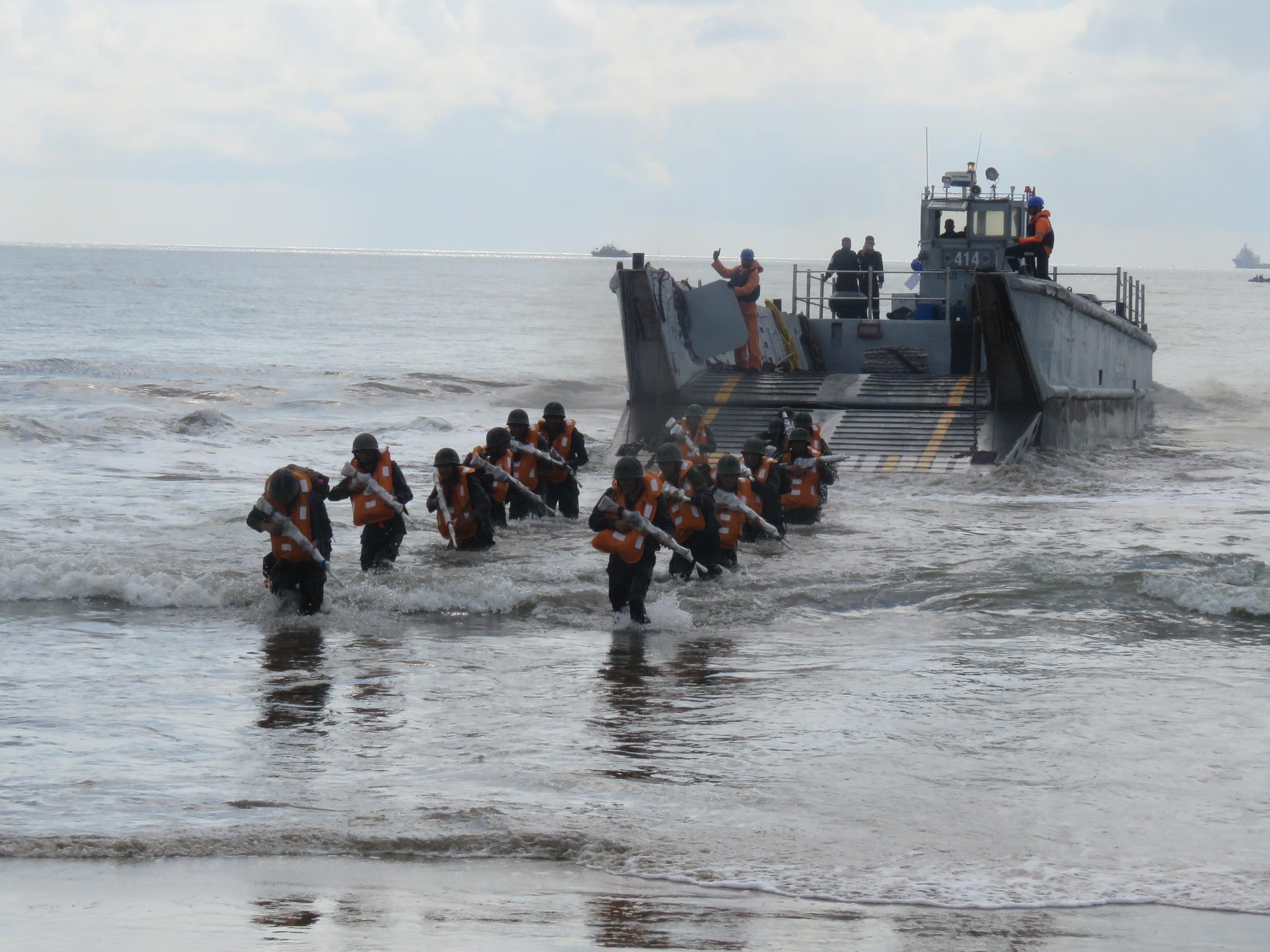
 INS Jalashwa, the only amphibious ship that navy currently operates. (File photo)
New Delhi: The Indian Navy has issued a request for proposal (RFP) to shortlisted domestic shipyards for the construction of four landing platform docks (LPDs), the vice chief of the Naval Staff, Vice Admiral Ajay Kochhar said on Monday.
The ships are large amphibious vessels meant to land troops, vehicles and equipment on a hostile or disaster-hit shore.
Speaking at the curtain-raiser press conference for Swalamban 2026, Kochhar said that the RFP had gone out the previous week. He did not name the shipyards. Swalamban is the Navy’s innovation and indigenization seminar, scheduled for October 26-27.
An RFP is the formal stage at which the Ministry of Defence (MoD) asks shortlisted bidders for technical and commercial offers.
Kochhar also said an RFP for the next-generation frigate had been issued a couple of weeks earlier and that responses were awaited.
In reply to a question, he said that 78 platforms and 120 fast interceptor craft, together worth about ₹2.41 lakh crore, had received acceptance of necessity (AoN), the first formal approval in the procurement process. Their procurement was at different stages, he said.
All about Landing Platform Docks
Each LPD is to displace over 30,000 tonnes, which would make it the largest combat ship built in India after the 45,000-tonne aircraft carrier INS Vikrant. The ship will be about 220 metres long, with a crew of 60 officers and 525 sailors.
It will carry 900 fully equipped Army personnel along with vehicles, tanks and artillery.
The amphibious fit includes specialized landing craft, two heavy-lift helicopters and 12 helicopters for special operations.
An onboard workshop will let the ship support other vessels in a task force. The modular design also allows use as a mobile logistics hub or a floating hospital.
The project is estimated to cost nearly ₹50,000 crore. That is well above the roughly ₹33,000 crore at which the Defence Acquisition Council (DAC), chaired by the defence minister, Rajnath Singh, granted AoN on October 23, 2025.
The DAC’s approval described ships of 20,000-25,000 tonnes.
A long-delayed programme
The Navy has pursued the LPD for more than a decade. The MoD sent an RFP to private yards in 2014 for four ships of around 40,000 tonnes, at an estimated ₹25,000 crore. It withdrew the RFP in September 2020.
The Comptroller and Auditor General noted in 2020 that the Navy had not concluded the contract despite deciding on the acquisition in 2010.
A fresh request for information (RFI), restricted to Indian yards, followed on August 24, 2021. It allowed bidders to team up with foreign designers.
The Navy’s only LPD today is INS Jalashwa, the former USS Trenton, an Austin-class ship acquired from the United States. The shipyards’ teaming arrangements indicate who may be in the race.
Mazagon Dock Shipbuilders signed an exclusive agreement with Swan Defence and Heavy Industries in October 2025 to design and build the ships.
Naval Group of France has also signed a memorandum of understanding with Hindustan Shipyard Limited, Visakhapatnam, to support a bid.
Electric propulsion and the India-UK link
The ships are expected to use an electric propulsion system being developed under India-UK defence industrial cooperation. The two sides plan to co-design, co-create and co-produce the power plant.
The prime minister, Narendra Modi, and his British counterpart, Keir Starmer, announced the initiative when they met in Mumbai in October last year.
GE Vernova has partnered with Bharat Heavy Electricals Limited (BHEL) to set up India’s first land-based maritime testing facility for such systems.
Operational role
The LPDs would let India land troops and equipment without relying on ports or jetties.
In August 2025 the services issued a joint doctrine for amphibious operations. It sets out how maritime, air and land forces are to work together and envisages amphibious force headquarters. The LPDs are meant to anchor amphibious groups able to deploy Marine and Army battalions with armour, artillery and logistics for sustained operations.
The Navy plans to use the ships as command platforms. They are also meant to coordinate unmanned aerial vehicles and unmanned underwater vehicles.
Naval drones could extend surveillance well beyond what shipborne helicopters can cover. Underwater vehicles could handle mine countermeasures, seabed mapping and anti-submarine tasks.
The ships will carry weapons against aircraft, missiles and drones. Links to space-based, cyber and electronic warfare assets would let LPD task forces work as nodes in networked joint operations.
The China factor
Chinese naval expansion in the Indian Ocean is a main driver of the programme. The People’s Liberation Army Navy operates Type 071 landing platform docks and Type 075 amphibious assault ships, which give Beijing wide power-projection capability across the Indo-Pacific. Chinese port calls and deployments at Gwadar in Pakistan, Djibouti and Sri Lanka and a possible larger presence in the Maldives, have added to Indian concerns.