By Manish Anand
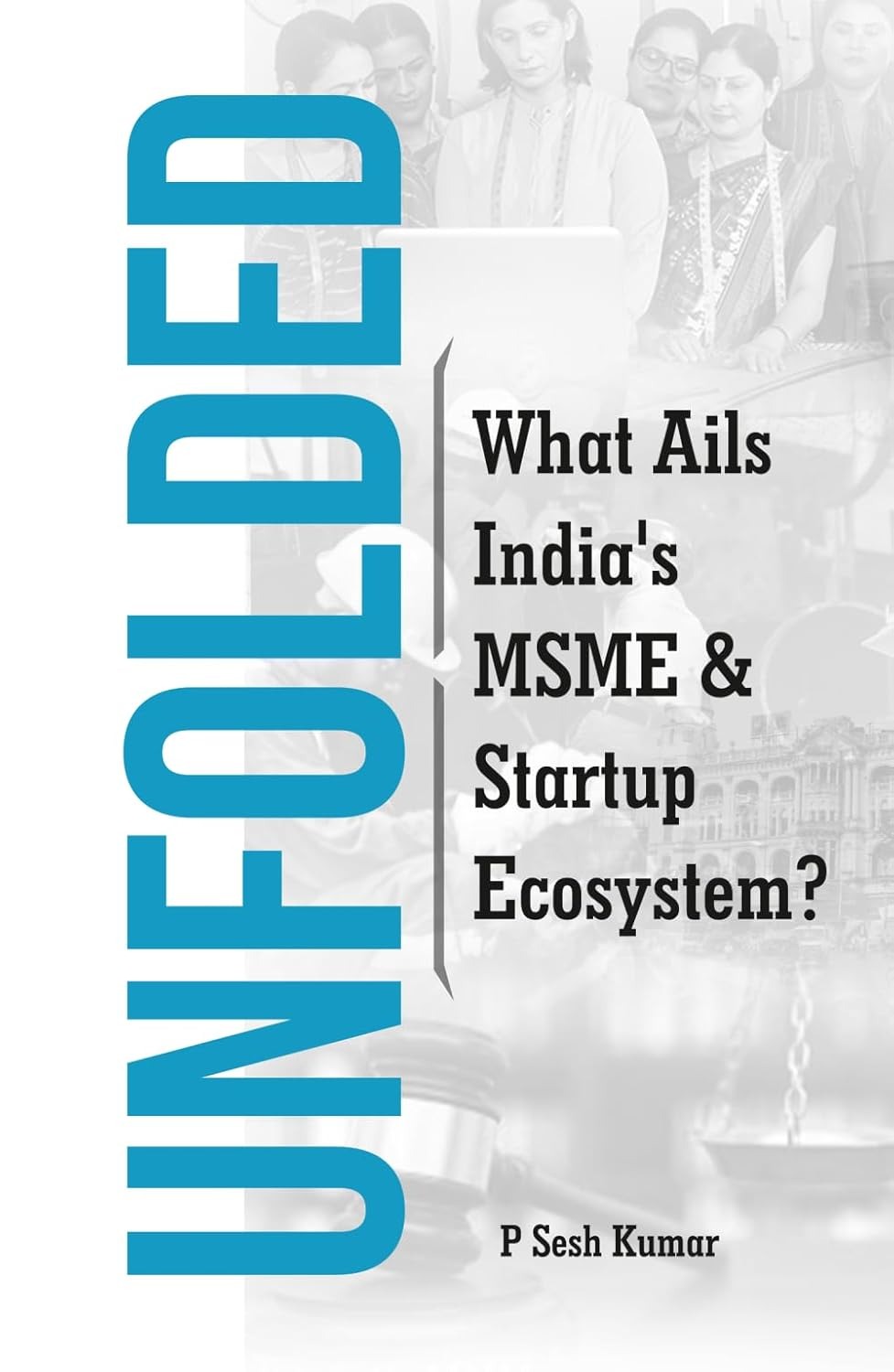
New Delhi: Atmanirbhar Bharat has been hailed as a mainstay of India’s defence sector indigenisation. The slogan sits at the centre stage of Indian dream to break into the league of defence goods exporting nations. But the slogan seeks a paradigm shift to embrace MSMEs and Startups to deliver. That paradigm shift is not yet on horizon as revealed by P. Sesh Kumar, who brings his insight from days spent in the Ministry of MSME in his latest book Unfolded: What Ails India’s MSME and Startup Ecosystem?
Taking an empathetic lens on the MSMEs and Startups in the defence sector, Kumar reveals disturbing details of frustration of entrepreneurs and structural hardships faced by them to significantly contribute in the transformation of defence productions in India.
From the stage of tendering to that of testing and eventually payment, tales of MSMEs and Startups per Kumar in the book are of exasperation and exhaustion.
Indeed, the numbers are growing as more and more MSMEs and Startups onboard India’s defence productions. But Kumar writes that those numbers at best may be ornamental. Kumar backs up his story with anecdotal citations to argue that the MSMEs and Startups somehow are stuck mid-bridge as India makes a tall claim of Atmanirbhar Bharat in defence productions.
Kumar dissects flagship schemes like iDEX and Make-II in detail in his book, which has been published by The Browser.
The Innovations for Defence Excellence (iDEX) programme should have heralded the full force of India’s entrepreneurial talent in the defence sector. This offered a full stack to the MSMEs and Startups -- pitch a model, avail financing, and bag procurement contracts.
“By mid-2024, more than 350 contracts had reportedly been signed with startups, resulting in 35 new items procured worth over ₹2,000 crore,” writes Kumar.
He further states that “the tally by 2025 rose to 430 contracts and 43 items worth ₹2,400 crore.” The scope covered an impressive array — Drone swarm systems, AI-based surveillance tools, and Lightweight body armour. They suggested indigenous tech entering military inventory.
But Kumar, who has also served in the CAG of a director general, reveals the brutal truth -- 35 items from 350 agreements amounts to roughly a 10% conversion rate into meaningful procurement.
“In effect, nine out of ten iDEX engagements did not culminate in significant military induction,” he adds in the book.
Calling for a full-scale CAG audit in the schemes meant for the MSMEs and Startups in the defence sector, Kumar poignantly asks -- if an MSME meets 80 percent requirement, shouldn’t it benefit from hand-holding against an outright import solution. Importing is easier. Building a solution locally is tougher. The divide deepens for attitudinal challenges also. Kumar gives a ringside view from the Ministry of MSME where top officials find their postings temporary and uneventful.
To make the MSMEs and Startups clear the 20 percent hurdle in passing the acceptance test with flying colours, Kumar argues, India will need more than a slogan and institutionalise structures and attitude.
Why a Pune-based Startup should wait endlessly to get a time slot at a testing centre at a faraway place, asks Kumar in the book. He also questions delay in payment for the MSME defence suppliers who lose precious time in chasing for the payments which take ages to come.
Kumar advocates PFMS (Public Finance Management System) be embedded in the defence supply chain to trigger automatic payments. That should also accompany a policy tweak from the Ministry of Defence with a deadline cast in the stone. Backing up with case studies, Kumar underlines that MSMEs almost die because of delay in payments.
To break the proverbial glass ceiling and also smash red-tapism, Kumar calls for a no-holds-barred CAG audit.
He even lists out what the CAG should set out to find in the engagement of the MSMEs and the Startups in the defence sector -- How many iDEX winners actually received service orders; How many Make-II projects were shelved; Whether Armed Forces and DPSUs are meeting engagement targets; and Systemic delays in certification, re-testing, and procedural rejections. If the CAG were able to find answers to specific slow burn challenges for the MSMEs and the Startups, India’s bid for Atmanirbharta in defence manufacturing can acquire wings to fly.
The MSMEs cannot be pitched against large groups, argue Kumar in the book, as he advocates for a “complexity-weighted” procurement model. Why a large group or a conglomerate should be competing with MSMEs for supplying nuts and bolts, asks Kumar.
He states that “subsystems and components of complex platforms could be broken out and reserved for smaller firms.”
The author makes a bold prescription that tenders under ₹100 crores be exclusively reserved for the MSMEs and they also be aggressively promoted in MRO (Maintenance, Repair and Overhaul) services.
Kumar had served the Ministry of MSME as a joint secretary. His stint allowed him to speak to cross-sections of the industry.
He has dissected challenges confronting the MSMEs and the Startups in the book. By offering solutions, Kumar has sought to make his diagnosis of the ailments afflicting the MSMEs and Startups constructive.
(The author is a senior Delhi-based journalist, who has worked for over two decades for India’s leading English dailies.)