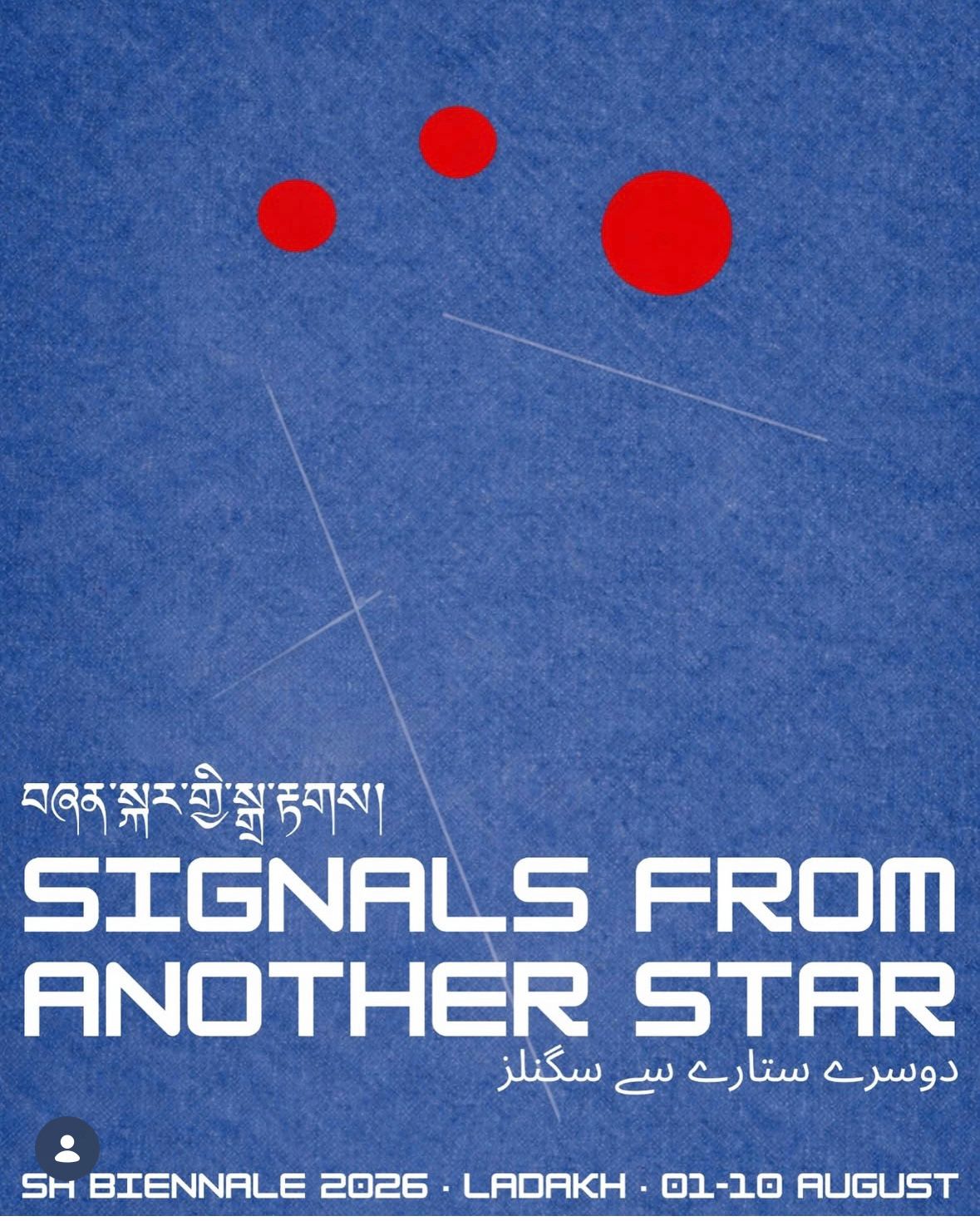
New Delhi: Conceived as a non-white cube biennale, the sā Ladakh Biennale unfolds at 3600m of altitude across Ladakh’s lived landscapes under the theme ‘Signals from Another Star’, placing regeneration, learning, and ethical engagement at the centre of artistic practice.
Taking place from 1-10 August 2026, the Biennale will travel along the Leh-Kargil corridor, engaging villages, learning spaces, and open terrains across the region.
Rather than concentrating artworks within institutional venues, the Biennale places contemporary artistic practice within Ladakh’s ecological, cultural, and social contexts.
Commenting on the curatorial approach, curator Vishal K Dar said, “We seek to send out signals from a high altitude landscape. Here, each work assumes a frequency of its own, echoing collective memory, weather, trade routes and extraction.”
Dar will be working closely with Tsering Motup, who will be the associate curator for this edition. Moving beyond a festival-led format, the sā Ladakh Biennale is envisioned as a long-term cultural initiative rooted in learning, collaboration and regional partnerships.
Founded in 2023 in Ladakh, the Biennale emphasises ethical and equitable curation, zero-to-minimal-footprint artistic practices, and sustained engagement in one of the world’s most ecologically sensitive regions.
Bringing together artists from Ladakh and international contexts in equal measure, the Biennale seeks to foster meaningful exchange between local knowledge systems and global contemporary practices.
Speaking on the founding vision, Raki Nikahetiya, founder of sā said, “sā Ladakh Biennale is an exercise in institution building, thinking beyond the moment of a festival and towards deep time. It asks how art can take responsibility for climate, culture, and community, by listening first to the land and its people, while remaining connected to the wider world and its urgencies.”
Education, mindful tourism, accessibility, and engagement with differently abled communities form key pillars of the Biennale.
Programmes will include workshops, residencies, community-led initiatives, and site-responsive artistic projects developed in close dialogue with local communities across the region.
sā Ladakh has formed a deep bond with regional cultural institutions and community partners to ensure that local histories and lived realities remain central to its framework. Anthropologist Dr Monisha Ahmed, founder and Executive Director of Ladakh Arts and Media Organisation, noted, “Ladakh lay along a historic crossroads, and has long been a location where people, commerce, and cultures intermingled and its artforms therefore reflect influences from many other places suggesting that the artefactual world of Ladakh intermixes indigenous ideas with all kinds of external elements. This biennale is in many ways an extension of that.”
sā Ladakh Biennale 2026 is developed through collaboration with a wide network of community partners, including Disko Valley Bike Park, Ladakh Arts and Media Organisation, Dolkhar, Roots Ladakh, Local Futures - Ladakh, Crashpad, People’s Action Group of Inclusion and Rights, Women’s Association of Ladakh, Parkhang Collective, Likir Pottery, Roots Ladakh, Unlock Hundurman - Museum of Memories and Earthling Ladakh.
International and cultural exchange partners include the German Embassy to India, Austrian Cultural Forum, Pro Helvetia - Swiss Arts Council, Italian Institute of Culture, Australian High Commission, and Indian Council for Cultural Relations.
The Biennale also collaborates with art, knowledge, and outreach platforms including Fremantle Biennale, Rubin Museum of Himalayan Art, India Art Fair, Dharamshala International Film Festival, museum in progress, Disability in Arts, Disadvantage in Art, Australia, The Land Art Generator Initiative, Good Life X and STIR - collectively supporting a framework of ethical cultural practice, regional learning, and long-term engagement in Ladakh and beyond.
Operating at the intersection of, climate community, and contemporary artistic practice, sā Ladakh Biennale 2026 seeks to model how large-scale cultural initiatives can function responsibly within ecologically sensitive regions. Grounded in learning and dialogue, the Biennale positions Ladakh not only as a site of exhibition, but as a space for sustained cultural exchange, long-term engagement, and shared inspiration.