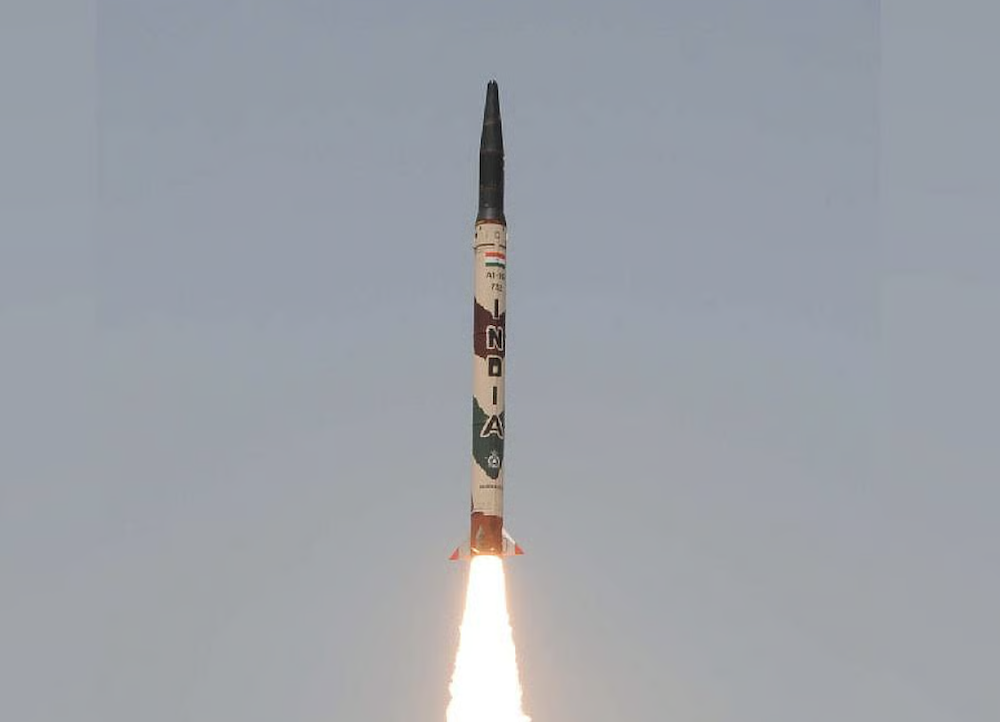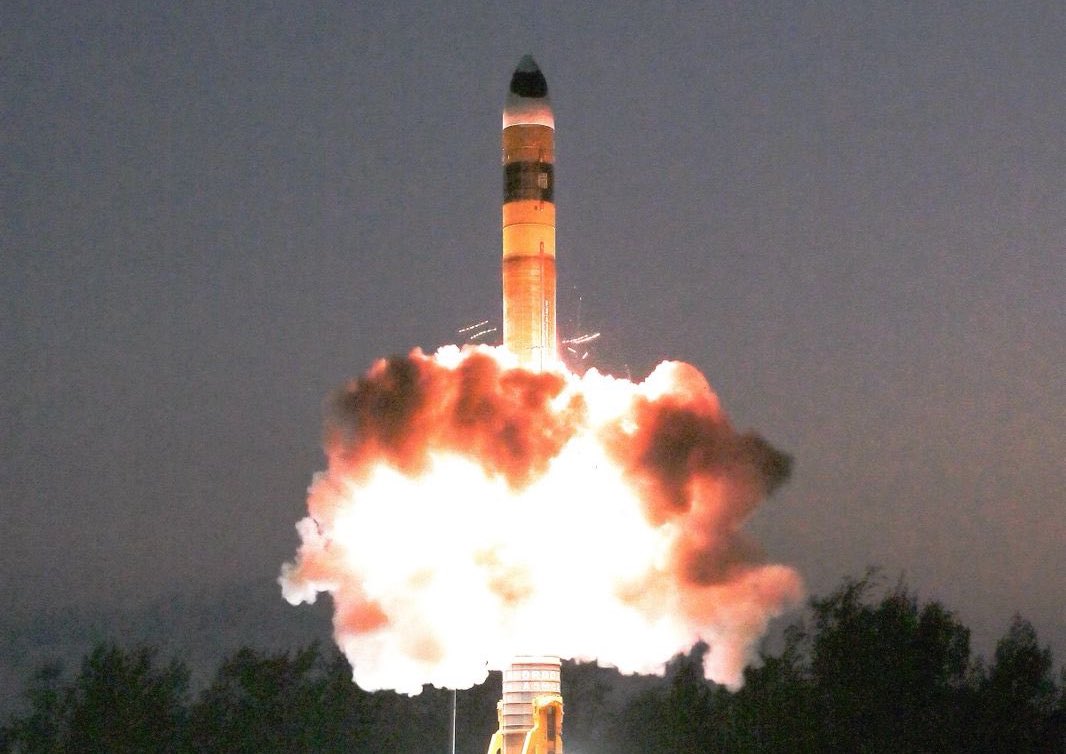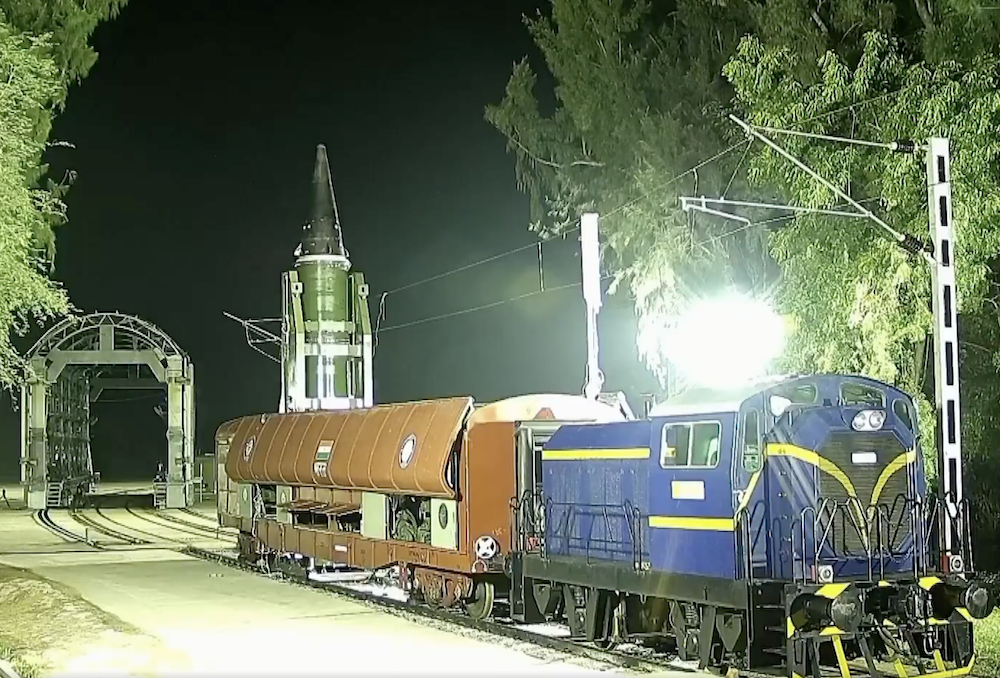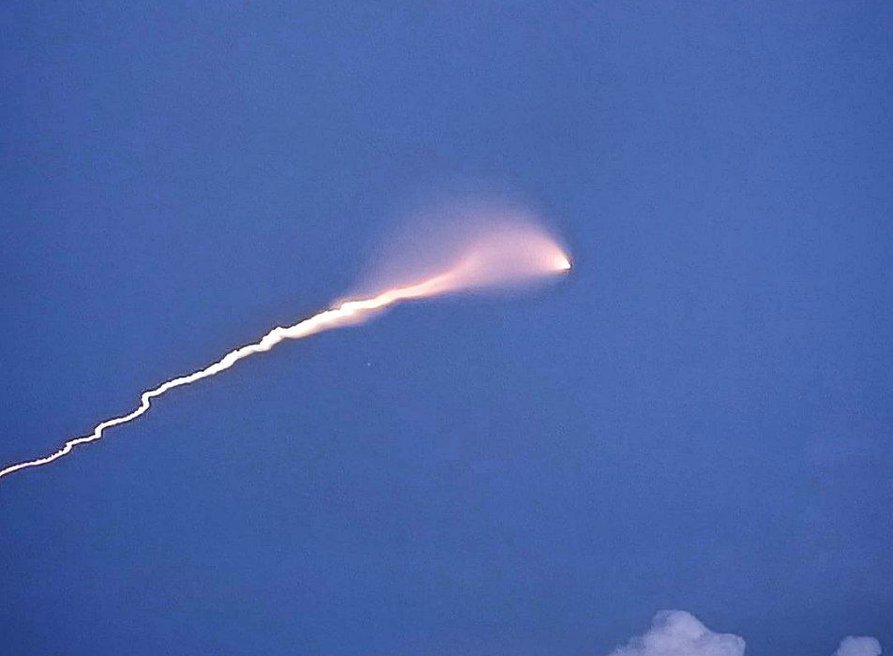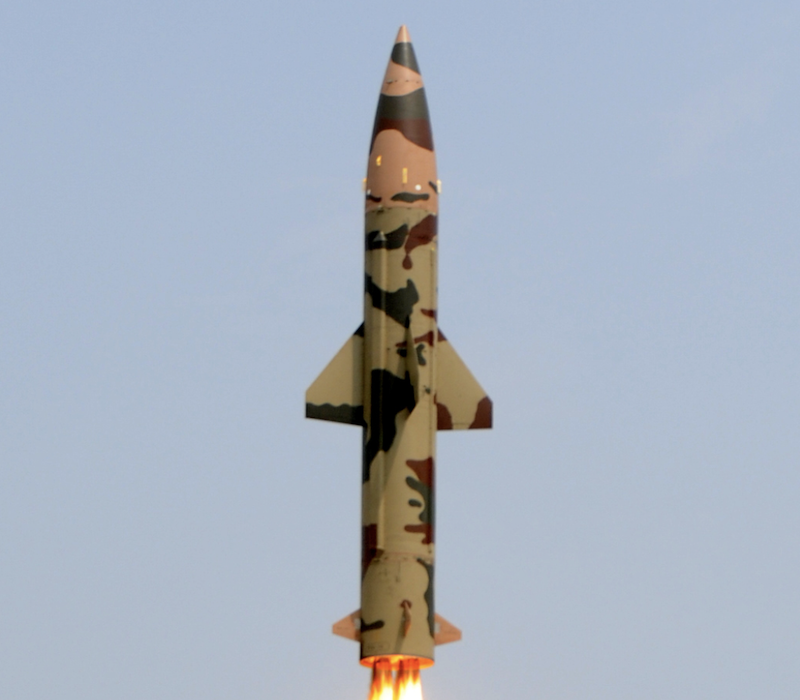
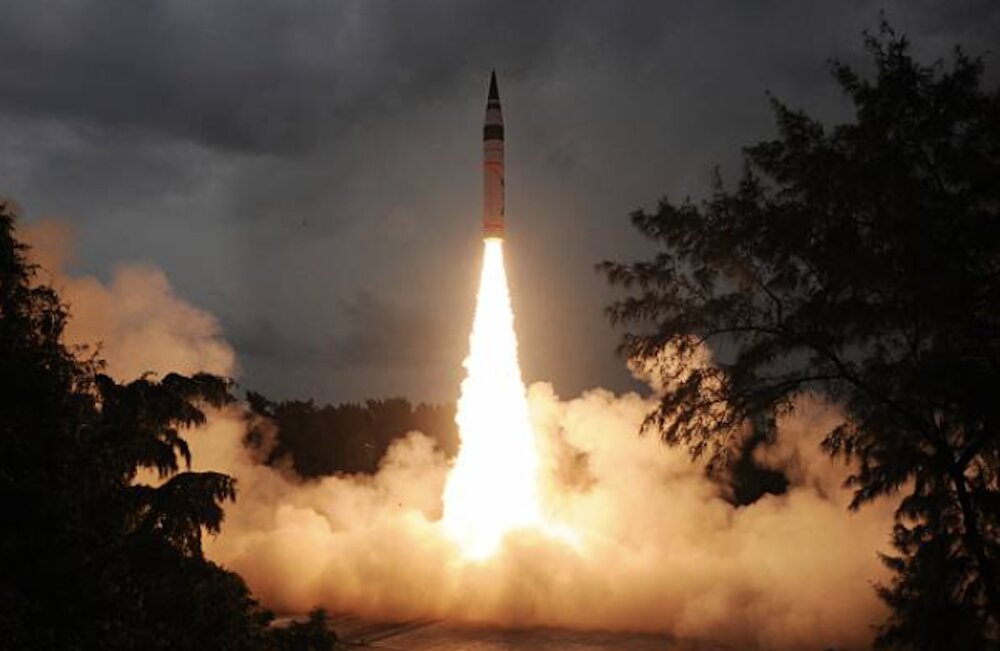
 File photo of an Agni-5 missile being test-fired.
New Delhi: India’s nuclear posture appears to have entered a new phase, with a small number of warheads now assessed to be deployed in peacetime for the first time, according to the Stockholm International Peace Research Institute’s (Sipri) Yearbook 2026. It says India currently has 12 nuclear weapons ready to be launched.
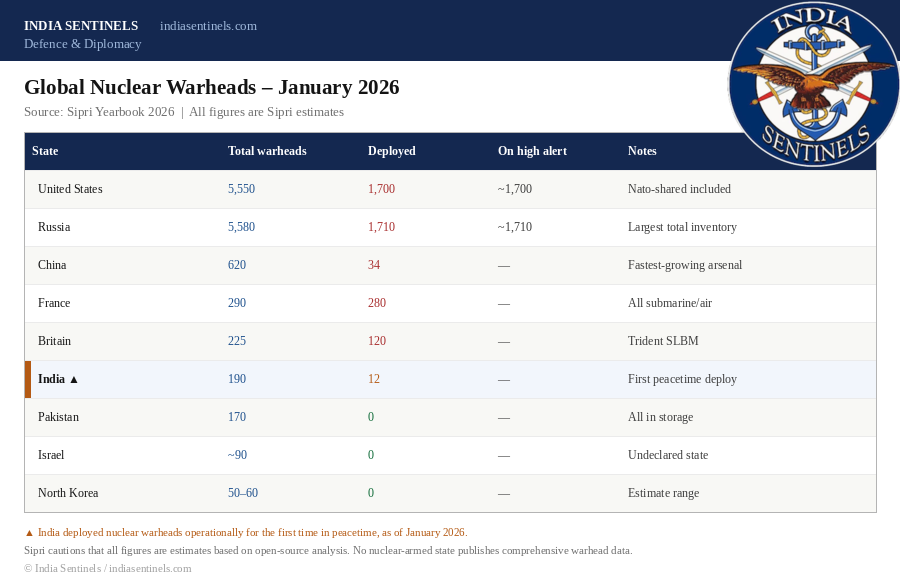
The Sipri assessment, released on Monday, estimates that India’s nuclear arsenal has risen to 190 warheads, up from 172 in 2024. Of these, 12 are assessed to be deployed, while the remaining 178 warheads are believed to be held in storage in unmated state. In Sipri’s terminology, deployed warheads are those already mated with delivery systems or positioned at operational bases for immediate or near-immediate use.
If correct, the finding marks a measurable operational shift for a country long seen as maintaining a recessed deterrent in peacetime, with nuclear warheads kept separate from missiles and aircraft. The change does not in itself amount to a revision of India’s declared doctrine, but it does suggest New Delhi is adapting its deterrent posture to a strategic environment that has become more demanding.
Read also: Global nuclear arsenals expand, disarmament dead, deterrence under strain, Sipri says
Operational shift, doctrinal continuity
India’s nuclear doctrine, formally articulated in 2003, remains built around credible minimum deterrence, a “no first use” policy, and the promise of massive retaliation in response to a nuclear attack on Indian territory or on Indian forces anywhere. The authority to order nuclear use remains with the Nuclear Command Authority, whose political council is chaired by the prime minister.
On its face, Sipri’s estimate does not contradict that framework. A limited number of deployed warheads does not mean India has diluted political control over its arsenal, nor does it mean the country has moved away from its no-first-use doctrine. But it does indicate that the old model of keeping the deterrent entirely de-mated in peacetime may no longer apply across the board.
That distinction matters. For years, India’s handling of its nuclear arsenal was cited as evidence of a restrained posture: warheads in storage, delivery systems separate, and readiness deliberately moderated. Such an arrangement allowed New Delhi to underline that its arsenal was intended for deterrence rather than warfighting. It also matched the needs of a force that was smaller, less diversified, and less dependent on continuous readiness.
The latest assessment suggests India may now be balancing restraint with a greater premium on survivability and responsiveness. In practical terms, that is the difference between a recessed deterrent and one that is still under tight political control but more operationally available.
Read also: Global peacekeeping at 25-year low as funding dries up and great powers clash, Sipri says
China is central
The strategic logic behind this shift is difficult to understand without reference to China. Pakistan remains central to India’s deterrence decision-making, but the longer-term pressure on Indian nuclear planning is increasingly coming from Beijing.
Sipri estimates that China now has 620 nuclear warheads, with 34 in a deployed state. That expansion forms part of a broader Chinese effort to improve both the scale and readiness of its strategic forces. Since 2021, satellite imagery and open-source analysis have identified the construction of multiple new missile silo fields in western China, while systems such as the DF-41 have strengthened the credibility of China’s long-range nuclear deterrent.
For India, this alters the strategic equation in important ways. A deterrent posture designed primarily around Pakistan is not necessarily sufficient in an environment where China is enlarging its arsenal, strengthening its delivery systems, and improving readiness. New Delhi has increasingly had to think in terms of a two-front nuclear reality, in which strategic stability depends not only on numbers but also on the survivability and responsiveness of its own retaliatory capability.
That is one reason the deployment of 12 warheads should be read less as an escalatory gesture and more as an adjustment to a changed threat landscape. India remains far below China in total arsenal size and well behind the major powers in deployed weapons. Even so, the shift suggests strategic planning in New Delhi is now being shaped more heavily by the demands of deterrence against a modernizing China than by the subcontinental balance alone.
Read also: Dragon’s Arsenal – Know about China’s new weapons displayed at V-Day parade
More mature triad
The most likely explanation for the change lies in the development of India’s nuclear triad, particularly the sea-based leg.
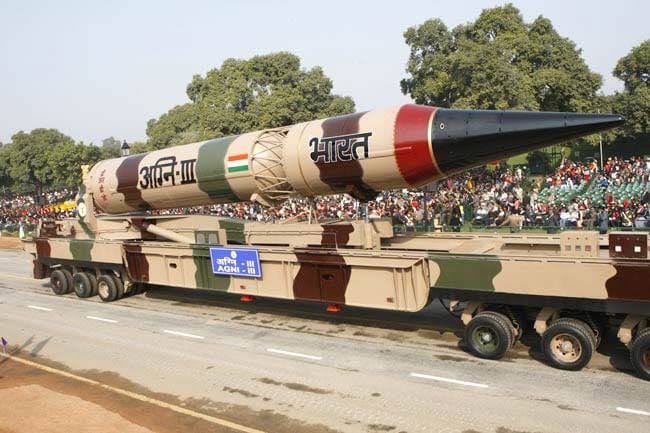
India’s strategic deterrent is built around land-based ballistic missiles, aircraft-delivered nuclear weapons, and submarine-launched ballistic missiles. The land-based component is centred on the Agni series, especially the Agni-5, which is capable of striking targets deep inside China at ranges exceeding 5,000 kilometres. The shorter-range Agni-1 and Agni-2 remain more closely aligned with deterrence against Pakistan.
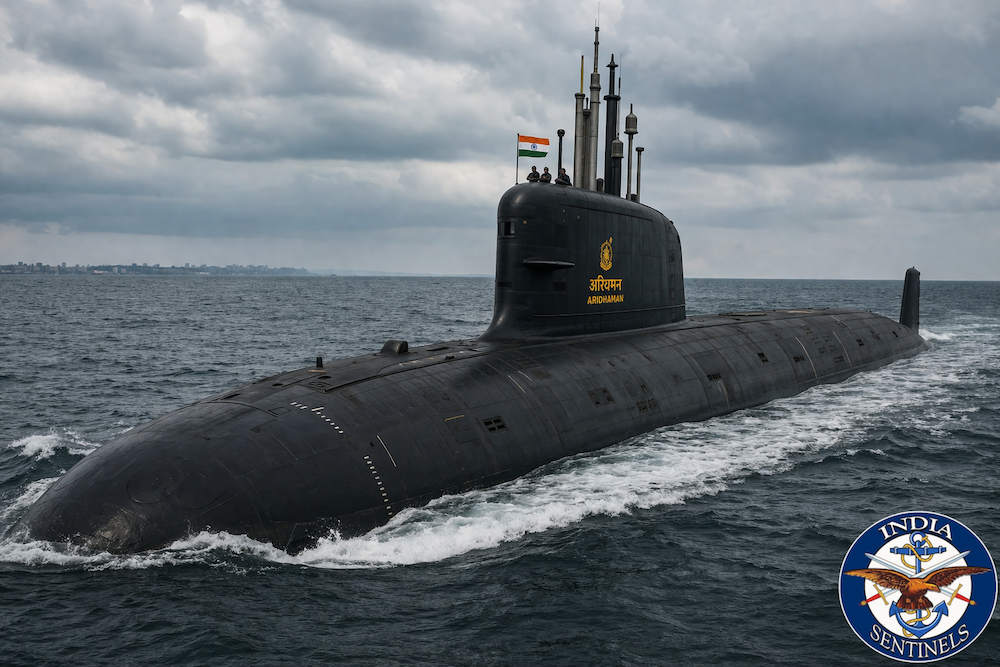
The air-delivered leg remains part of the deterrent structure, but the most consequential development in recent years has been at sea. India’s Arihant-class nuclear-powered ballistic missile submarines have given the country a more credible second-strike capability, which is the core requirement of any stable no-first-use doctrine. A force that can survive an enemy first strike and still retaliate is central to deterrence credibility.
That is where deployment patterns become important. A ballistic missile submarine on deterrent patrol cannot perform its strategic role if its weapons are not operationally available. For that reason, the presence of some deployed warheads may reflect less a doctrinal shift than the practical demands of maintaining a functioning sea-based deterrent.
India does not disclose which warheads are deployed or to which delivery systems they are assigned. Sipri also stops short of identifying the exact platform mix. Still, given the logic of a survivable second-strike posture, it is reasonable to assess that the submarine leg is likely to account for at least part of the deployed total.
This reading also fits the broader trajectory of India’s strategic programmes. As the sea-based deterrent expands through additional Arihant-class boats and supporting infrastructure, the command-and-control architecture must evolve with it. Limited peacetime deployment, in that context, may be less a departure from doctrine than an outcome of deterrent maturation.
Read also: India’s defence spending surges 8.9% to $92.1 billion in 2025, Sipri says
Small but meaningful number
The figure of 12 deployed warheads is modest in absolute terms and should be treated with caution. Sipri says its numbers are estimates based on open-source analysis, satellite imagery, fissile material production, and assessments of delivery systems. No nuclear-armed state publishes a full and verifiable accounting of its stockpile, and India remains particularly guarded on operational details.
Even so, the estimate matters because it appears to capture a threshold India had long avoided crossing in public assessments. A country whose deterrent was once defined by recessed peacetime readiness is now being described by one of the world’s leading arms-control research institutes as keeping at least a small portion of its arsenal in deployable condition.
The wider global context reinforces the point. Sipri estimates that the world’s nine nuclear-armed states together hold 12,187 warheads, of which 4,012 are deployed. The United States and Russia still dominate the field, accounting for roughly 86 per cent of the global inventory and maintaining more than 2,000 deployed warheads each. Britain and France are estimated to maintain 120 and 280 deployed warheads respectively.
In regional terms, however, India’s position is more revealing. Pakistan is estimated to have 170 warheads – none deployed in peacetime. China’s deployed total stands at 34. India, at 12, appears to be moving into an intermediate category: no longer fully recessed, but still far from the alert postures maintained by the major powers.
That is consistent with India’s broader strategic style. New Delhi has traditionally modernized its nuclear forces incrementally, avoided dramatic signalling, and kept doctrinal language stable even as capabilities evolved. The latest Sipri assessment fits that pattern. There has been no official declaration, no doctrinal rewrite, and no overt political messaging. Yet the operational picture appears to be changing.
If Sipri’s estimate is broadly accurate, the significance lies not in the scale of deployment but in what it reveals about India’s strategic evolution. The country still appears committed to restraint, minimum deterrence, and political control. But it also seems to be adapting to a harder strategic environment in which survivability, readiness, and credible second-strike capability are becoming more important than the old logic of complete peacetime separation.
That is a limited change, but it is not a trivial one.
Follow us on social media for quick updates, new photos, videos, and more.
X: https://x.com/indiasentinels
Facebook: https://facebook.com/indiasentinels
Instagram: https://instagram.com/indiasentinels
YouTube: https://youtube.com/indiasentinels
© India Sentinels 2026-27