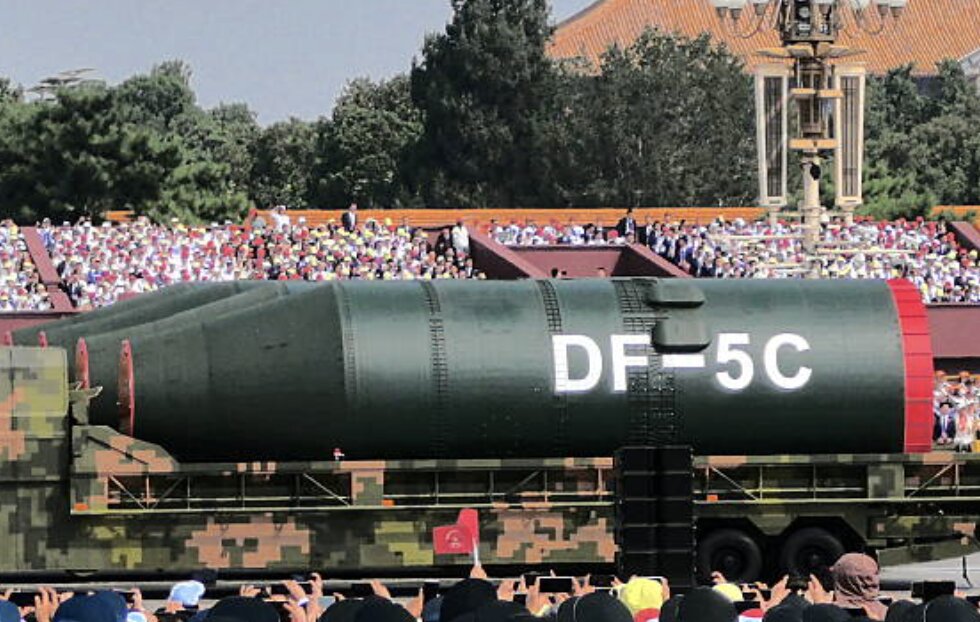
 Chinese Dongfeng-5C ICBMs displayed during Victory Day parade in Beijing, on September 3, 2025.
New Delhi: The world’s nine nuclear-armed states collectively possessed an estimated 12,187 warheads as of January 2026, of which approximately 9,745 were in active military stockpiles available for use, according to SIPRI Yearbook 2026. The findings, released by the Stockholm International Peace Research Institute (Sipri) on Monday, paint a troubling picture of nuclear weapons returning to the centre of national security strategies.
It shows the reversing of the progress made after decades of incremental disarmament – even as the risks of miscalculation and escalation are demonstrably rising. The report’s most immediate geopolitical backdrop is the brief but consequential armed conflict between India and Pakistan during Operation Sindoor in May 2025, which Sipri flags as a direct challenge to nuclear deterrence logic.
Read also: Global peacekeeping at 25-year low as funding dries up and great powers clash, Sipri says
India, Pakistan and Op Sindoor
India is assessed to have once again slightly expanded its nuclear arsenal through 2025 and to have continued developing new types of nuclear delivery systems. The modernization programme is increasingly oriented toward long-range weapons capable of reaching targets deep inside China, although Pakistan continues to figure centrally in India’s nuclear planning. Sipri does not provide a precise warhead count for India in the released summary of its yearbook, but the trajectory is unambiguously upward.
Pakistan, for its part, continued developing new delivery systems and accumulating fissile material through 2025. This, Sipri assesses, suggests Islamabad’s nuclear arsenal could grow considerably over the coming decade.
What makes this year’s assessment particularly significant from an Indian perspective is the specific context Sipri provides around Operation Sindoor in May 2025. The yearbook notes that the brief armed conflict saw India attacking Pakistani air and missile bases that are “likely to have nuclear-related roles” – a formulation that is carefully worded but carries substantial implications. Critically, Sipri also notes that both sides took steps to avoid escalation.
This is a concerning observation. That India struck facilities with a potential nuclear connection without triggering nuclear signalling from Pakistan – and that the conflict did not spiral – will be studied by strategists for years. But Sipri’s broader point is that the episode itself “challenges the logic” of nuclear deterrence.
The institute’s director, Karim Haggag, put it directly: “The dangers associated with nuclear weapons are growing due to advances in weapon technology, the breakdown of nuclear arms control and heightened geopolitical tensions, among a range of other factors. At the same time, world events – not least the outbreak of conflict between nuclear-armed India and Pakistan – are challenging nuclear deterrence logic.”
For India, which has long maintained a no-first-use posture and structured its nuclear doctrine around the credibility of assured retaliation, the broader Sipri finding – that China and India may now “occasionally deploy a small number of warheads mounted on missiles during peacetime” – marks a significant shift in the subcontinent’s nuclear posture, even if tentative.
Read also: India’s defence spending surges 8.9% to $92.1 billion in 2025, Sipri says
China’s arsenal expanding fastest
Sipri estimates that China now possesses around 620 nuclear warheads and is expanding its arsenal faster than any other country. Beijing showcased several new nuclear systems during its 2025 military parade, and by January 2026 had loaded hundreds of missiles into three large silo fields in the country’s north, while completing additional silos in three mountainous eastern regions.
The numbers are not yet in the same league as Russia or the United States, but the trajectory is consequential for India. Sipri notes that China could potentially have at least as many intercontinental ballistic missiles (ICBMs) as either Russia or the US by the turn of the decade. Even if China crosses 1,000 warheads by 2030 – which Sipri considers possible – that would still represent roughly a quarter of each of the current Russian and American stockpiles.
Yet for a country like India, which is already planning its nuclear modernization partly around the China threat, the pace of Chinese expansion is strategically disruptive regardless of the absolute numbers.
Read also: Dragon’s Arsenal – Know about China’s new weapons displayed at Victory Day parade
Russia and US still dominant
Russia and the United States together hold around 83 per cent of all stockpiled nuclear warheads globally. Their combined share is shrinking marginally as other arsenals grow, but the two countries remain overwhelmingly dominant.
Both states’ military stockpiles remained broadly stable in 2025, but their extensive modernization programmes point toward larger and more diverse arsenals in the future. An additional layer of uncertainty has been added by the expiry of the bilateral 2010 New START treaty in February 2026, the last remaining arms control framework governing US-Russian strategic nuclear forces. Sipri warns this is likely to increase uncertainty about the future direction of both countries’ force levels.
Russia’s modernization programme is encountering difficulties: another test launch of the Sarmat ICBM failed in 2025, and western sanctions combined with the continuing costs of the war in Ukraine appear to be affecting the programme. Meanwhile, the Burevestnik nuclear-powered ground-launched cruise missile – a troubled system – was claimed to have achieved a successful flight test covering more than 14,000 kilometres.
Russia has also begun building a forward-operating base for its dual-capable Oreshnik intermediate-range ballistic missile (IRBM) in Belarus, and Oreshnik missiles have been used against Ukraine with conventional warheads, most recently in May this year.
The United States’ modernization effort is advancing but facing planning and funding challenges that are likely to delay and raise the cost of the programme. The Donald Trump administration’s proposed “Golden Dome” missile-defence system – estimated to cost $1.2 trillion – will add significant budgetary and logistical stress.
Hans Kristensen, associate senior fellow with Sipri’s Weapons of Mass Destruction Programme, offered a blunt assessment. He said, “The evidence is growing that the nuclear weapon states are sidelining, and even walking away from, their disarmament commitments and are instead flexing their nuclear muscles. By reaching for nuclear solutions, states are creating new risks and fuelling arms-race dynamics.”
Read also: India second-largest arms buyer globally, Pakistan fifth, Sipri report says
North Korea and Israel
North Korea continues to develop its nuclear capabilities in pursuit of its stated aim of exponentially expanding its arsenal. Sipri estimates Pyongyang has possibly assembled around 60 warheads and possesses sufficient fissile material to produce at least 30 more, with production accelerating. In 2025, North Korea continued testing new missile systems, including the Hwasong-20 – a next-generation solid-fuelled ICBM – alongside medium-range, highly manoeuvrable systems designed to evade missile defences.
Israel, which neither confirms nor denies possessing nuclear weapons, is assessed to be modernizing its arsenal. In 2025, Israel intensified construction at a new site at the Negev Nuclear Research Center near Dimona – activity that Sipri suggests could be connected to its nuclear capabilities.
Read also: Ukraine has crossed the Rubicon putting Kyiv at Russia’s crosshairs
Verdict: Disarmament dead, deterrence logic failing
The yearbook’s overarching finding is that the decades-long trend of gradual reduction in global nuclear inventories – driven by the dismantlement of cold war-era warheads by Russia and the United States – is about to reverse. The pace of dismantlement is slowing, while deployment of new nuclear weapons is accelerating.
Compounding this is the deteriorating state of multilateral nuclear governance. The 2026 Review Conference of the Nuclear Non-Proliferation Treaty (NPT) ended on May 22 without issuing an outcome document – the third consecutive NPT review conference to fail in this way. Haggag was pointed in his assessment: “The absence of a successor agreement to New START, the modernization of nuclear forces and plans to increase the deployment of nuclear weapons are all likely to further undermine the legitimacy of the Non-Proliferation Treaty.”
Matt Korda, associate senior researcher with Sipri’s Weapons of Mass Destruction Programme, added a further dimension of concern – one that speaks directly to crisis stability: “We can no longer assume that leaders operating within such systems will receive accurate data during nuclear crises, nor that they will act rationally during periods of heightened tension.”
The broader geopolitical framing in the yearbook’s introduction is equally stark. Haggag identifies two dominant forces reshaping global security: “the resurgence of war between technologically advanced states and the fraying of the USA’s relationships with its allies.” He warns of a self-reinforcing cycle in which major powers pursue security and dominance in ways that deepen the overall sense of insecurity – and in which mutual interdependence, once considered a guarantor of peace, has given way to the weaponization of trade, technology, and supply chains.
For India, which sits at the intersection of at least three of the world’s most active nuclear rivalries – with Pakistan, with China, and within the broader Indo-Pacific competitive environment – the Sipri Yearbook 2026 is much more than an academic document. It is a strategic mirror.
Follow us on social media for quick updates, new photos, videos, and more.
X: https://x.com/indiasentinels
Facebook: https://facebook.com/indiasentinels
Instagram: https://instagram.com/indiasentinels
YouTube: https://youtube.com/indiasentinels
© India Sentinels 2026-27