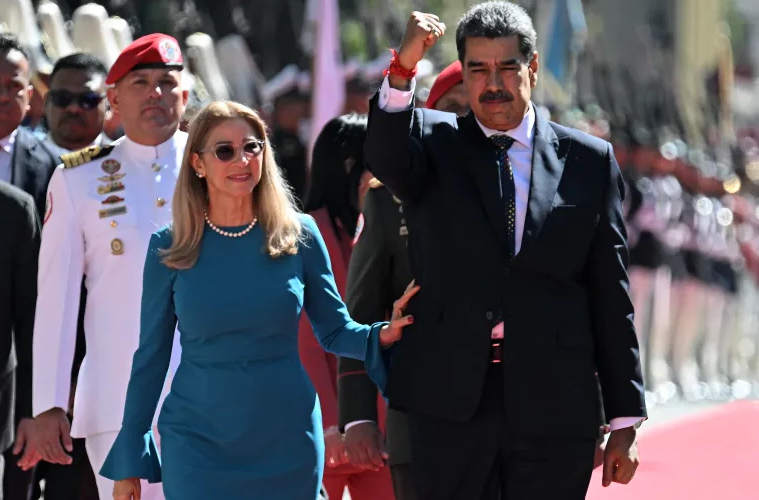
 Nicolás Maduro (R) with his wife, Cilia Flores. (Photo via X)
New Delhi: In an operation that marks the most audacious display of American military force in Latin America in decades, the United States has bombed multiple sites across Venezuela and captured the country’s president, Nicolás Maduro, along with his wife, Cilia Flores. The couple were flown out of the country in the early hours of Saturday, and are now in US custody facing narcoterrorism charges that Washington has pursued for nearly six years.
The coordinated assault, which the US president, Donald Trump, described as a “large-scale strike”, represents a dramatic escalation in years of confrontation between the two nations. It also raises profound questions about the limits of sovereignty, the use of military force to enforce criminal warrants, and the future of non-intervention norms in the Western Hemisphere.
The Caracas Raid
Multiple explosions shook Venezuela’s capital shortly after midnight local time on January 3. Residents reported at least seven loud blasts and low-flying aircraft over the capital, Caracas, while similar strikes hit targets in the states of Miranda, Aragua, and La Guaira. Airports, military airfields, and defence installations bore the brunt of the assault, according to eyewitness accounts and official Venezuelan statements.
As conventional strikes created chaos and disabled air defences, an elite unit from the US Army’s Delta Force – one of America’s most secretive special operations teams – moved to capture Maduro. US officials, speaking to major American networks, confirmed that the Central Intelligence Agency provided targeting intelligence for the raid. Within hours, Trump announced that both Maduro and Flores had been “captured and flown out of the country”.
The operation was surgical in its primary objective but broad in its military footprint. The US Federal Aviation Administration immediately banned American commercial flights over Venezuelan airspace, citing “ongoing military activity”. Power cuts rippled through parts of Caracas, and communications were disrupted as the state struggled to respond to the shock.
Legal Justification and Political Context
Washington has framed the operation not as regime change but as law enforcement backed by military power. Maduro and Flores face longstanding indictments in the Southern District of New York on charges of narcoterrorism and drug trafficking, first filed in 2020. The indictments accuse Maduro of deliberately using cocaine “as a weapon” against the United States – allegations he has consistently denied.
The US attorney general, Pam Bondi, and the country’s secretary of state, Marco Rubio, confirmed publicly that the couple would face trial in federal court. Sources indicate Maduro is being transported to New York and will likely be held in a high-security facility in Manhattan. The US government had progressively increased pressure on Maduro, at one point offering a reward reportedly as high as 50 million dollars for information leading to his arrest.
The Trump administration argues that Venezuela under Maduro effectively operates as a criminal cartel that has flooded America with cocaine. Officials portray the military strike as a necessary extension of law enforcement when dealing with a hostile state that harbours and protects indicted criminals. However, critics note that this rationale sets a precedent for using military force to execute arrest warrants abroad – a move that could destabilize international norms around sovereignty.
The operation caps a months-long military build-up under Operation Southern Spear, a campaign publicly described as targeting drug traffickers but widely understood by regional analysts to carry an implicit regime-change component. In late 2025, the US Congress debated resolutions that would have restricted Trump’s ability to use military force against Venezuela but ultimately voted them down, leaving the executive branch with broad latitude to escalate.
Venezuela’s Response and Internal Crisis
Inside Venezuela, the remaining leadership has declared a national emergency and denounced the strikes as “military aggression” against a sovereign nation. The vice-president, Delcy Rodríguez, said authorities lost contact with Maduro and Flores during the attacks and demanded that Washington provide “proof of life” for both. Venezuelan officials claim air defences were activated and accuse the US of deliberately hitting civilian infrastructure along with military targets.
The country now faces an immediate power vacuum. While the constitutional line of succession points to senior figures like the vice-president, whether they can exercise real authority amid shock, military disruption, and possible internal rivalries remains unclear. Parts of the security forces may question the legitimacy or capacity of any successor government, particularly if they perceive it as either aligned with or imposed by external powers.
Caracas remains tense. Streets are partially deserted, blackouts are intermittent, and a heavy security presence surrounds sensitive sites. Opposition groups, which have long opposed Maduro but also criticized US sanctions and intervention, appear to be assessing the situation carefully. Many are mindful that being seen as too closely aligned with an external military operation could undermine their domestic legitimacy.
International Reactions
Regional leaders have reacted with evident concern about the precedent of a US strike to capture a sitting president. The Colombian president, Gustavo Petro, has spoken publicly about the breadth of locations reportedly struck, suggesting a wider operational footprint than US officials initially acknowledged. Governments across Latin America are convening emergency consultations, with some likely to condemn the operation as a violation of sovereignty while others – particularly Maduro’s critics – may quietly welcome his removal.
Human rights and legal experts are raising pointed questions about the operation’s consistency with international law. The United Nations Charter places strict restrictions on the use of force between states, generally permitting it only in self-defence or with United Nations security council authorization. Using military units to execute an arrest warrant abroad occupies legally uncertain territory that most international lawyers would view as problematic at best.
The operation also risks deepening global divisions over US interventionism. Russia, China, and other states that have supported or engaged with Maduro’s government may view the strike as further evidence of American unilateralism. At a time of heightened geopolitical competition, the move could complicate Washington’s efforts to build coalitions on other issues.
What Comes Next
Close allies of Trump, including Rubio and members of congressional intelligence committees, have suggested that the administration does not anticipate “further action in Venezuela now that Maduro is in US custody”. This signals a preference – at least for now – to treat the operation as a discrete law-enforcement mission rather than the opening phase of a larger war or occupation.
However, the strike’s consequences are likely to reverberate far beyond the immediate arrest. Much will depend on how quickly a functioning chain of command emerges in Caracas, how the Venezuelan armed forces react, and whether international actors move toward recognizing new leadership or push for negotiations. Venezuela was already suffering a deep economic and humanitarian crisis before the strikes; the sudden removal of its president, however unpopular he may have been with many Venezuelans, adds another layer of instability.
For Washington, the operation represents a high-stakes gamble. If Maduro is successfully prosecuted and Venezuela transitions toward a government more amenable to US interests, the administration will claim vindication. If instead the country descends into chaos, civil conflict, or prolonged instability, the strike will be remembered as a reckless overreach. Either way, the precedent has been set: the United States has demonstrated it is willing to use military force to seize foreign heads of state it has indicted.
As information continues to emerge, details remain contested – particularly regarding the full extent of damage from the strikes and the precise conditions under which Maduro and Flores are being held. Major international outlets and official statements from both governments are expected to clarify these points in the coming days. For now, the world watches to see whether Venezuela can stabilize, and whether other nations will accept or challenge the norms the United States has just rewritten.