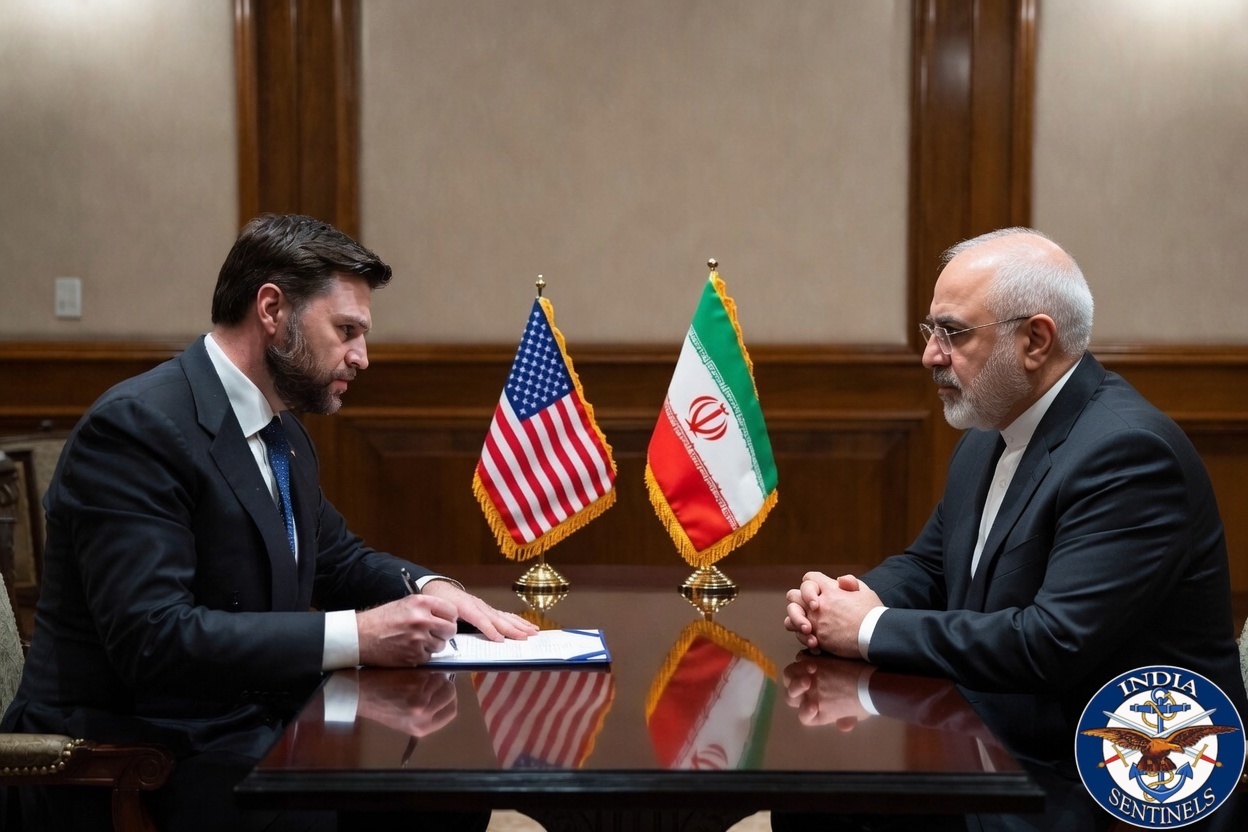
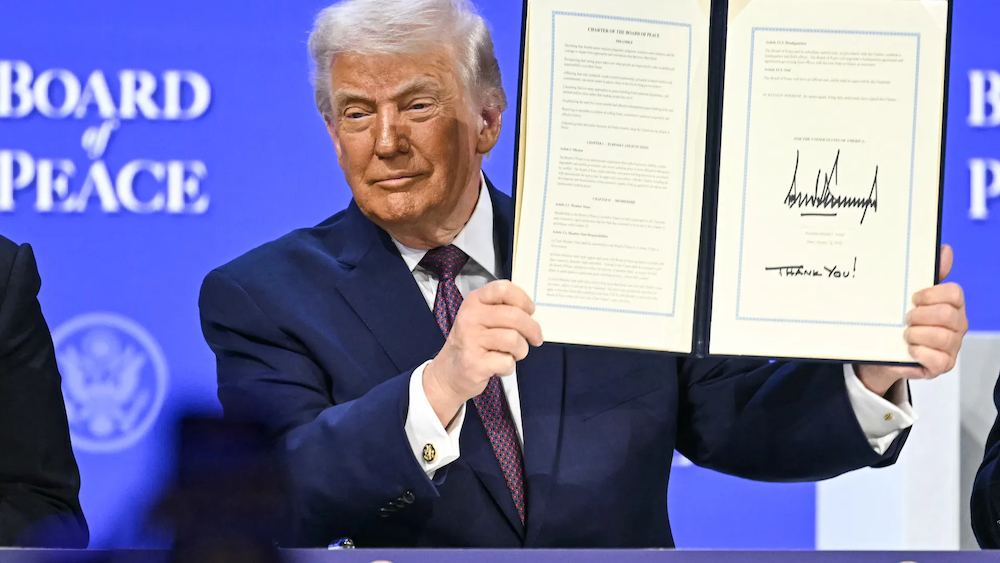
 Donald Trump displaying his signature on Charter of the Board of Peace, at Davos, on January 22, 2026. (Photo via X)
New Delhi: When the US president, Donald Trump, signed the Charter of the Board of Peace at a ceremony in Davos on Thursday, he framed the moment as historic. His administration officials described it as “the greatest and most prestigious board ever assembled” – an international body designed initially to oversee Gaza’s reconstruction but rapidly expanding into what Trump calls “a bold new approach to resolving global conflict.” The 11-page charter makes no mention of Gaza. Instead, it establishes the board as an entity with authority over “areas affected or threatened by conflict” worldwide, effectively positioning it as an alternative mechanism to the United Nations.
The board operates within a legal grey zone. It received formal authorization through UN security council Resolution 2803, passed 13-0-2 on November 17, 2025, yet it functions independently of UN oversight, governance structures, and accountability mechanisms. Trump serves as life-long chairman with unchecked authority to appoint members, dissolve subsidiaries, and set agendas. Membership requires financial commitment: permanent seats cost $1 billion. Between 25 and 35 nations have received invitations, with approximately 25 accepting despite reservations from established allies and major powers. China declined participation unless the board operates under direct UN supervision – a position reflecting broader concerns about precedent-setting governance architecture centred on individual leadership rather than collective multilateralism.
From Gaza ceasefire to global mandate
The board emerged from Trump’s so-called “Comprehensive Plan to End the Gaza Conflict” – a 20-point framework unveiled in September 2025 and accepted by both Israel and Hamas on October 9, 2025. Unlike previous Middle Eastern peace initiatives emphasizing negotiated political settlements, Trump’s approach prioritizes security demilitarization, international administration, and infrastructure reconstruction as prerequisites for political resolution. Phase One involved hostage exchanges and ceasefire implementation. Phase Two, now overseen by the board, mandates demilitarization, transitional governance reform, and economic revitalization.
Trump’s rationale reflects explicit dissatisfaction with the UN. Announcing the board on January 15, he stated that “the UN never helped me,” positioning the institution as a pragmatic alternative to what the charter describes as approaches that “have too often failed”. Yet the administration simultaneously sought UN security council authorization, suggesting calculated strategy: achieving quasi-legitimacy while maintaining operational autonomy.
The US secretary of state, Marco Rubio, characterized the board as “a board of action, much like President Trump is a president of action”. Trump himself remarked at Davos that “once this board is fully formed, we can essentially do whatever we choose” – a statement crystallizing the institutional philosophy underlying the structure.
The charter’s scope extends far beyond Gaza. In correspondence to the Argentine president, Javier Milei, Trump articulated dual purposes: resolving the Gaza conflict while pioneering new approaches to global disputes. When questioned whether the board might replace the UN, Trump demurred, claiming it was “not meant to supplant” the organization – yet his rhetoric simultaneously asserted operational superiority. US state department officials described the global mandate as “aspirational” but expressed optimism given “ongoing frustrations” with the UN, suggesting Gaza serves as a pilot project with potential application to Ukraine, Venezuela, and other contested territories.
Institutional architecture and power concentration
The board’s governance structure deviates fundamentally from conventional international administration. Trump holds the chairmanship indefinitely, retaining the position even after leaving the White House “until he resigns it,” according to US officials. The charter grants him “exclusive authority to create, modify or dissolve subsidiary entities as necessary or appropriate to fulfil the Board of Peace’s mission.” He can unilaterally appoint and remove executive board members, who serve two-year terms “subject to removal by the chairman”. He sets the agenda. Replacement requires only voluntary resignation or incapacity – a structure resembling personal stewardship rather than collegial international governance.
This concentration contrasts sharply with comparable administrations. One might remember that the UN Transitional Administration in East Timor [archived link] (UNTAET) operated under explicit UN mandate with defined term limits and UNSC accountability. The UN Interim Administration Mission in Kosovo functioned under civil authority with specified decision-making protocols. The board lacks analogous restraints. Eliav Lieblich, an international law scholar at Israel’s Tel Aviv University, called it [archived link] “a charter evidently designed as a challenge to the UN and reflects a lack of trust in this organization.”
The founding executive board comprises 13–15 individuals representing a coalition of US officials, business executives, international financial figures, and select foreign leaders. Core members include Rubio, Middle East special envoy Steve Witkoff, Trump’s son-in-law, Jared Kushner, and the former British prime minister, Tony Blair. Additional members include Marc Rowan, chief executive of Apollo Global Management; Ajay Banga, World Bank president; and Robert Gabriel, US deputy national security adviser. The Turkish foreign minister, Hakan Fidan, and Qatari diplomat Ali Al Thawadi coordinate regional participation.
The composition reflects calculated geographic representation alongside institutional allegiances to financial capitalism and pro-Israel orientation. World Bank leadership signals reliance on international financial architecture for reconstruction funding. Investment banking executives suggest conceptualization of Gaza’s future as primarily an economic-development problem amenable to private capital mobilization. Notably absent are representatives of major UN agencies – UNRWA, UNDP – Palestinian civil society organizations, or Gaza-based humanitarian institutions, a structural exclusion sharply delimiting operational legitimacy within affected populations.
Tiered membership and financial gatekeeping
The charter establishes unprecedented tiered membership. Permanent members must contribute $1 billion to Gaza reconstruction funds; other member states participate for renewable three-year terms without mandatory financial commitment. Between 25 and 35 nations received invitations. Approximately 25 accepted, including Israel, the UAE, Saudi Arabia, Bahrain, Egypt, Turkey, Qatar, Indonesia, Pakistan, Canada, Hungary, and Morocco.
This financing model fundamentally reshapes traditional membership-governance relationships. Rather than the UN principle of “one state, one vote”, the board instantiates a “one billion dollars, one voice” principle for enhanced influence. The charter authorizes member states to vote on proposals, including annual budgets and major policy determinations, yet all resolutions require chairman approval, effectively rendering member votes advisory rather than binding.
US officials characterize the $1 billion contribution as “voluntary”. yet diplomatic pressure and normative expectations of commitment functionally render it coercive for states seeking genuine influence. China explicitly referenced this concern when declining full participation, insisting board involvement occur under UN auspices – a position affirming the principle that major international governance should operate within established multilateral frameworks rather than through ad hoc coalitions centred on individual leaders.
Legal ambiguity of UNSC authorization
As cited earlier, the board’s authority rests ambiguously on UNSC Resolution 2803. The resolution “welcomes” the board’s establishment and grants it “international legal personality”, conferring certain Gaza-specific functions. However, legal analysts identify significant gaps: the resolution provides no ongoing UN oversight mechanism, contains deliberately vague language regarding the board’s “structure, composition and terms of reference,” and explicitly avoids invoking Chapter VII enforcement powers that would legally bind member states.
This ambiguity generates substantive legal questions. In an article an Washington-based thinktank Arab Center’s website, Brian Brivati, executive director of the Britain Palestine project, argues [archived link] the board’s global mandate exceeds UNSC authorization for Gaza, creating precedent whereby council-endorsed institutions can unilaterally expand authority beyond mandate. The council provided no supervisory framework to check such mission creep – a structural deficit undermining the principle that UNSC-authorized entities should remain answerable to the council.
The resolution does not explicitly terminate Israeli occupation. By assigning reconstruction and governance functions to the board, it effectively fragments occupying power accountability. Under the Fourth Geneva Convention, occupying powers bear ultimate responsibility for civilian welfare.
By delegating this responsibility to the board, does Israel retain occupying power status or relinquish associated obligations? This unresolved question creates legal immunity for Israel while simultaneously subjecting the board to occupying power responsibilities it lacks formal authority to discharge – an accountability vacuum critics argue incentivizes cosmetic reconstruction while enabling continued Israeli security control.
Gaza vision and economic framework
Trump’s administration has articulated an extraordinarily ambitious vision for Gaza’s post-conflict reconstruction. Unveiling the master plan on January 22, special envoy Kushner specified that reconstruction would require a minimum of $25 billion, with estimates ranging as high as $67 billion depending on infrastructure scope. This scale situates Gaza reconstruction among the most expensive post-conflict rebuilding projects in recent history, comparable to or exceeding Marshall Plan [archived link] expenditures adjusted for inflation.
The financing architecture relies on multiple sources: the $1 billion contributions from permanent board members, dedicated trust funds established through the World Bank, government pledges from participating nations, and private capital mobilization through development corporations and investment vehicles. The plan explicitly positions Gaza’s reconstruction as an “incredible investment opportunity”, with Kushner acknowledging that “investing in a place like this carries some risks” but emphasizing the imperative for faith and capital commitment.
Kushner outlined a six-phase development timeline commencing in southern Gaza and advancing northward. Phase One focuses on Rafah and Khan Yunis; subsequent phases gradually expand reconstructed zones toward Gaza City and the broader territory. The most ambitious component involves construction of “New Gaza” and “New Rafah” – planned urban centres designed as regional economic engines modelled on Dubai and Doha.
Physical infrastructure includes 180 mixed-use towers for coastal tourism development, a new international airport replacing one destroyed decades ago, a modern port facility designed to facilitate future maritime commerce, and comprehensive public utilities modernization. New Rafah alone incorporates projections for 100,000-plus housing units, 200-plus schools, and integrated healthcare facilities, with Kushner estimating a completion timeline of two to three years – an extraordinarily compressed schedule for urban redevelopment of this magnitude.
Supporting infrastructure investments include $1.5 billion designated for vocational and retraining programs, $3 billion allocated to commercial zones and microenterprise development, and targeted investments in agriculture, manufacturing, and digital economy sectors. The overarching economic targets envision transforming Gaza’s GDP from its current devastated state to $10 billion-plus, with average household incomes reaching $13,000 annually and creation of 500,000-plus employment opportunities across construction, manufacturing, agriculture, and technology sectors.
Paralleling the international Board, the plan establishes a Palestinian technocratic governance layer: the National Committee for the Administration of Gaza (NCAG). Comprising 15 Palestinian professionals and led by Ali Shaath, a former Palestinian Authority deputy minister, the NCAG is mandated to oversee day-to-day service delivery – electricity, sanitation, water systems, and municipal administration – while operating “under the leadership of the Board of Peace”"
A Bulgarian diplomat, Nickolay Mladenov, has been appointed “high representative for Gaza”, serving as administrative link between the Palestinian technocratic committee and the Trump-chaired board. This hierarchical structure places strategic decision-making authority at the board level while delegating operational implementation to Palestinian technocrats functioning in subordinate administrative capacity.
Reconstruction plan and its critics
While the Trump administration has presented Gaza’s reconstruction as an unprecedented opportunity for regional transformation, the plan has encountered substantial criticism from Palestinian civil society, international legal scholars, human rights organizations, and political analysts across the region. The fundamental critique concerns not merely the plan’s feasibility or cost, but its underlying assumptions about ownership, legitimacy, and the relationship between international reconstruction and Palestinian political agency.
Palestinian analysts and civil society organizations have characterized the master plan as neocolonial in structure and intention. Ramy Adbu, founder of the Euro-Mediterranean Human Rights Monitor, described it as [archived link] “a plan to transform and control Palestinians based on domestication, subjugation, and control.” The writer and analyst Wissam Afifa remarked that [archived link] “Palestinians have been reduced to municipal workers. They are responsible for maintaining infrastructure and rebuilding schools, yet they have no influence over the political future of their territory. It’s a sovereignty-minus framework.”
This critique fundamentally interrogates whether a Palestinian technocratic committee operating under international chairmanship can exercise autonomous decision-making authority over reconstruction priorities, resource allocation, and development trajectories. Historical precedent suggests structural impediments: Palestinian governance bodies operating under international supervision during the 1990s Oslo Accords period were repeatedly constrained by external security concerns and donor conditionality. The NCAG’s explicit subordination to the board perpetuates rather than overcomes this dynamic.
International legal scholars have emphasized that the Gaza reconstruction framework lacks what UN transitional administrations in East Timor and Kosovo possessed: demonstrable Palestinian consent to the governing architecture. The board was established through UNSC authorization and bilateral Israeli-Hamas agreement regarding ceasefire terms, yet Palestinians were not party to institutional design determining how their territory will be governed or how reconstruction resources will be allocated. A referendum on Palestinian self-determination preceded UNTAET’s establishment in East Timor; no equivalent democratic process preceded the Board’s inception.
This absence of consent raises profound questions about legitimacy and long-term sustainability. The conditioning of Palestinian statehood on Palestinian Authority reform and board-determined criteria for governance effectiveness means that external actors retain veto authority over Palestinian self-determination – effectively gatekeeping independence rather than stewarding it.
Operational difficulties have already emerged. Reporting from Gaza reveals tensions between US military personnel and Israeli forces regarding aid access, humanitarian coordination, and ceasefire enforcement. A Le Monde report [archived link] documented one US general shouting at Israeli officers regarding access restrictions at the Kerem Shalom crossing, with sources noting that “the Israeli army remains in charge, but the Americans are challenging it.” Such conflicts suggest the board’s institutional architecture will struggle to reconcile Israeli security prerogatives with humanitarian access requirements.
The plan’s assumption that Gaza can be economically transformed into a regional hub within five years also encounters scepticism from development specialists. Comprehensive reconstruction following major conflicts typically requires 10–15 years. Gaza’s particular constraints – Israeli military occupation, Hamas disarmament requirements, Palestinian Authority governance questions – suggest timelines compressed beyond historically achievable rates.
Precedent and global implications
Critics emphasize that Gaza serves as a pilot project: if this model succeeds, it establishes precedent for US-led international governance structures in Venezuela, Ukraine, and other contested territories. The board’s expansion beyond Gaza-specific mandate signals intent to institutionalize this model globally, potentially displacing UN-centred multilateralism with US-curated governance coalitions organized around bilateral relationships and financial commitments rather than universal principles.
Apart from that, China’s explicit reservations about board participation without UN oversight reflect concerns that institutionalizing ad hoc governance structures will sideline the UN Charter framework and will elevate individual great powers’ operational prerogatives over collective international law.
The board represents an institutional innovation with consequential implications for international governance. By embedding a non-UN administrative body within UNSC authorization while maintaining operational autonomy from UN systems, the board instantiates what might be termed “outsourced multilateralism” – formal UN endorsement without substantive UN oversight. This model potentially reshapes the balance between national great-power discretion and collective multilateral constraint that has undergirded the post-World War II international order.
For established US allies, the board presents an awkward position: non-participation risks exclusion from influence over reconstruction and regional diplomacy; participation endorses an institutional model that concentrates authority in the US chairperson and subordinates traditional multilateral decision-making to unilateral executive prerogative. This structural tension has generated hesitation from Canada, several European states, and India, which view the board as establishing a problematic precedent for international governance while simultaneously recognizing the practical necessity of engaging with conflict resolution mechanisms that control access to reconstruction resources.
The path ahead
The “Board of Peace” represents Trump’s most consequential assertion of institutional power in international conflict resolution. By combining formal UN security council authorization with operational independence from UN systems, concentrating authority in lifetime executive chairmanship, and explicitly expanding its mandate beyond Gaza, the institution embodies a distinctive vision of how international governance should function: pragmatically rather than procedurally, hierarchically rather than consensually, and oriented toward executive efficiency rather than multilateral accountability.
Whether this model succeeds in stabilizing Gaza and catalysing reconstruction will substantially determine whether it becomes the template for future US engagement with post-conflict administration globally. The institutional precedents it establishes – presidential control of international governance, membership predicated on financial contribution, explicit rejection of UN-centred multilateralism – will reverberate throughout the international system, either legitimizing or delegitimizing this approach depending on the Board’s operational success and political viability in the eyes of affected populations and international observers.
The fundamental question remains: can an institution designed around personal authority and financial gatekeeping achieve the legitimacy necessary for sustainable post-conflict governance? History suggests that effective transitional administrations require not only resources and political will, but consent from governed populations and accountability to international norms.
Whether Trump’s “Board of Peace” can reconcile its unprecedented concentration of power with these democratic imperatives will determine not only Gaza’s future, but the trajectory of international governance architecture in an era of renewed great-power competition.
Follow us on social media for quick updates, new photos, videos, and more.
X: https://x.com/indiasentinels
Facebook: https://facebook.com/indiasentinels
Instagram: https://instagram.com/indiasentinels
YouTube: https://youtube.com/indiasentinels
© India Sentinels 2025-26