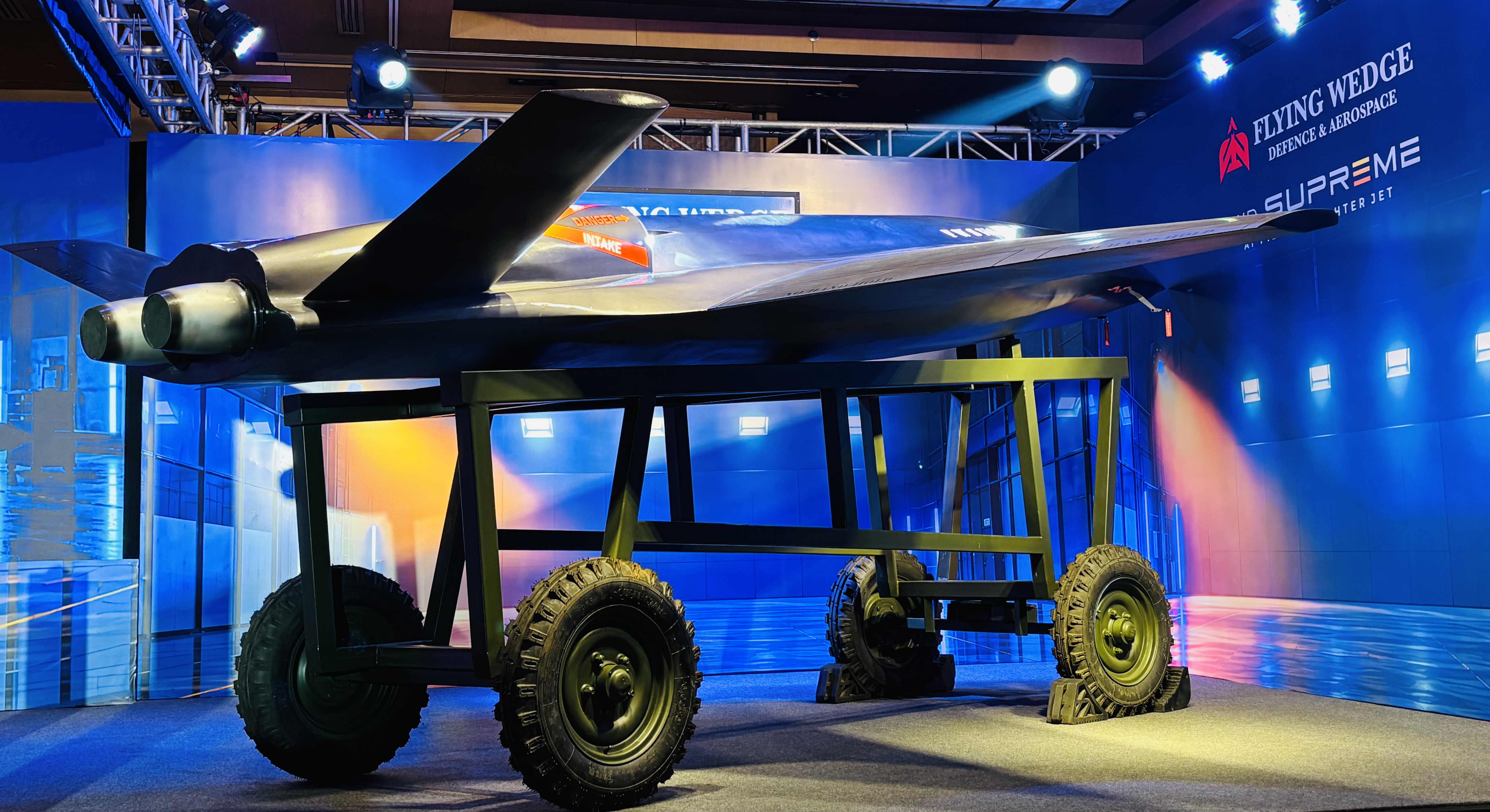
New Delhi: Flying Wedge Defence showed its FWD Supreme aircraft at an event in the national capital on Tuesday. The company also set out plans to build a family of aircraft flown by artificial intelligence (AI), with costs kept in line with what missions actually require.
The company's founder, Suhas Tejaskanda, said the aim was an indigenous range of AI-piloted aircraft that does not overshoot operational needs on price.
He said a smaller variant, the FWD Supreme Lite, had completed taxi trials and was being readied for its maiden flight.
Flying Wedge also intends to bring in foreign partners for Operation Triple Seven, which it describes as an India-led development and manufacturing initiative.
Phase 1 specifications
According to the company's Phase 1 specifications, the FWD Supreme is a flying-wing aircraft of about 10 metres by 10 metres with an internal weapons bay. A flying wing blends the fuselage and wings into one surface, a layout often chosen to cut drag and radar visibility.
The aircraft weighs more than 1,500 kg and can carry a payload of about 350 kg.
It is designed around a 5-kN thrust rating, with a top speed of Mach 0.8-0.85 and a cruising speed of 500–600 kmph. Its range is listed at more than 1,500 km and its endurance at over two hours. It is also specified to carry satellite communication equipment.
These are the company's stated design parameters. Details of testing, the aircraft's operational role and the development timeline were not immediately available.
Government backing
A. Anbarasu, additional secretary and director general (acquisition) at the Ministry of Defence, attended the unveiling and congratulated the company. He stressed the need to strengthen India's domestic defence industrial ecosystem.
"Let me convey my heartiest congratulations to Flying Wedge for unveiling such a wonderful aircraft. It makes us happy to see the Indian defence ecosystem growing at a stellar pace," he said.
Anbarasu pointed to the Russia–Ukraine war, continuing uncertainty in West Asia and India's Operation Sindoor last year. He said the changing security environment demanded that the country be ready to react without delay.
"The environment is such that we should be in a mode to respond to the situations without any wasting of time," he said.
He also recalled the prime minister, Narendra Modi's, emphasis on jointness, Atmanirbharta (self-reliance) and innovation, which he described as the cornerstones of the defence ecosystem.
"The Prime Minister gave the mantra of J-A-I: J for jointness, A for Atmanirbharta and I for innovation," he said.
He urged stakeholders to work together on innovative products made in India.
The unveiling comes as India works to widen private-sector participation in defence manufacturing and build indigenous capabilities in aerospace and emerging military technologies.
With its proposed aircraft family and plans for international partnerships, Flying Wedge Defence has placed AI-enabled aviation and domestic development at the centre of its ambitions.