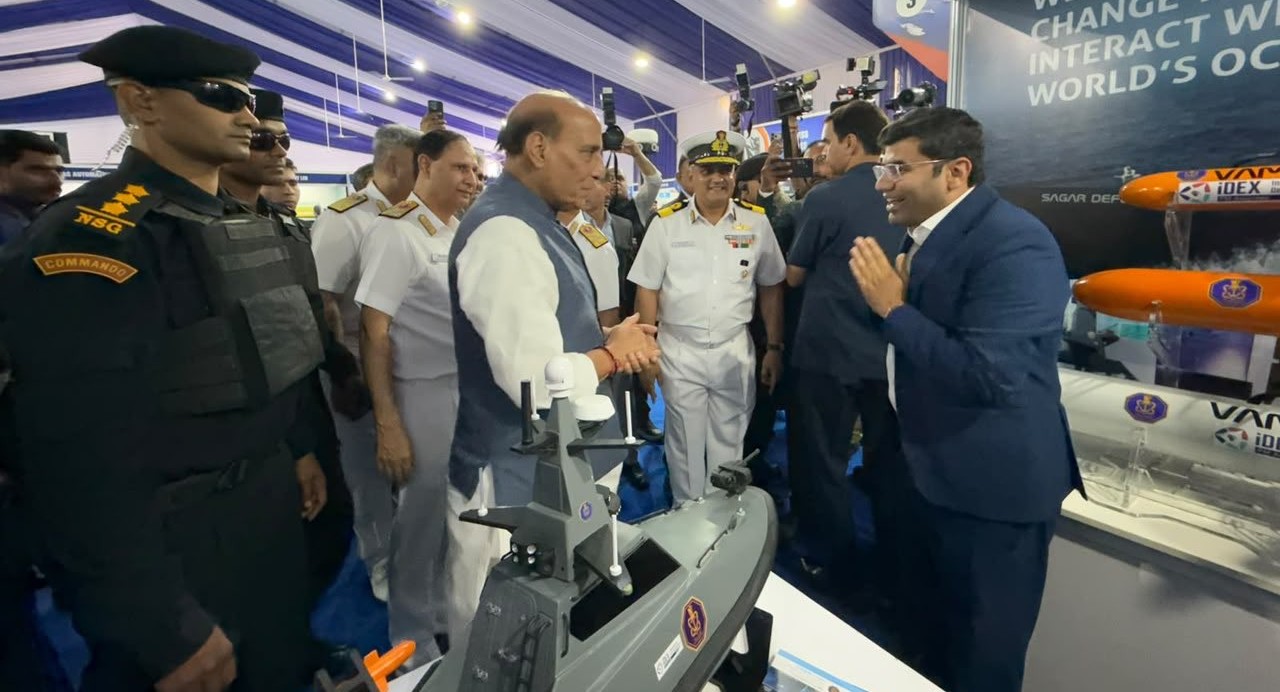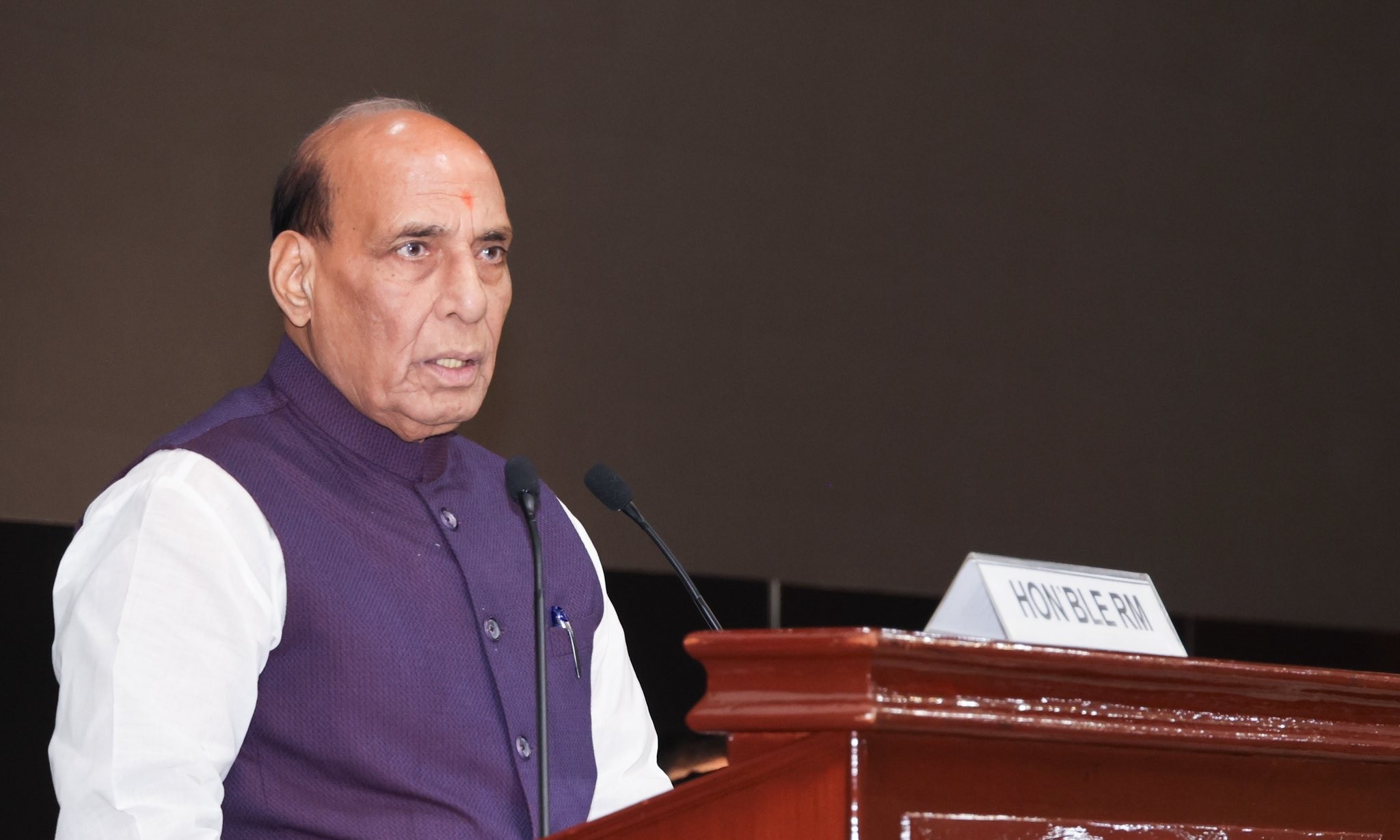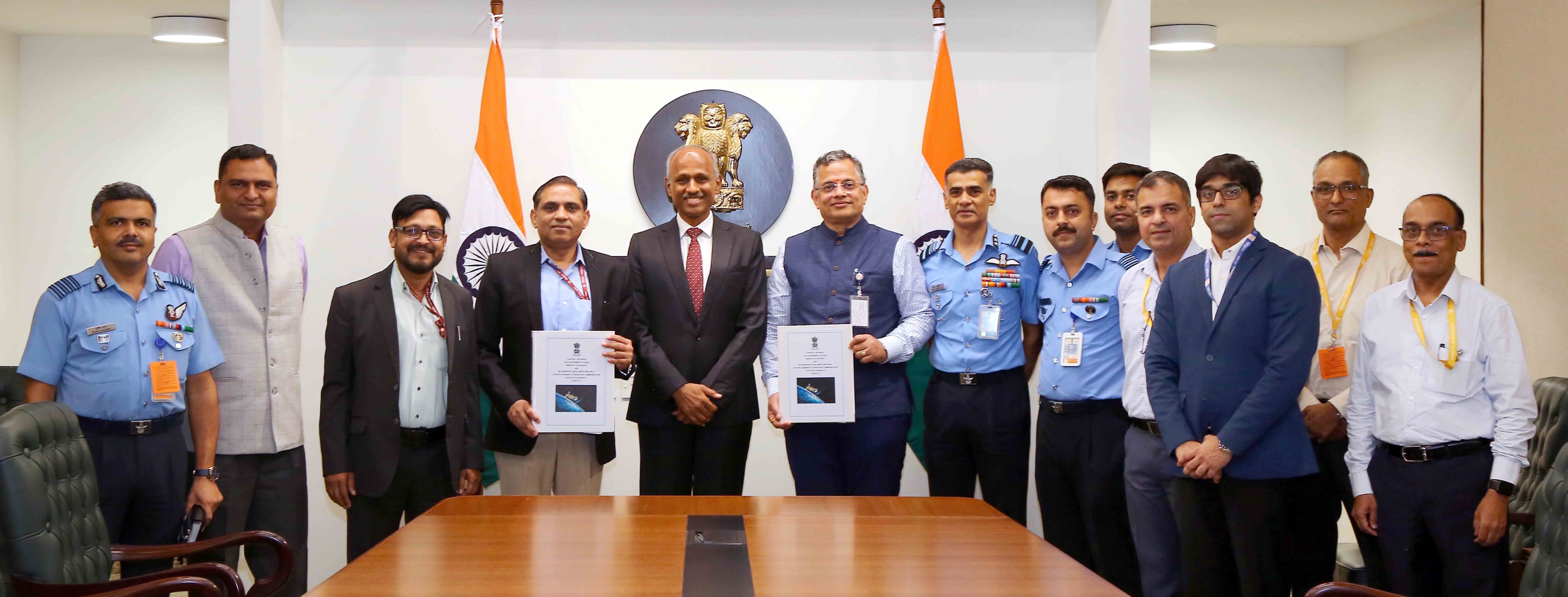
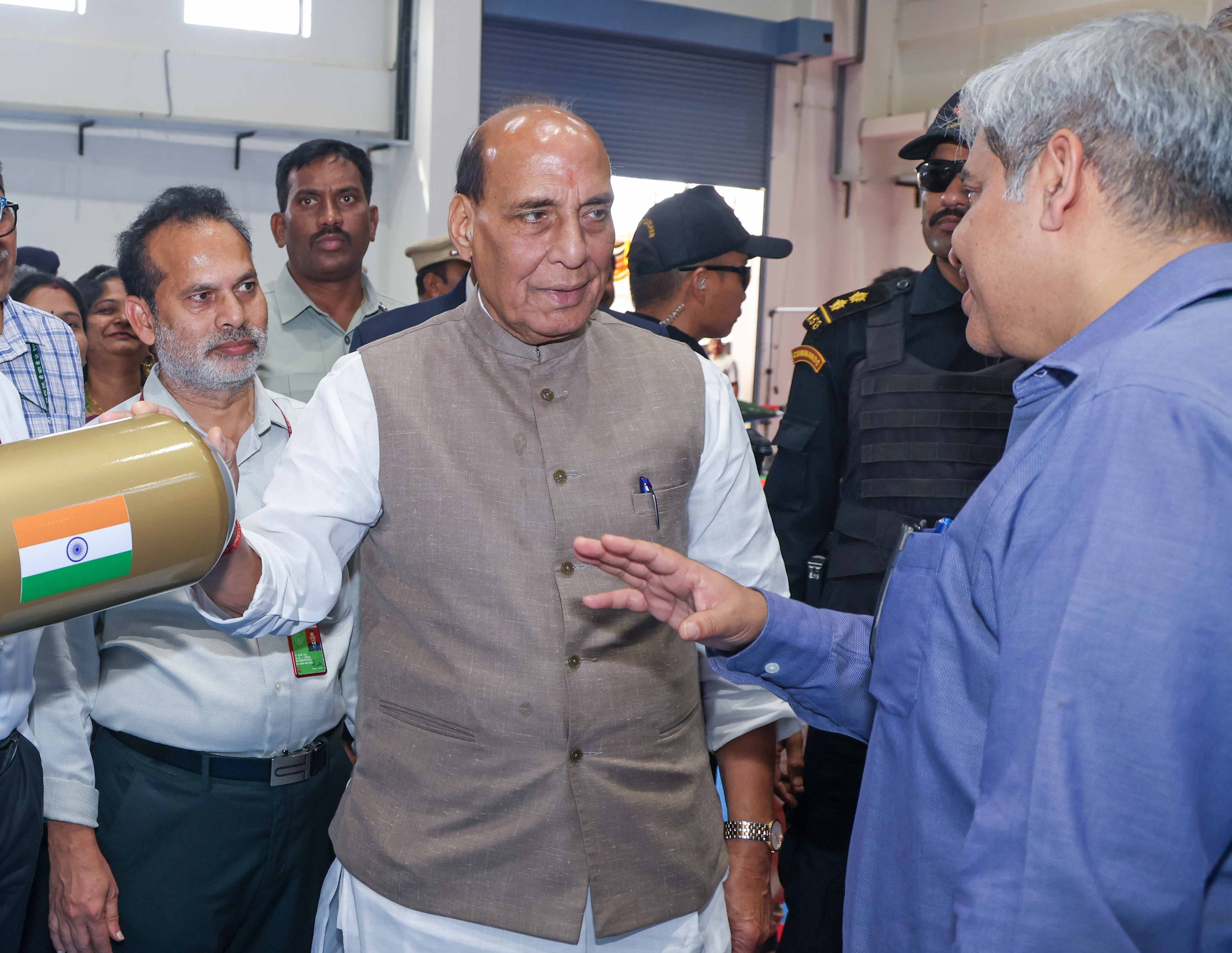
 Rajnath Singh along with DRDO scientists at DRDL, Hyderabad (Photo: MoD)
Hyderabad: The defence minister, Rajnath Singh on Thursday inaugurated an Advanced Weapon System Complex at the Defence Research and Development Laboratory (DRDL), a part of the Dr APJ Abdul Kalam Missile Complex, in Hyderabad and delivered a pointed endorsement of the country’s indigenous missile programme in the aftermath of Operation Sindoor.
Operation Sindoor, Indian armed force’s strikes against terror infrastructure in Pakistan and Pakistan-occupied Kashmir carried out in May 2025, was the first major test of several domestically developed weapon systems in a live conflict environment. Singh said their performance had provided definitive proof that India’s defence research and development ecosystem had come of age.
“The systems developed by DRDO, such as Akash and BrahMos, proved that India possesses the capability to compete in the global defence technology ecosystem. Strength is essential for peace, and self-reliance is the most reliable foundation for that strength,” Singh said.
The Akash surface-to-air missile system, developed by DRDO and produced by Bharat Dynamics Limited and Bharat Electronics Limited, has been in service with the Indian army and air force since the 2010s.
The BrahMos supersonic cruise missile, a joint venture between India and Russia, is among the fastest anti-ship cruise missiles in the world. Both systems were reported to have been deployed during Operation Sindoor, though the government has not disclosed detailed operational specifics.
A multi-tiered missile shield - Mission Sudarshan Chakra
Singh devoted a substantial portion of his address to Mission Sudarshan Chakra, a multi-layered ballistic and cruise missile defence programme announced by the prime minister, Narendra Modi,in his Independence Day address in August 2025. The name draws on the Sudarshana Chakra, a spinning disc weapon associated with the Hindu deity Vishnu, signalling a deliberate invocation of civilisational imagery in the branding of a modern strategic programme.
“Mission Sudarshan Chakra is set to become a multi-level missile defence system of modern India. It will not only protect military installations and critical infrastructure, but also ensure the safety of civil infrastructure and key establishments. Its three-layered protection will ensure minimal inconvenience to citizens and prioritise their safety,” Singh said.
The programme is broadly analogous to Israel’s multi-tier air defence architecture, which combines the Iron Dome, David’s Sling, and Arrow systems to intercept threats at short, medium, and long ranges. India does not currently possess an equivalent integrated layered system, and Mission Sudarshan Chakra represents an attempt to build one indigenously, supplementing existing platforms such as Akash and the Russian-supplied S-400 Triumf batteries India has inducted since 2021.
New warfare, old imperatives
Singh also addressed the broader transformation of modern conflict, citing precision-strike capabilities, hypersonic weapons, autonomous platforms, artificial intelligence, electronic warfare, and advanced sensor technologies as forces reshaping the nature of warfare. The defence minister’s remarks come at a time when India is investing heavily across each of these domains, with DRDO running parallel programmes on hypersonic technology demonstrators, loitering munitions, and AI-assisted battlefield management.
Singh framed India’s strategic posture around two qualities: resilience, which he defined as the capacity to absorb any shock and recover, and deterrence, the ability to convince a potential aggressor that any hostile action would draw a decisive response.
Closing the gap between lab and battlefield
A recurring theme in Singh’s address was the gap between research and mass production, a persistent criticism levelled at DRDO by defence analysts and former service chiefs. While the organisation has built an impressive portfolio of tested systems, converting that portfolio into battlefield-ready equipment at scale has historically been slow.
Read also: India opens tactical missile production to private sector
Singh urged DRDO, the armed services, and private industry to function as an integrated ecosystem that could move faster from development to large-scale production.
“Success in war is not ensured by technological superiority alone; large-scale production capability is equally crucial,” he said, calling for shorter development-to-production timelines, simpler manufacturing processes, and a higher proportion of indigenous content in defence equipment.
India has set a target of achieving defence exports worth ₹50,000 crore by 2029, up from roughly ₹21,083 crore in the financial year 2023-24, and domestic production is central to that ambition.
The new Advanced Weapon System Complex
The newly inaugurated Advanced Weapon System Complex at DRDL is intended to expand the laboratory’s capacity to develop and test advanced missile and weapon systems. DRDL is the primary DRDO laboratory responsible for missile development and has been the lead institution for programmes including Agni, Prithvi, Akash, and Nag.
Singh also visited a technical exhibition at the complex, which showcased advanced weapon systems and indigenous missile platforms developed by DRDO. The director general for missile and strategic systems, U Raja Babu, and the director of DRDL, Ankathi Raju, were among the senior officials present.