 Representational image (Photo: X)
New Delhi: The leader of opposition in the Lok Sabha, Rahul Gandhi, has turned India’s most ambitious infrastructure project into an acute political battleground, accusing the government of handing tribal land to corporate interests while ignoring ecological catastrophe in one of the country’s most geologically volatile territories.
New Delhi: A three-day visit by the Congress leader and leader of opposition, Rahul Gandhi, to the Andaman and Nicobar Islands has thrust the government’s ₹72,000–92,000 crore Great Nicobar Island development project into fresh political controversy.
The dispute cuts to the heart of a long-running tension in Indian policymaking: the pull between strategic ambition and the rights of indigenous communities and ecosystems that stand in its path.
Gandhi met families, ex-servicemen, and residents of Gandhi Nagar and Campbell Bay village during his visit. Shortly afterwards, he posted a video on social media alleging that land in the Great Nicobar Islands was being seized from local communities and transferred to large corporate interests, including the Adani Group, with tribal rights under the Forest Rights Act being systematically denied.
He described the project as “one of the biggest scams and gravest crimes against this country’s natural and tribal heritage” -- destruction, he said, dressed in the language of development.
What the project involves
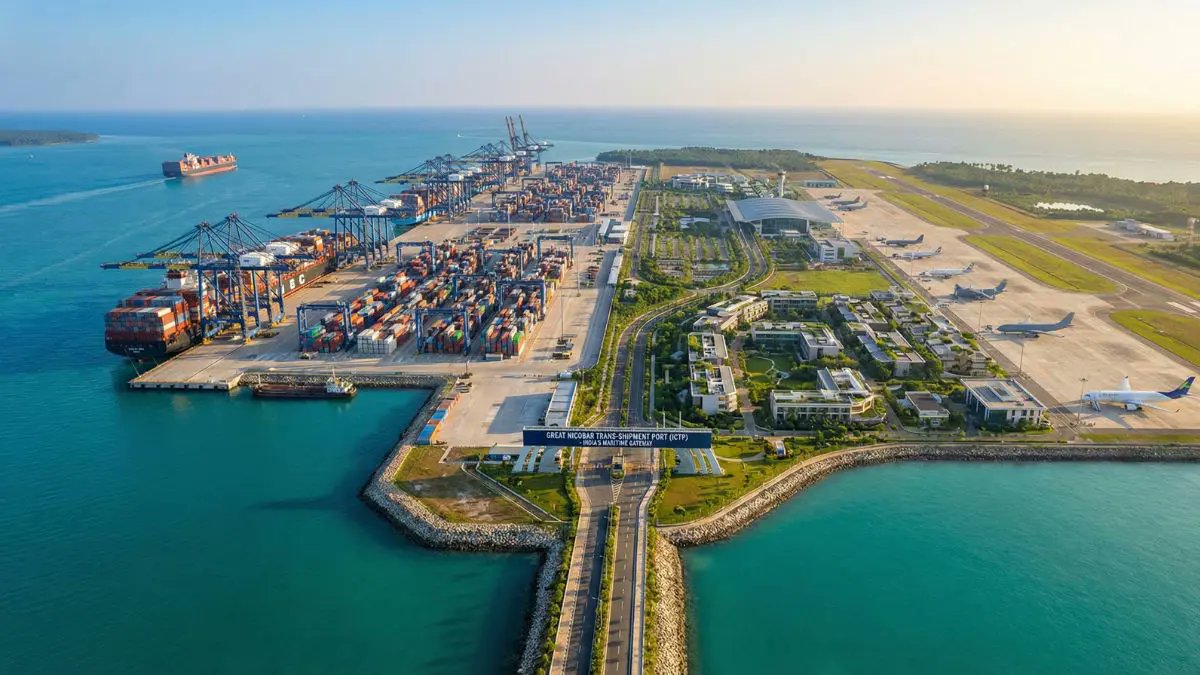
Conceived by the NITI Aayog in 2021, the Great Nicobar Island development project envisages an international container transshipment terminal, a dual-use civil and military airport, a power plant, and a township on India’s southernmost island.
Its stated purpose is to strengthen India’s presence in the Indian Ocean region and reduce dependence on foreign transshipment hubs such as Singapore and Colombo, through which a significant share of Indian cargo currently moves.
The island sits at a commanding geographical position: nearly equidistant from Colombo, Port Klang, and Singapore, and close to the Strait of Malacca, one of the world’s busiest and most strategically sensitive shipping corridors.
The government argues that the Galathea Bay port, with a natural draught of 18 to 20 metres, can meaningfully reduce India’s reliance on foreign transshipment and generate substantial annual savings.
The environmental cost, however, is substantial. The project requires the diversion of nearly 130 sq km of forest land and the felling of close to one million trees.
Wildlife at risk includes the leatherback sea turtle, the saltwater crocodile, and the Nicobar macaque. The government proposes to offset rainforest loss by planting trees in the scrublands of north India and to translocate crocodiles and thousands of coral colonies to other parts of the island, a proposition that ecologists have widely criticized as inadequate.
Seismic risk and the specter of 2004
The ecological alarm extends well beyond biodiversity. Great Nicobar sits directly atop a major seismic fault line, classified under seismic zone V – the highest earthquake risk category in India.
The 2004 Indian Ocean tsunami, whose epicentre lay approximately 80 miles away, caused the island’s southern tip to sink by around 15 feet, dramatically altering its coastline.
In July 2025, a geologist warned publicly that a cluster of ongoing smaller earthquakes near the Nicobar Islands could signal volcanic activity in the Andaman Sea, raising the spectre of another major seismic event.
Critics argue that building large-scale permanent infrastructure in such a zone, including a military airport and a township projected to house hundreds of thousands of people, represents an unacceptable gamble.
The Shompen and the question of consent
At the human level, the stakes are existential. The Shompen, a particularly vulnerable tribal group of fewer than 300 individuals who live in near-complete isolation within the project area, stand to be most severely affected. Their language has not been fully deciphered.
Anthropologists and rights groups have long cautioned that any large-scale development in their territory risks the group’s cultural and physical survival.
In 2025–26, the Nicobarese Tribal Council alleged that the administration falsely certified community consent for the project. Critics further argue that the high-powered committee model imposed by the government to govern tribal affairs effectively undermines the democratic gram sabha powers that tribal councils are entitled to under the Forest Rights Act.
The island’s current population of just over 8,000 is projected to increase more than 80-fold once the project is fully operational. That scale of demographic transformation, critics say, would place irreversible pressure on resources and almost certainly erase the cultural fabric of indigenous communities that have inhabited these islands for centuries.
Government's position and legal backing
The government maintains that the project has received environmental clearance subject to 42 strict compliance conditions covering biodiversity, pollution, marine ecology, and disaster management. Three independent monitoring committees have been established to oversee pollution control, biodiversity protection, and tribal welfare.
In February 2026, the National Green Tribunal declined to interfere with the clearance, citing what it described as adequate safeguards and the project’s strategic importance. Legal challenges, however, continue in the Calcutta High Court.
The BJP's nationalist framing
The ruling Bharatiya Janata Party has responded to Gandhi’s campaign in sharply nationalistic terms, alleging that he and the Congress have links to China and to foreign-funded networks, and asserting that the opposition to the project is motivated by the fact that it directly threatens China’s strategic interests.
Proponents of the project note that more than 80% of China’s oil imports pass through the Strait of Malacca, and that a developed Great Nicobar would position India at the mouth of this critical waterway. Gandhi’s critics argue he has conspicuously avoided engaging with this geopolitical dimension.
The charge of links to China or foreign interests, standard fare in BJP political communication against the Congress in recent years, remains unsubstantiated. Gandhi has not responded to it directly.
Congress' rebuttal
On May 3, 2025, the Congress general secretary in charge of communications, Jairam Ramesh, issued a detailed counter-statement setting out the party’s objections.
Ramesh cited ecological risks, the impact on biodiversity including leatherback turtle nesting habitats, concerns over tribal rights, and pointed to what he described as inconsistencies in official estimates of the number of trees to be felled – a question of transparency that the government has not fully addressed.
The Great Nicobar project now sits at the intersection of India’s most pressing strategic imperatives and its most difficult domestic obligations.
For a government that has made maritime power projection a central plank of its foreign policy, abandoning the project is barely a political option.
For the Shompen, for the leatherback turtle, and for the old-growth forest that makes Great Nicobar one of the last genuinely wild places under the Indian flag, the calculation looks very different.