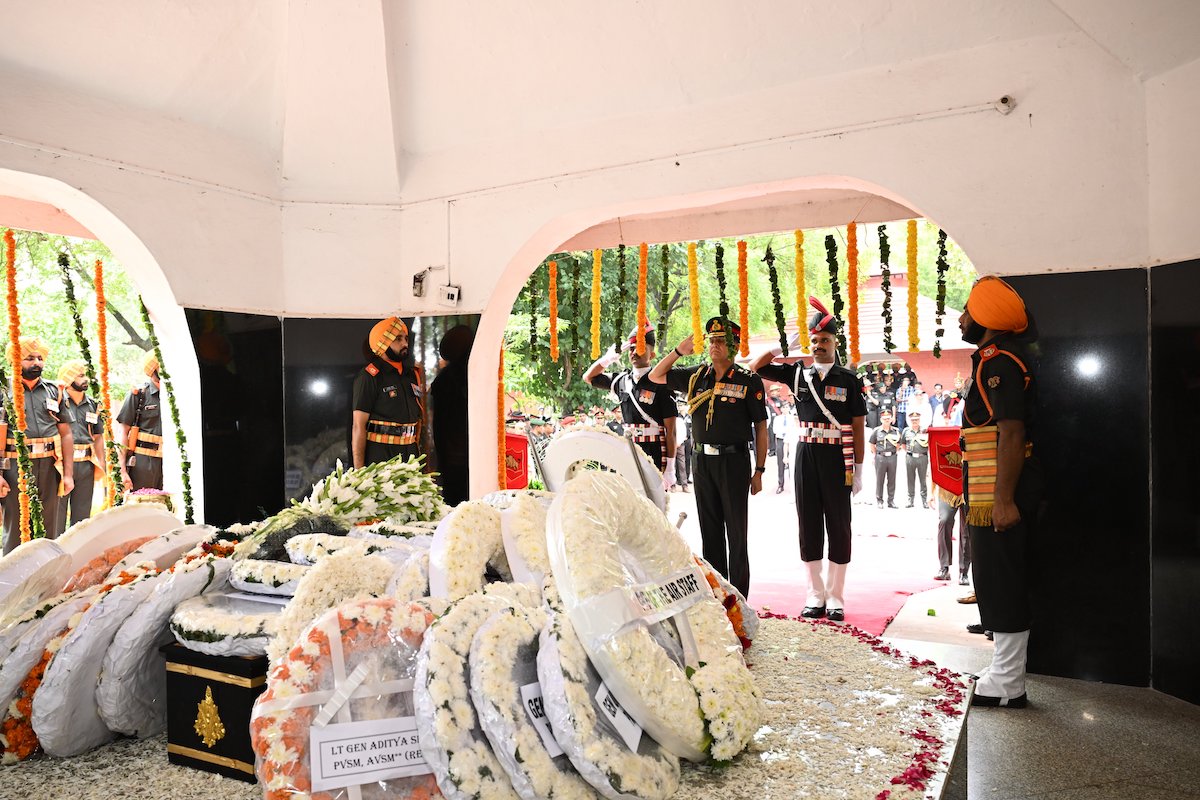
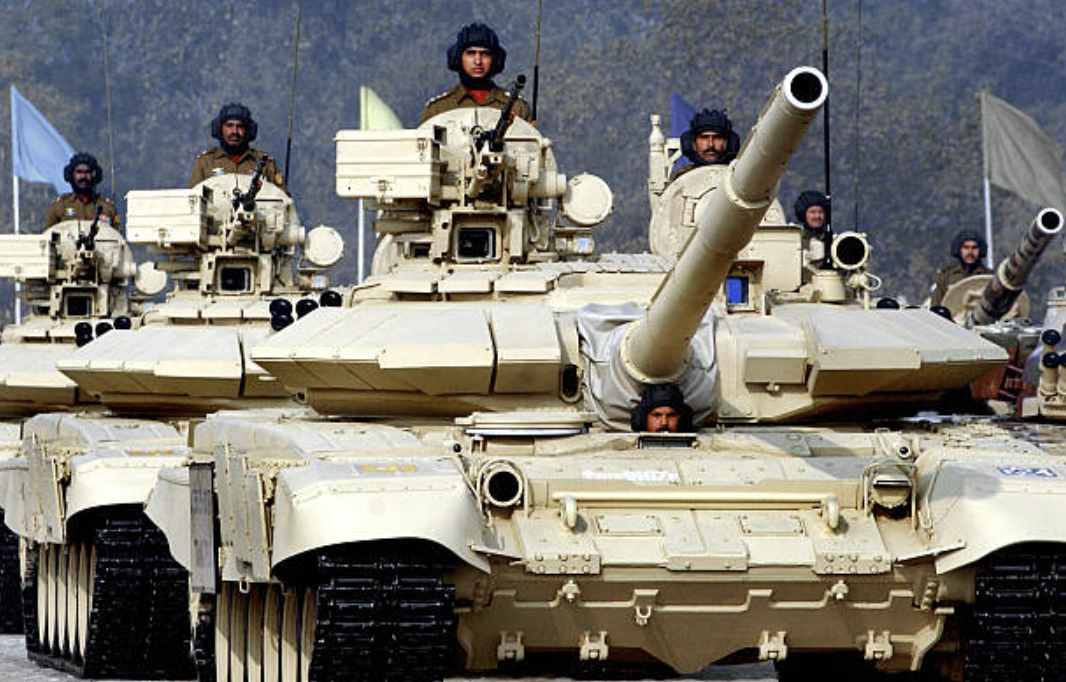
 Indian Army soldiers on tanks during a Army Day parade in New Delhi. (File photo)
Every year on May 1, the Indian Army observes Armour Day – a commemoration of its Armoured Corps that is equal parts history, pride, and resolve. The date marks the moment in 1938 when India’s traditional horse cavalry took its first decisive step towards mechanization, and the formal creation of an Armoured Corps headquarters three years later in 1941.
Over the decades, May 1 has come to symbolize the extraordinary journey from sabres and lances to steel and composite armour, and the rise of a corps that today fields dozens of armoured regiments at the heart of India’s land combat power.
Why May 1 Matters
On May 1, 1938, the Scinde Horse – one of the oldest cavalry regiments in the then British Indian Army – became the first Indian cavalry regiment to shed its horses and be equipped with armoured fighting vehicles. Official Army records note that the regiment transitioned to Vickers light tanks and Chevrolet armoured cars, marking the true commencement of mechanization of Indian cavalry regiments.
This shift was no mere change of equipment; it was a doctrinal revolution. Cavalrymen who had spent generations mastering horsemanship, lance and sabre now had to command engines, transmissions, gun systems and radio communications. In recognition of that watershed moment, the Armoured Corps of the Indian Army celebrates May 1 every year as Armour Day, honouring both the pioneering Scinde Horse and the broader transition from horse-mounted to armoured warfare.
Cavalry to Armour
The roots of the Indian Armoured Corps lie in the old cavalry regiments raised under colonial rule, some dating to the late eighteenth century. Units such as 1st Horse (Skinner’s Horse), 17th Horse (the Poona Horse), 14th Horse (the Scinde Horse) and 9th Horse (the Deccan Horse) evolved over decades from irregular cavalry and princely state forces into regular regiments of the British Indian Army.
Mechanization began in earnest in the 1930s, and on May 1, 1941, the Indian Armoured Corps was formally constituted within the British Indian Army, with its headquarters at Ferozepur, to administer the growing number of mechanized and tank units. Simultaneously, a dedicated training establishment for armoured warfare – the Fighting Vehicles School – was set up at Ahmednagar in Maharashtra. That institution would later grow into the Armoured Corps Centre and School (ACCS), the enduring cradle of Indian tank warfare, where generations of crews have been shaped into formidable soldiers.
During World War II, Indian armoured formations equipped with American-origin M4 Sherman tanks formed the spearhead of the British 14th Army in the Burma campaign. These units provided the shock action and mobility that helped drive Japanese forces from Burma, giving Indian armour its first taste of large-scale mobile warfare in jungle and riverine terrain.
Read also: Gunners’ Day – Let’s know about Indian Army’s Regiment of Artillery
Partition and the First Wars
The Partition of 1947 divided the British-era Indian Army between the new dominions of India and Pakistan. Contemporary accounts note that roughly two-thirds of the assets and personnel of the British-era Indian Armoured Corps – including all training establishments such as the one at Ahmednagar – came to India, while about one-third went to Pakistan.
Even so, India’s starting point was modest. Only about a dozen armoured regiments, besides the Governor-General’s Bodyguard (later renamed the President’s Bodyguard), formed the nucleus of the new Armoured Corps of the Indian Army. These regiments were quickly thrown into battle during the 1947–48 war over Jammu & Kashmir, operating in difficult mountain terrain that was far from ideal for armoured vehicles.
The defining early test of post-independence Indian armour came in Operation Bison during that war, when Major General KS Thimayya devised an audacious plan to use light tanks to recapture the vital Zoji-la (la means pass in Tibetan) from Pakistani forces and tribal irregulars. M5 Stuart light tanks of 7 Cavalry were dismantled, transported along narrow mountain tracks and reassembled near the pass. On November 1, 1948, they led a surprise assault at around 11,500 feet – then the highest altitude at which armour had ever been employed in combat anywhere in the world. Their appearance helped break the enemy’s hold on Zoji-la, Dras and Kargil, reopening the land route to Leh.
Expansion and Modernization
In the decades after independence, the Armoured Corps expanded steadily as India raised additional armoured regiments to meet the demands of a larger Army and a contested neighbourhood. Pre-existing cavalry and armoured regiments were gradually renumbered, and from the 1950s onward new units were raised: the 20 Lancers (re-raised in 1956), the 41st through 44th Armoured Regiments in the early 1980s, and a succession of regiments up to the 60th Armoured Regiment in 2019.
Today, open sources indicate that the Indian Army fields approximately 67 armoured regiments, including the President’s Bodyguard, making the Armoured Corps one of the largest and most diversified armoured forces in the world. These regiments are deployed across the plains of Punjab and Rajasthan, the semi-desert sectors of Rajasthan, central India and selected high-altitude areas, configured for both offensive thrusts and mobile defence.
The equipment of the Armoured Corps has evolved through several generations of tanks. Immediately after independence, units largely operated World War II designs such as the Sherman, before acquiring Centurion and AMX-13 tanks that became mainstays during the 1965 and 1971 wars. From the early 1980s, the Soviet-origin T-72M1 “Ajeya” became the backbone of Indian armour and remains in large-scale service.
From the early 2000s, the Russian-origin T-90S “Bhishma” was inducted as the Army’s principal main battle tank; current estimates suggest around 1,300 T-90S tanks in service, supplemented by upgraded variants. Alongside them, India’s indigenous Arjun main battle tank, developed by the Defence Research and Development Organisation (DRDO), has entered limited service, with approximately 124 Arjun-Mk1 tanks deployed and the more advanced Arjun-Mk1A variant under progressive induction.
Modernization has not been limited to acquiring foreign platforms or licence-producing them. The Army’s Corps of Electronics and Mechanical Engineers has, for example, developed “Atharva,” an innovative hybrid that marries the hull of a T-72 with the more advanced turret of a T-90, combining superior firepower and protection with a proven chassis. In parallel, India is developing a new generation of indigenous Zorawar light tanks specifically for high-altitude deployment in Ladakh and similar terrain, while existing T-72 fleets are being upgraded with improved armour, engines and fire-control systems.
Read also: Infantry Day – Let’s know more about the Indian Army’s ‘Queen of Battle’
Role in Indian Doctrine
Within the Indian Army’s warfighting doctrine, armoured regiments provide the decisive shock action in the plains and desert sectors, delivering rapid, hard-hitting blows against enemy forces over extended distances. Their mobility, protection and firepower make them central to both offensive operations – deep thrusts into enemy territory – and counter-offensive tasks aimed at restoring the situation when an adversary has seized the initiative.
Paired with mechanized infantry, artillery and close air support, armoured regiments are designed to fight as part of combined arms battle groups rather than as independent tank columns, a principle drawn from lessons of World War II and India’s own experience of conflict. Over time, the corps has also adapted to high-altitude and semi-mountainous warfare, as demonstrated from Zojila in 1948 to more recent deployments of T-72s and T-90s on the Ladakh plateau.
Notable Armoured Battles Since 1947
Beyond the broad sweep of history, certain battles stand out for the centrality or significance of armour. The following engagements illustrate how Indian armoured units have repeatedly adapted their tactics, exploited terrain and demonstrated courage against numerically or technologically formidable opponents.
Zoji-la/Operation Bison, 1948 (Jammu & Kashmir War):
In late 1948, Pakistani forces and tribal irregulars held the Zojila Pass, threatening India’s hold over Ladakh. In an audacious plan conceived by Major General KS Thimayya, M5 Stuart light tanks of 7 Cavalry were dismantled, hauled along narrow mountain tracks and reassembled near the pass. On November 1, 1948, they spearheaded the assault at around 11,500 feet – then a world record for armour in combat – helping recapture Zoji-la and restore the land route to Leh. The operation remains a masterclass in improvisation and the intelligent application of armour in terrain where none was thought possible.
Battle of Asal Uttar, September 8–10, 1965 (India-Pakistan War):
In the Khem Karan sector of Punjab, Pakistan launched its powerful 1 Armoured Division, equipped with modern American M47 and M48 Patton tanks, aiming to break through toward Amritsar in what Pakistani commanders hoped would be a decisive armoured thrust. Indian forces, including Centurion and Sherman tanks and anti-tank teams, flooded the fields around the village of Asal Uttar and arranged their armour in a U-shaped defensive layout, luring Pakistani tanks into waterlogged, muddy ground. The result was a rout: estimates suggest over 90 Pakistani tanks were lost in the sector, and the battlefield was soon dubbed “Patton Nagar” – “town of Pattons” – by Indian soldiers. It was one of the largest tank battles in Asia since World War II.
Battle of Basantar (Shakargarh), December 4–16, 1971 (India-Pakistan War):
In the Shakargarh bulge on the western front, Pakistan’s II Corps, backed by strong armoured formations, sought to slice through Indian lines toward Pathankot. The Indian 54 Infantry Division, with 16 Independent Armoured Brigade under command and equipped mainly with Centurion and AMX-13 tanks, crossed the heavily mined Basantar River, established a bridgehead and then repelled repeated Pakistani armoured counterattacks, destroying or capturing between 46 and 60 enemy tanks for significantly lighter Indian losses. The battle immortalized heroes such as Second Lieutenant Arun Khetarpal, who was posthumously awarded the Param Vir Chakra – India’s highest military honour – for his courage at the Basantar bridgehead. He was 21 years old.
Battle of Longewala, December 4–5, 1971 (India-Pakistan War):
Although Longewala was primarily an infantry action, it merits mention for the remarkable manner in which Pakistani armour was defeated. At the border post in Rajasthan, approximately 120 soldiers of 23 Punjab faced an assault by an estimated 2,000 Pakistani troops supported by 40 to 50 tanks of Pakistan Army’s 22 Cavalry. Using terrain, minefields and, crucially, close air support from the Indian Air Force in the early morning hours of December 5, 1971, the defenders stalled the advance. Many Pakistani tanks bogged down in sand dunes and were destroyed from the air; around 36 tanks and over 100 vehicles were knocked out or abandoned, forcing a full retreat. The battle prevented a deeper armoured thrust towards Jaisalmer and entered Indian popular memory through both history books and cinema.
Armour Day Today
In contemporary times, Armour Day on May 1 is observed across the Armoured Corps with parades, equipment displays, veteran interactions and regimental functions. The Indian Army’s official messaging consistently describes the day as a commemoration of “the commencement of mechanization of the Indian cavalry regiments” and recalls that on May 1, 1938, the Scinde Horse became the first regiment to dismount from horses and take to tanks.
Recent Armour Day celebrations have showcased how the corps uses the occasion to highlight its evolution from horse cavalry with lances to a modern force operating T-90s, T-72s, Arjuns, infantry combat vehicles and a growing range of indigenous platforms. The day serves both as a tribute to the heritage of mounted soldiers who served with distinction across continents and as a reaffirmation of the corps’ commitment to remaining at the cutting edge of technology, tactics and national service.
A Legacy of Steel
From the last mounted parade of the Scinde Horse at Rawalpindi in April 1938 to the thunder of Arjun and T-90 tanks on modern firing ranges, the story of the Indian Army’s Armoured Corps is one of continuous adaptation, individual courage and institutional innovation.
Every year on May 1, when crews polish their tanks, don their black berets and observe Armour Day, they stand in an unbroken line with cavalrymen who once charged on horseback, and with tank crews who clawed their way up to Zoji-la, fought Pattons at Asal Uttar, held the bridgehead at Basantar and the Indian infantrymen faced down the Pakistani armoured columns at Longewala. In that lineage, steel and composite armour are only the latest expression of an enduring spirit – a spirit that promises that, whatever the terrain and whatever the odds, India’s armoured regiments will continue to be the sharp, unstoppable spearhead of the Army.
Follow us on social media for quick updates, new photos, videos, and more.
X: https://x.com/indiasentinels
Facebook: https://facebook.com/indiasentinels
Instagram: https://instagram.com/indiasentinels
YouTube: https://youtube.com/indiasentinels
© India Sentinels 2026-27