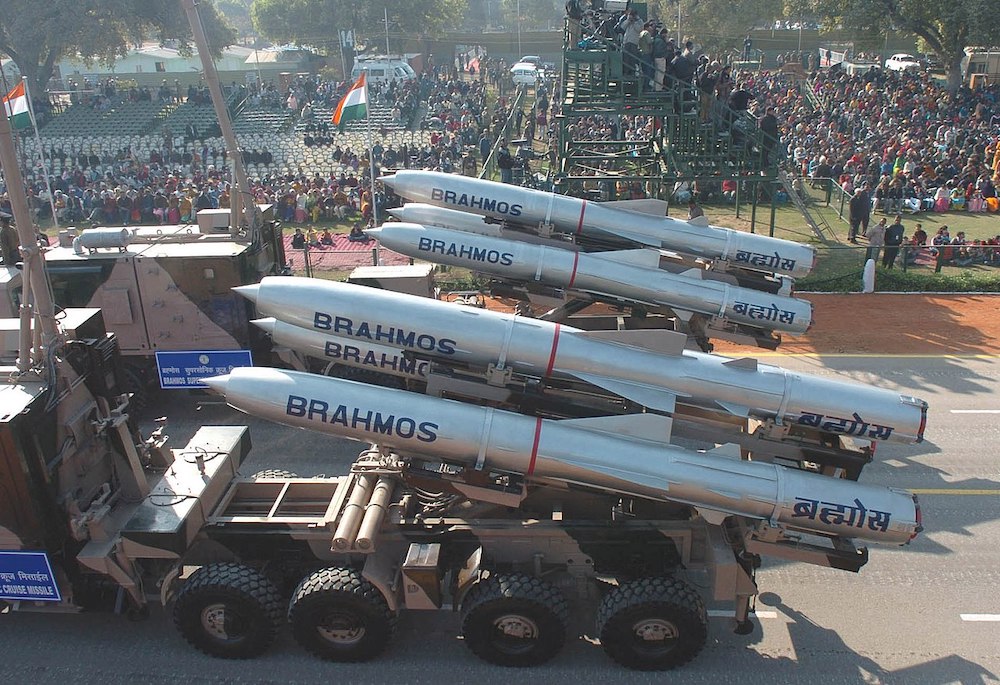
 India has steadily expanded its missile arsenal in recent years.
New Delhi: The Indian Army chief has called for the creation of a dedicated rocket force, describing it as essential to match capabilities developed by Pakistan and China amid evolving battlefield dynamics in the region. General Upendra Dwivedi told reporters on Tuesday that the distinction between rockets and missiles has blurred in modern warfare, with both weapons systems now capable of delivering decisive strategic impact.
His remarks came during the Army chief’s annual news conference ahead of Army Day celebrations scheduled for January 15.
“We are looking towards a rocket-missile force because, as you know, Pakistan has established a rocket force, and China has also created such a force. It is the need of the hour that we also establish such a force,” Gen Dwivedi said.
The proposed force would likely operate as a triservice command, integrating long-range rockets and missiles under unified control – a structure that reflects contemporary military thinking on precision strike capabilities.
Systems under consideration
The rocket-missile force would deploy weapons including the Pinaka multi-barrel rocket launcher system, the Pralay tactical ballistic missile, and the BrahMos supersonic cruise missile, jointly developed with Russia.
Gen Dwivedi highlighted recent advances in India’s strike capabilities, particularly the Pinaka system, which was successfully tested at its maximum range of 120 kilometres last month by the Defence Research and Development Organisation (DRDO).
“We have also signed several other contracts that will explore ranges up to 150km, and later we will see it reaching a range of 300–450km,” the Army chief said.
India has steadily expanded its missile arsenal in recent years, driven partly by border tensions with China following deadly clashes in Ladakh in June 2020, and the enduring rivalry with Pakistan.
Strategic rationale
The call echoes recommendations from Dwivedi’s predecessor. In October 2024, the former Army chief, General Manoj Pande, argued for developing rocket forces capable of engaging targets beyond 450 kilometres – a range currently beyond India’s conventional artillery and missile inventory.
“In recent conflicts and the ones that are ongoing, we have seen the utilisation of long-range missiles, long-range artillery to very good effect,” Gen Pande had said in an interview. “They not only give you longer ranges, they are [also] more accurate. I would also suggest that it is more economical.”
Gen Pande had noted that while India can engage targets up to approximately 400–450km, “beyond that range, while there are targets which are existing which you would want to target as part of your conventional operations and with conventional weapon systems, we do not have any means to do it.”
Regional context
Pakistan announced plans to establish its army rocket force in August last year, though details about its operational capabilities remain limited.
China’s People’s Liberation Army – Rocket Force (PLA-RF), by contrast, is a well-established independent service branch that oversees an extensive arsenal of land-based ballistic, cruise and hypersonic missiles – both nuclear and conventional. The force handles deterrence, precision strikes and strategic support missions, and has undergone significant modernisation over the past two decades.
Military analysts suggest India’s proposed rocket force would primarily focus on conventional precision-strike capabilities rather than nuclear delivery systems, which remain under the separate Strategic Forces Command under the Prime Minister’s Office.
The timing of Dwivedi’s announcement, just ahead of Army Day, underscores the priority the military leadership places on developing credible long-range strike options as part of India’s broader military modernization efforts.