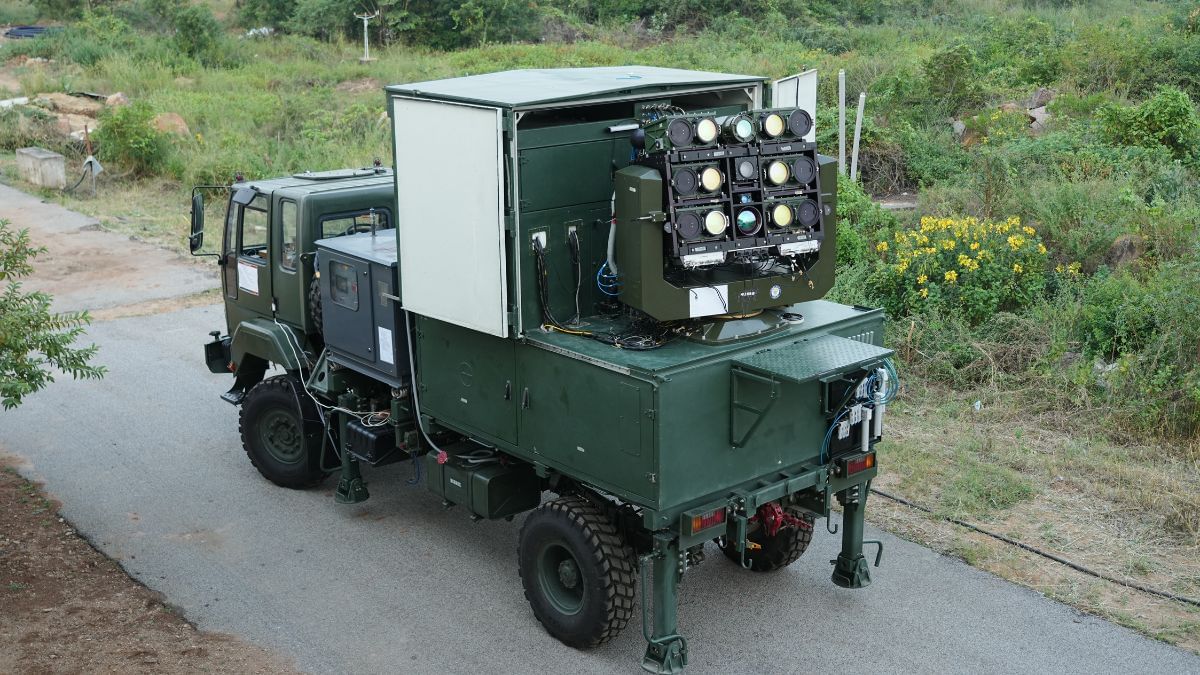
 DRDO-developed 30kW laser weapon (File photo)
New Delhi: The Defence Research and Development Organisation (DRDO) expects the first-of-production model (FOPM) of its 30 kW-class directed-energy weapon (DEW) to be ready within a year. It will invite an expression of interest (EoI) within six months to choose a production partner, a senior official from the DRDO has said to two media outlets.
BK Das, director general (electronics and communication systems) at DRDO, told The Hindu BusinessLine and Outlook that the technology had already been demonstrated. The weapon is mounted on a truck and uses electromagnetic energy to destroy targets by soft kill or hard kill. A soft kill disables a target’s sensors or electronics, while a hard kill destroys it physically.
Where the weapon stands
The system is being developed under the Integrated Drone Detection and Interdiction System (IDD&IS) Mk-IIA programme and is designed to counter drone swarms, fixed-wing unmanned aerial vehicles (UAVs) and surveillance sensors. It can engage such targets at ranges of up to 5 km.
DRDO’s Centre for High Energy Systems and Sciences (CHESS) conducted the trial at the National Open Air Range in Kurnool, Andhra Pradesh. On April 13, 2025, the system engaged fixed-wing drones at long range, countered a multiple-drone attack and destroyed surveillance sensors and antennae. Final trials ended in August 2025.
Das said: “Technology is proved,” adding “but the system needs a little more time before the next stage is locked in.”
Link to Sudarshan Chakra
The laser is described as a strong arm of the Sudarshan Chakra air defence system announced by the prime minister, Narendra Modi.
Modi announced the initiative from the Red Fort on August 15, 2025, at the 79th Independence Day celebrations, with a target of having an indigenous system operational by 2035. It is meant to cover strategic and civilian sites such as hospitals, railways and places of worship. Modi has said it should also be able to strike back at attackers.
A high-level committee was later asked to prepare a roadmap with five-year and 10-year phases.
BK Das called the mission a great vision and said the country needs it. He added that most of the required ingredients already exist in India’s ecosystem and now have to be integrated into an effective layered defence. Private industry, micro, small and medium enterprises and start-ups are deeply involved in the effort.
Lessons from Operation Sindoor
The armed forces felt the need for such a system during Operation Sindoor, the military action against Pakistan in May 2025, when both sides used drones heavily. Outlook reported that Pakistan used cheap probing drones to locate Indian air defence positions and drain expensive interceptors. That is the cost imbalance a laser is meant to correct.
A directed-energy weapon does not depend on physical missiles, which makes it more economical against large numbers of low-cost drones.
India deployed DRDO’s 2kW DEW along the Line of Control (LoC) during the operation, as part of the inner tier of its multilayered air defence, over a range of up to 1 km.
According to the BusinessLine report, the 30 kW system is the third in DRDO’s series of indigenous DEWs. It places India among a small group of countries, including the United States, China, Russia, Israel, the United Kingdom and Germany, with such capabilities.
Industry role and next steps
DRDO has earlier worked with Bharat Electronics Limited (BEL), which was licensed to produce the 2 kW and 10 kW counter-drone variants. In November 2025, CHESS reportedly issued an EoI inviting Indian companies to acquire the technology for the 30 kW system, with only three production licences to be granted. It is not clear from the reports how the new EoI relates to that earlier tender.
The next six months, when the production partner is chosen, will show how quickly the 30 kW system moves from trials to the field.