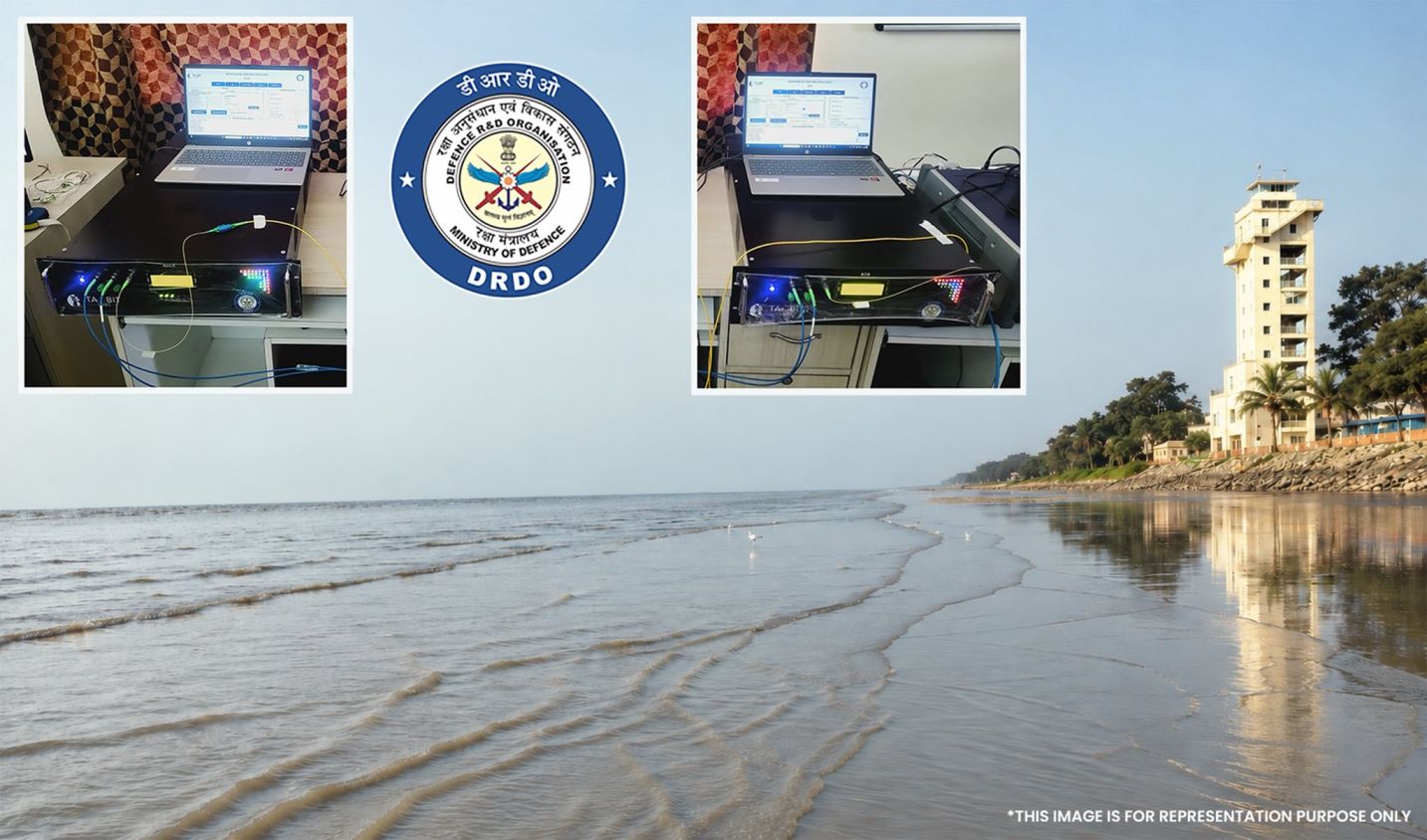
New Delhi: The Defence Research and Development Organisation (DRDO) has successfully tested a quantum key distribution (QKD) platform on the live network at its Proof & Experimental Establishment (PXE) in Chandipur, Odisha. Announced on Wednesday, the trial demonstrated an application of quantum technology intended to protect sensitive information exchanged during artillery and armoured weapon evaluations.
According to the announcement, the system was configured to strengthen the security of real-time observations and telemetry generated during weapons testing. It was developed under DRDO’s microelectronic devices, computational systems and cyber security cluster, with Bengaluru-based Taqbit Labs as its production partner.
The significance of the Chandipur demonstration lies in testing the platform within a working range network, where sensitive information supports the assessment of military equipment. Such networks carry telemetry, sensor readings, performance measurements and technical observations between different centres, making their protection an important part of weapons development.
QKD addresses a crucial component of secure communication: generating and sharing the secret cryptographic keys used to protect information. It uses quantum signals and specialized equipment to establish those keys, which can then be supplied to an encryption system protecting the actual data traffic.
Its distinctive feature is the ability to detect possible interception of the quantum exchange, because attempts to measure the signals can disturb their quantum properties. This provides a way to identify potentially compromised key material, although QKD alone does not authenticate the communicating parties or secure every component of a network.
DRDO described the platform as providing unconditional security with eavesdropping detection, but that claim needs to be understood within the conditions of the technology’s security model. The US National Security Agency’s technical guidance on QKD emphasizes that practical protection depends on hardware, engineering and authentication, rather than being guaranteed solely by the underlying physics.
The Chandipur announcement did not specify the link distance, secure key generation rate, duration of operation or detailed results of security testing. Those omissions limit an assessment of the platform’s performance and readiness for wider deployment, even as the live-network trial establishes a concrete military application.
The latest test follows several years of Indian work on quantum communication, including a DRDO-IIT Delhi demonstration announced on February 23, 2022. That experiment established a QKD link over more than 100 kilometres between Prayagraj and Vindhyachal in Uttar Pradesh, using commercial-grade optical fibre already installed in the field.
A separate free-space experiment at IIT Delhi, announced on June 16, 2025, demonstrated entanglement-based quantum communication over more than one kilometre without an optical fibre connection between the endpoints. The experiment achieved a secure key rate of approximately 240 bits per second and a quantum bit error rate below 7%, providing a basis for further research into wireless quantum links and larger networks.
DRDO subsequently announced the completion of military field trials of a scalable fibre-based QKD system on July 14, 2026. Together, these milestones show a progression from experimental links towards practical systems and their integration into defence communication infrastructure.
QKD also differs from post-quantum cryptography, which uses mathematical algorithms designed to resist attacks by future quantum computers and can operate on conventional computing platforms. The distinction matters because improving communication security may involve different technologies suited to different networks, rather than a single replacement for existing encryption.
India’s broader ambitions are set out in the National Quantum Mission, approved on April 19, 2023, with an allocation of ₹6,003.65 crore for 2023–24 to 2030–31. Its communication objectives include satellite-based quantum links between ground stations over 2,000 kilometres within India, inter-city QKD over similar distances and networks connecting multiple nodes.
Against that background, the Chandipur trial represents a specific step towards applying quantum security to sensitive defence data. The next measure of progress will be whether such systems can sustain reliable operation, meet independently validated security requirements and be integrated across larger communication networks.