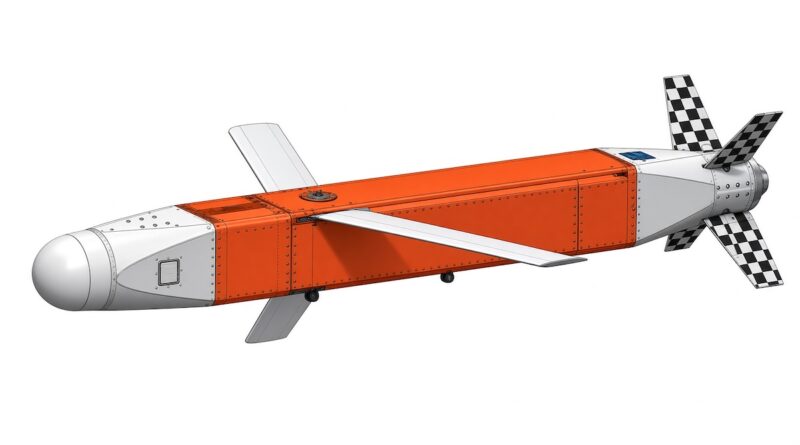
New Delhi: The Ministry of Defence on Wednesday signed a contract worth ₹810.79 crore with Bharat Dynamics Limited (BDL) for 160 Satellite Smart Anti Airfield Weapons (SAT-SAAW) and associated equipment for the Indian Air Force (IAF).
The order falls under the Buy (Indian – Indigenously Designed, Developed and Manufactured) category, the ministry's most indigenous acquisition route. The 160 weapons are due for delivery in 2027-28 and 2028-29.
What the weapon does
SAT-SAAW is an air-to-ground, precision-guided glide bomb that can be launched from the Jaguar, Hawk and Su-30MKI, and can neutralize enemy airfields from a long stand-off range. It is meant for targets such as runways, bunkers, taxiways and hardened aircraft shelters. Because it is released at a distance, the launching aircraft need not approach the target directly, which reduces its exposure to enemy air defences.
The satellite element
The "satellite" in the name refers to the guidance system. The weapon steers towards its target using satellite navigation, and the Air Force tested this configuration on October 28, 2021, when a Su-30MKI fired a satellite-guided SAAW at the Pokhran range in a dual rack pylon configuration. Open-source accounts say it pairs an inertial navigation system with GPS or India's NavIC constellation for mid-course guidance. The ministry has not confirmed those details. A separate variant uses an electro-optical seeker. Tests of both the satellite-navigation and electro-optical versions have been completed successfully. The imaging infrared seeker was tested from a Jaguar on November 3, 2021, and was meant to sharpen terminal accuracy.
Indigenous content
The Defence Research and Development Organisation (DRDO) designed and developed the system, which will have 60 per cent indigenous content. The ministry said sub-systems such as the inertial measurement unit, the long impact delay fuse and the twin store carrier are also being indigenized.
Background
The government sanctioned the SAAW project in September 2013 as India's first fully indigenous anti-airfield weapon. DRDO's Research Centre Imarat in Hyderabad developed it, and the first test was carried out in 2016. The government approved it for procurement for the Navy and the Air Force in September 2020. On January 21, 2021, a Hawk-i of Hindustan Aeronautics Limited released the weapon off the Odisha coast in the ninth successful SAAW mission. The weapon is in the 125 kg class and has a range of up to 100 km.
BDL, a defence public sector undertaking based in Hyderabad, has handled other DRDO-designed missile programmes. In May 2022, it won a contract worth ₹2,971 crore for Astra Mk1 beyond-visual-range air-to-air missiles for the Air Force and Navy. The latest order marks the SAAW's shift from trials to serial production and induction.