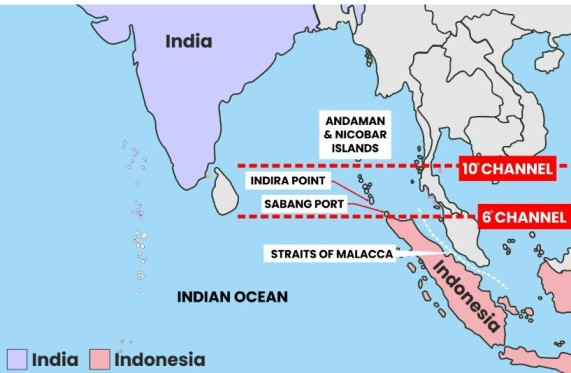
New Delhi/Jakarta: India and Indonesia on Tuesday agreed to jointly develop the strategically located Sabang port on Weh Island off the northern tip of Sumatra, giving New Delhi a presence on both sides of the Strait of Malacca, one of the world’s busiest maritime chokepoints and a vital artery for China’s energy imports.
The agreement, announced during Prime Minister Narendra Modi’s state visit to Jakarta, is among the most strategically significant outcomes of the visit.
Besides Sabang, the two countries signed agreements covering Indonesian procurement of India’s Astra beyond-visual-range air-to-air missiles, development of Indonesia-specific electronic voting machines, and cooperation in critical minerals including nickel and rare-earth magnets.
The significance of Sabang lies less in the size of the port than in where it sits. Located less than 100 nautical miles from India’s upcoming Great Nicobar transshipment hub, Sabang overlooks the northern entrance to the Strait of Malacca, through which an estimated one-quarter to 40 per cent of global seaborne trade and as much as 80 per cent of China’s crude oil imports transit each year.
Read also: India, Indonesia strengthen Indo-Pacific partnership
Together, Great Nicobar on Indian territory and Sabang on Indonesian soil give New Delhi an unprecedented strategic presence on both flanks of the strait, even as China's navy expands its operations deeper into the Indian Ocean.
India’s answer to China’s ‘Malacca dilemma’
Chinese strategists have for two decades referred to Beijing’s dependence on the strait as the “Malacca dilemma”, a phrase popularized during Hu Jintao’s presidency.
India’s Great Nicobar project, centred on the Galathea Bay International Container Transshipment Terminal along with a dual-use airport, a power plant and a new township, is being built at an estimated cost of $9 billion, with some assessments putting the figure closer to $9.7 billion. Its first phase is due by 2028.
The project was cleared by India’s National Green Tribunal in February 2026 and is designed to give New Delhi a permanent commercial and military foothold at the strait's western gateway.
Read also: Indonesia to buy Astra air-to-air missiles, BrahMos
Sabang, on Indonesian rather than Indian soil, extends that footprint to the strait’s Sumatran shore, giving India presence without the cost or political weight of full sovereignty.
Strategic value beyond commerce
Indian strategic writing has been candid that Sabang carries value well beyond commerce. A developed port there could host surveillance assets, serve as a forward logistics point for the Indian Navy, and complement the naval and air infrastructure being built at Great Nicobar, including the base at Campbell Bay and the wider Naval Communication Network stations in the Andaman and Nicobar Islands.
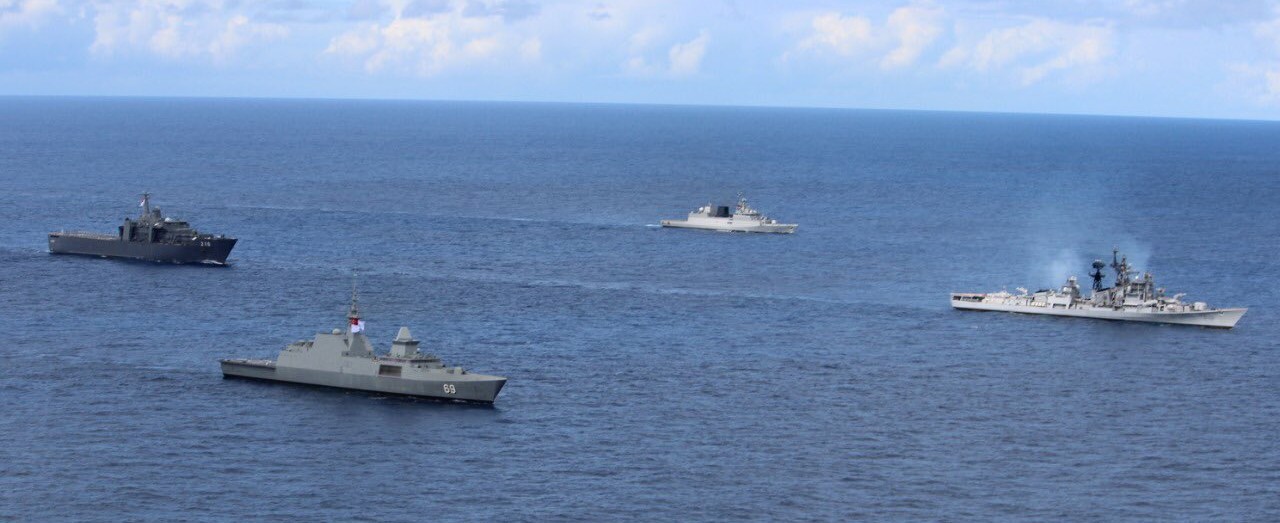
India and Indonesia have run coordinated naval patrols in the region since 2002, and annual exercises in the Andaman Sea have steadily built interoperability between the two navies.
For China, whose navy has been increasing submarine and surface deployments into the Indian Ocean, a facility linked to India overlooking the strait’s northern mouth narrows its room for manoeuvre.
Beijing’s discomfort, and its limits
Chinese analysts have in the past voiced concern over India’s Sabang ambitions, reading Great Nicobar and Sabang together as a strategic squeeze near Malacca. Indonesia maintains a substantial relationship with China, reinforced through ASEAN and through Chinese-backed infrastructure such as the Jakarta-Bandung high-speed railway, and Jakarta has been careful not to frame Sabang as directed against Beijing.
Read also: Explained: Modi’s Indo-Pacific diplomatic push
Sabang’s own history helps explain Indonesia’s motivation. Declared a free port under Dutch administration in 1896 and again by Indonesian governments in 1963 and 2000, the port has repeatedly failed to attract the shipping volumes or investment its location would suggest.
South Korea and Japan have both shown past interest in developing it, and India’s own interest dates back to at least 2014-15. Jakarta’s economic incentive to court Indian capital, whatever the optics vis-à-vis Beijing, is real and long-standing.
Commerce alongside strategy
Beyond the military angle, Sabang is meant to anchor short-sea shipping across the Bay of Bengal, linking Indian ports such as Chennai, Kolkata, Paradip and Haldia with Southeast Asian markets.
Bilateral trade between India and Indonesia, currently running at close to $30 billion a year and already ahead of India’s trade with the United Kingdom, is targeted by both governments to reach $100 billion by 2030, even as India’s trade deficit with Indonesia, put at roughly $20 billion, remains a point of friction.
Indian port operators have shown sustained interest in the project, which sits within New Delhi’s wider Act East policy and its Sagarmala port-led development programme.
Follow us on social media for quick updates, new photos, videos, and more.
X: https://x.com/indiasentinels
Facebook: https://facebook.com/indiasentinels
Instagram: https://instagram.com/indiasentinels
YouTube: https://youtube.com/indiasentinels
© India Sentinels 2026-27