New Delhi: India and Japan on Thursday expanded their Special Strategic and Global Partnership in a major way after signing a series of agreements spanning artificial intelligence, defence, economic security, energy resilience and critical technologies. This came after wide-ranging summit talks between the prime minister, Narendra Modi, and his Japanese counterpart, Sanae Takaichi, on the second day of the Japanese leader’s three-day state visit to India.
The 16th India-Japan Annual Summit at Hyderabad House marked Takaichi’s first bilateral summit with Modi since assuming office and underscored the growing convergence between New Delhi and Tokyo on strategic, technological and economic priorities in an increasingly uncertain Indo-Pacific.
The two leaders reviewed the entire spectrum of bilateral relations, covering trade and investment, defence and security, maritime cooperation, supply-chain resilience, semiconductors, critical minerals, emerging technologies, energy security, connectivity and people-to-people exchanges. They also exchanged views on regional and global developments, reaffirming their commitment to a free, open, inclusive and rules-based Indo-Pacific.
A major outcome of the summit was the adoption of three landmark bilateral documents focusing on economic security, energy resilience and cooperation in artificial intelligence, reflecting the increasing emphasis both governments are placing on reducing strategic vulnerabilities while deepening high-technology collaboration.
先ほど、モディ首相と日印首脳会談を行いました。
— 高市早苗 (@takaichi_sanae) July 2, 2026
会談では、インド太平洋地域を中心に、地域情勢について意見交換しました。… pic.twitter.com/CHXTpzBGDc
The two countries also signed their first-ever agreement for the co-development of defence equipment, marking a significant step forward in bilateral defence industrial cooperation. While details of the project were not immediately disclosed, the agreement is expected to strengthen defence manufacturing collaboration under India’s push for indigenous capability development and Japan’s expanding defence partnerships.
Addressing the media after the summit, Modi said India and Japan would combine Japan’s strengths in precision engineering with India’s capabilities in software and digital innovation to contribute to global advances in artificial intelligence. He also underlined the importance of closer cooperation in economic security, resilient supply chains and advanced manufacturing.
Takaichi described India as an indispensable strategic partner and said the changing international environment made closer bilateral cooperation more important than ever. She stressed that Japan and India could leverage their complementary strengths to achieve shared prosperity while contributing to regional stability.
Economic cooperation featured prominently during the summit. The two sides agreed to deepen collaboration in semiconductors, critical minerals, clean energy, advanced manufacturing and next-generation mobility while accelerating Japanese investments in India. Reports indicated that the summit also unveiled a fresh investment roadmap aimed at sustaining Japan’s long-term economic engagement with India, one of Tokyo’s fastest-growing strategic partners.
Japan remains among India’s largest foreign investors, supporting major infrastructure projects, including the Mumbai-Ahmedabad high-speed rail corridor. Bilateral trade reached approximately $27.5 billion during the 2025-26 financial year, while Japanese investment into India stood at about $3.2 billion between April and December 2025, according to official figures.
The summit also reflected the broader strategic alignment between the two Quad partners as both countries seek to strengthen cooperation on maritime security, resilient supply chains, emerging technologies and regional stability against a backdrop of increasing geopolitical competition in the Indo-Pacific.
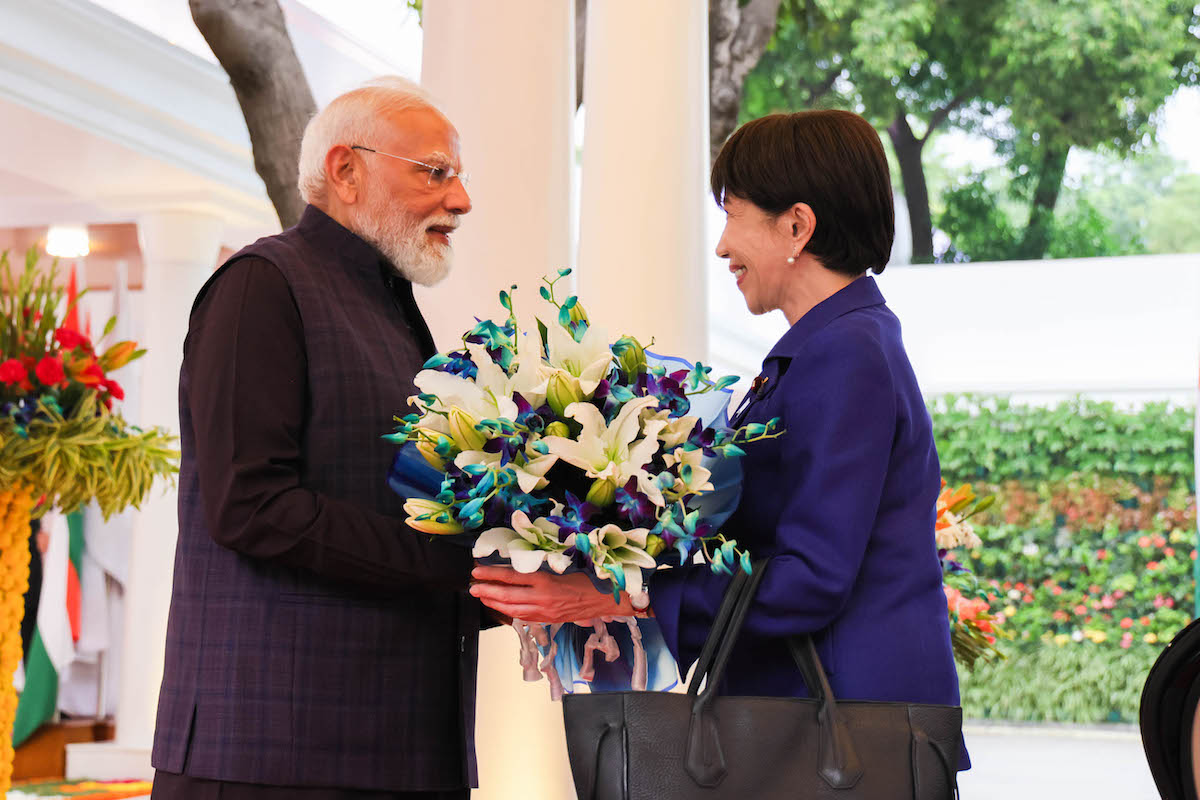
Earlier in the day, Takaichi was accorded a ceremonial welcome at Rashtrapati Bhavan before holding delegation-level talks with Modi. She also interacted with senior Indian officials and participated in engagements involving leading business representatives from both countries.
先ほど、モディ首相主催の夕食会にお招きいただきました。
— 高市早苗 (@takaichi_sanae) July 2, 2026
会談の場とはまた異なる和やかな雰囲気の中で、モディ首相と日印関係や国際情勢にとどまらず、両国の文化や食、そして互いの国への思いについても率直に語り合い、個人的な信頼関係を一層深めることができました。… pic.twitter.com/rOA3Hc7bn7
Arrival in New Delhi
Takaichi arrived in New Delhi on Wednesday evening, beginning her first official visit to India at the invitation of Modi. She was received at the airport by the minister of state, Jitendra Singh, and welcomed by senior officials from both governments.
Soon after arriving, the Japanese leader said economic security and energy security would be among the principal themes of her discussions with the prime minister. Modi welcomed her through a message on social media, describing the visit as an important opportunity to further strengthen the India-Japan Special Strategic and Global Partnership and advance peace, stability and prosperity across the Indo-Pacific
Takaichi is accompanied by a large business delegation, underlining the strong commercial dimension of the visit alongside its strategic and security objectives.
Final day of visit
On the third and final day of her visit on July 3, Takaichi is expected to conclude official engagements in New Delhi, including interactions with business leaders before departing for Tokyo. Officials from both countries are expected to begin follow-up work on implementing the agreements announced during the summit, particularly those relating to artificial intelligence, economic security, energy resilience and defence industrial cooperation.
The focus will also shift towards translating the political commitments into concrete projects and expanding collaboration in advanced technologies, resilient supply chains and strategic manufacturing over the coming months.
Follow us on social media for quick updates, new photos, videos, and more.
X: https://x.com/indiasentinels
Facebook: https://facebook.com/indiasentinels
Instagram: https://instagram.com/indiasentinels
YouTube: https://youtube.com/indiasentinels
© India Sentinels 2026-27