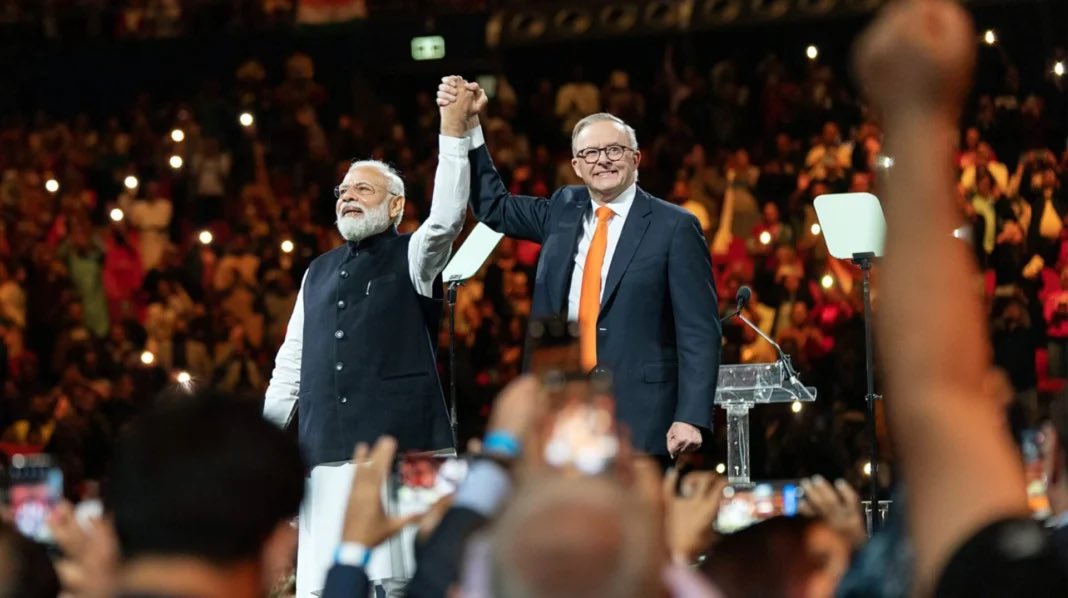
 Prime Minister Modi with Australian counterpart Anthony Albanese. (File photo)
New Delhi: The prime minister, Narendra Modi, will undertake a six-day tour of Indonesia, Australia and New Zealand from July 6 to 11, officials said on Friday. This is seen as a diplomatic outreach aimed at reinforcing the country’s strategic, economic and maritime engagement across the Indo-Pacific.
The tour comes as New Delhi seeks to deepen partnerships with key regional players under its Act East policy, amid an evolving geopolitical landscape in the region. It will take Modi to Jakarta, Melbourne and Auckland in succession, with the Australian leg centred on an annual leaders’ summit with the prime minister of Australia, Anthony Albanese.
Leg one: Indonesia, July 6-8
The tour begins in Jakarta, where Modi will hold bilateral talks with the president of Indonesia, Prabowo Subianto – his fourth visit to the country and the first bilateral trip since India and Indonesia elevated their ties to a comprehensive strategic partnership in May 2018.
Discussions in Jakarta are expected to cover defence cooperation, maritime security and digital connectivity, with reports suggesting talks on the export of the BrahMos supersonic cruise missile and submarine technology could also feature.
Modi is scheduled to visit the Prambanan Temple complex in Yogyakarta, a UNESCO World Heritage site, and address the Indian diaspora before departing for Australia.
Leg two: Australia, July 8-10
From Jakarta, Modi will travel to Melbourne for an annual leaders’ summit with Albanese. The meeting will be the sixth between the two leaders since 2022, and comes eight months after they last met on the sidelines of the G20 summit in Johannesburg in November 2025. It will also mark Modi’s third visit to Australia as prime minister, following trips in 2014 and 2023.
In Melbourne, PM @narendramodi will participate in the third India-Australia annual summit process.
— Abhishek Jha (@abhishekjha157) July 3, 2026
-In New Zealand, it will be the first visit by an Indian Prime Minister in 40 years https://t.co/YMko774hUp
Australia and India have described their ties as a comprehensive strategic partnership, a status the relationship was elevated to in 2020. Canberra’s release characterized India as the world’s fourth-largest and fastest-growing major economy and a critical economic partner, with cooperation spanning trade, defence, security and technology.
Albanese, announcing the visit, said he was honoured to welcome “my friend” Modi to Australia and described the relationship as more consequential than ever, adding that the partnership fostered peace, stability and prosperity in the Indo-Pacific.
Officials on both sides said the bilateral talks would focus on defence and security cooperation, critical minerals, resilient supply chains, trade, education and clean energy. Modi is expected to co-lead the India-Australia CEOs Forum, addressing senior business leaders from both countries on investment opportunities in manufacturing, clean energy and technology.
He is also scheduled to call on Australia’s governor-general, Sam Mostyn, and to address a large gathering of the Indian community, which India's ministry of external affairs has described as a foundational pillar of the bilateral relationship.
Victoria is home to one of Australia’s largest Indian-origin populations, and a community reception, billed as Melbourne Meets Modi, is planned at Marvel Stadium on July 9, with gates scheduled to open from 3.30pm.
Leg three: New Zealand, July 10-11
From Melbourne, Modi will travel to Auckland for a state visit hosted by the prime minister of New Zealand, Christopher Luxon. It is the first visit by an Indian prime minister to the country in nearly four decades, since Rajiv Gandhi’s trip in 1986.
Talks in Auckland are expected to review progress on the recently concluded India-New Zealand free trade agreement, along with cooperation in agriculture, education and technology.
Officials in New Delhi said the three-nation tour reflected India’s growing focus on the eastern Indian Ocean and the wider Indo-Pacific, coming after a series of diplomatic engagements with island nations and Japan. Both India and Australia are members, alongside the United States and Japan, of the Quadrilateral Security Dialogue, or Quad, a grouping that has become a recurring theme in discussions between the two governments on regional security.