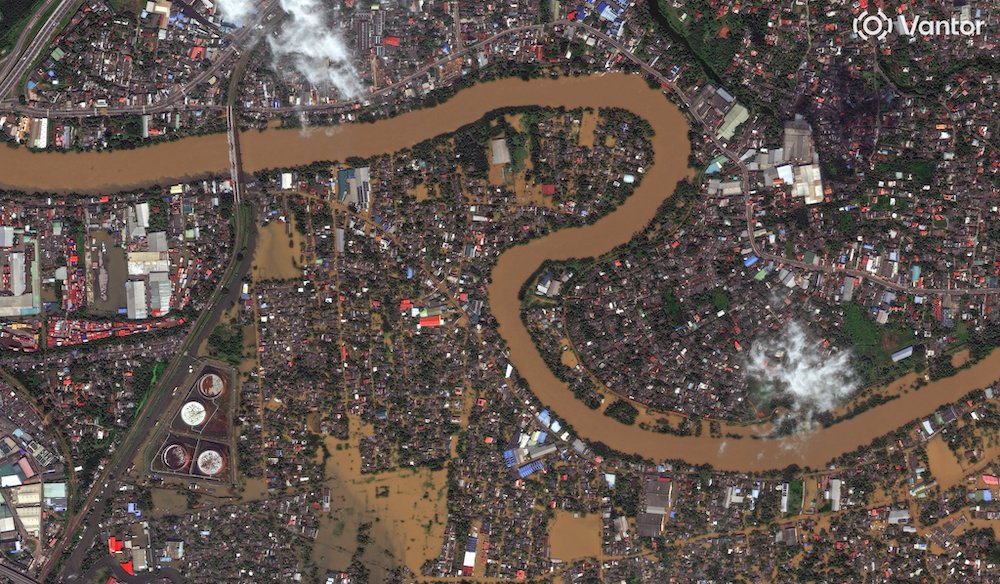
 This satellite image by Vantor shows the extend of damage caused in a Sri Lankan city by Cyclone Ditwah. (Photo credit: X/@vantortech)
New Delhi: India has launched one of its largest humanitarian operations in the Indian Ocean region (IOR) following Cyclone Ditwah’s catastrophic impact on Sri Lanka, which has left at least 410 people dead, 336 missing, and displaced approximately 233,000 across the island nation. Operation Sagar Bandhu, initiated within hours of the disaster unfolding, represents a coordinated deployment of naval vessels, military aircraft, specialized rescue teams, and a mobile field hospital to assist Sri Lankan authorities struggling to cope with widespread flooding and landslides.
The cyclone, which made landfall on Sri Lanka’s eastern coast around November 28, 2025, dumped unprecedented rainfall across all 25 districts, which triggered one of the worst natural disasters the country has witnessed in recent decades. With over 1.4 million people affected and hundreds of houses completely destroyed, the scale of destruction has overwhelmed local resources and necessitated substantial international assistance.
Vantor has activated its Open Data Program in response to the severe flooding across Asia caused by a series of cyclones combined with heavy monsoon rains in Sri Lanka, Indonesia and Thailand.
— Vantor (@vantortech) December 2, 2025
? Access via our Discover portal: https://t.co/Fo3tHC1YuZ (click the “Open Data”… pic.twitter.com/d10HICpdAl
Strategic airlift mobilizes specialist teams
The Indian Air Force mounted large-scale airlift operations beginning November 29, utilizing heavy transport aircraft to rapidly deploy specialized personnel and equipment. An IL-76 transported two urban search-and-rescue teams from the National Disaster Response Force – comprising approximately 80 personnel – along with four trained search dogs and nine tonnes of relief material. A C-130J Hercules followed with 12 tonnes of humanitarian aid, including food items, tents, tarpaulins, blankets, and hygiene kits.
#OperationSagarBandhu
— Dr. S. Jaishankar (@DrSJaishankar) November 30, 2025
Another @IAF_MCC C130J carrying approx 10 tons of disaster response supplies, BHISHM Cubes and a medical team for on-site training & support has landed in Colombo.
?? ?? pic.twitter.com/eycnW2dA6d
Combined with naval deliveries, India supplied approximately 27 tonnes of relief materials during the operation’s initial phase. The Air Force also deployed two Mi-17 helicopters specifically for search-and-rescue missions in interior districts where road access had been severed by landslides and washed-out bridges.
The tactical value of rotary-wing aircraft became evident in Sri Lanka’s hill country, where districts such as Kandy, Badulla, Nuwara Eliya, Kurunegala, and Matale bore the brunt of landslides. Localized rainfall reached 400mm within 24 hours in some areas, overwhelming river systems and triggering deadly slope failures in vulnerable settlements.
NDRF confronts challenging terrain
The National Disaster Response Force teams have undertaken some of the operation’s most demanding work, conducting search-and-rescue missions in conditions described by Indian officials as exceptionally challenging. Equipped with inflatable boats, hydraulic cutting tools, collapsed-structure search equipment, and medical kits, the urban search-and-rescue specialists have worked in close coordination with Sri Lanka’s Disaster Management Centre.
.@NDRFHQ teams working today at Sedawatta and Nadeegama areas near Colombo have rescued more than 43 people so far. Further rescue efforts at this site are ongoing.
— India in Sri Lanka (@IndiainSL) December 2, 2025
With water levels at 8–10 ft and with strong flows, NDRF teams continue saving the most vulnerable and ensuring… pic.twitter.com/OB5xJHCKo8
Specific interventions highlighted by India’s High Commission in Sri Lanka include the evacuation of a visually impaired elderly citizen trapped in a flooded locality, the rescue of an injured woman from a high-risk area with severely constrained access, and the recovery of a deceased person buried under deep, compacted debris. These operations have continued despite ongoing landslides and unstable structures that pose significant risks to rescue personnel.
The NDRF deployment reflects lessons learned from previous international disasters. The force’s specialized capabilities in urban search-and-rescue operations, particularly in structurally compromised environments, have been refined through multiple international missions and now represent a key component of India’s humanitarian assistance toolkit.
Naval assets redirected from ceremonial duties
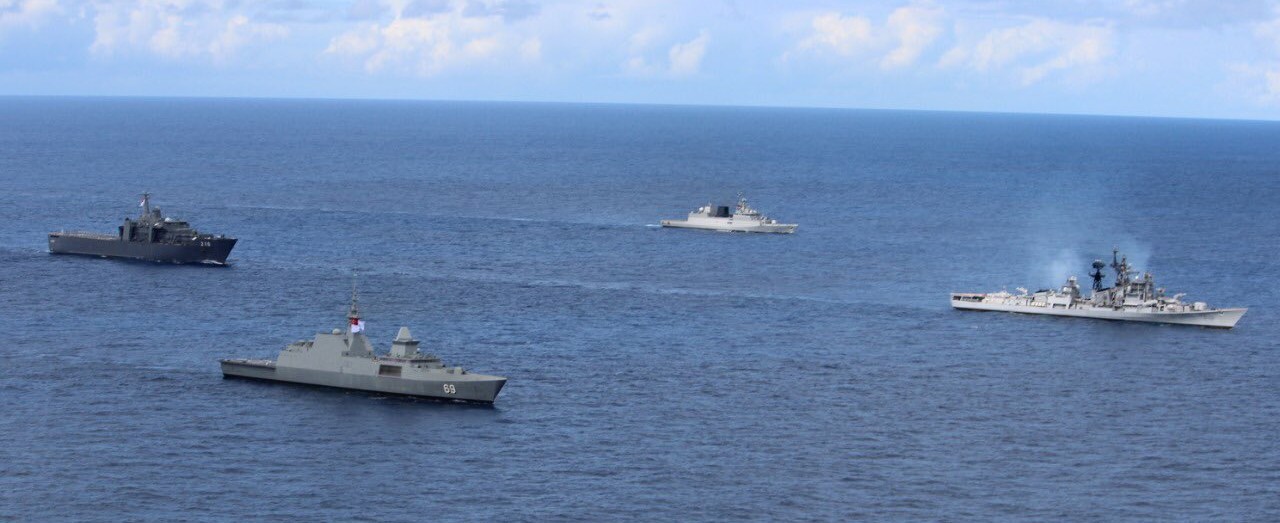
The Indian Navy’s response benefited from fortunate timing. Two major warships – INS Vikrant, the country’s aircraft carrier, and INS Udaygiri, a frontline frigate – were already docked in Colombo for Sri Lanka’s 75th Anniversary International Fleet Review when Ditwah struck. Both vessels were immediately retasked for humanitarian duties, with ship-borne helicopters conducting aerial reconnaissance of flood-affected regions while simultaneously delivering relief provisions to isolated communities.
?????#OperationSagarBandhu
— SpokespersonNavy (@indiannavy) December 3, 2025
In the aftermath of Cyclone Ditwah, #INSVikrant & #INSUdaygiri at Colombo delivered immediate assistance by providing relief provisions at short notice. Ship-borne helicopters were deployed for aerial recce of the affected areas and augmented ongoing… pic.twitter.com/pIrbjQKTe6
These naval helicopters, operating with Sri Lankan Air Force personnel on board, proved crucial in mapping cut-off areas and prioritizing rescue zones during the critical first 48 hours. The aircraft successfully evacuated numerous citizens from inundated localities where conventional rescue methods proved impossible due to destroyed road infrastructure and continuing landslides.
To expand coverage beyond the capital, the Indian Navy deployed INS Sukanya to Trincomalee on December 1, enabling more effective servicing of eastern and northeastern districts closer to the cyclone’s landfall zone. The vessel delivered critical relief material directly to Sri Lankan authorities, complementing the supply chain operating from Colombo.
Army establishes medical infrastructure
On December 2, the Indian Army formally joined Operation Sagar Bandhu, marking a transition from immediate rescue operations to sustained ground-based humanitarian support. The Army contingent’s primary contribution centers on a rapidly deployable field hospital staffed by approximately 70 medical and support personnel.
#OperationSagarBandhu | #CycloneDitwah
— ADG PI - INDIAN ARMY (@adgpi) December 2, 2025
As part of the national commitment of #NeighbourhoodFirst, the Indian Army is deploying an Integrated Task Force, a high-readiness, self-contained composite #HADR contingent from the #Shatrujeet Brigade to provide critical relief, restore… pic.twitter.com/FHn3Dfd0Sw
This mobile facility is designed to handle emergency trauma, fractures, and crush injuries resulting from landslides and building collapses – conditions that have overwhelmed Sri Lanka’s district hospitals. The field hospital provides general medical care for flood-related illnesses and offers basic surgical capability for stabilization before transferring severe cases to tertiary facilities.
The Army deployment also encompasses engineering tasks, including debris clearance and temporary infrastructure restoration, alongside logistics support for distributing relief material to remote communities. These capabilities address the prolonged displacement challenge, with large numbers sheltering in more than 1,400 temporary facilities and many homes rendered uninhabitable.
Meteorological factors amplified destruction
Cyclone Ditwah’s devastating impact stemmed from several unusual meteorological characteristics. The system formed from a low-pressure area in the southwest Bay of Bengal, a region not typically associated with highly destructive cyclones. Rather than moving rapidly across the island, Ditwah traveled slowly along Sri Lanka’s eastern coastline, ensuring three consecutive days of extremely heavy rainfall over a concentrated area.
While India’s Regional Specialized Meteorological Centre issued early warnings, Sri Lanka’s limited evacuation infrastructure made it difficult to relocate hundreds of thousands at short notice. The combination of a slow-moving system, orographic rainfall intensification in hilly terrain, and vulnerable hillside settlements meant that even with advance warnings, the humanitarian toll proved severe.
Major rivers including the Kelani crossed danger levels, flooding peri-urban and rural belts while complicating logistics for humanitarian agencies. Power infrastructure suffered extensive damage, with a substantial proportion of Ceylon Electricity Board customers experiencing outages at the disaster’s peak.
Diplomatic dimensions and bilateral ties
Sri Lanka’s high commissioner to India, Mahishini Colonne, acknowledged the operation’s significance while the relief phase continues. She noted that comprehensive damage assessment would require time but emphasized India’s consistent record as the first country to assist Sri Lanka during crises – from the 2004 tsunami through the recent economic crisis to the current cyclone.
The high commissioner indicated that medical teams and mobile hospitals from India are working directly with Sri Lankan officials, and expressed confidence that the crisis would further strengthen bilateral bonds. This perspective reflects broader recognition within Sri Lanka of India’s reliability as a first responder during humanitarian emergencies.
For New Delhi, Operation Sagar Bandhu reinforces strategic messaging around its “Neighbourhood First” policy and maritime vision positioning India as a net security provider in the IOR. The operation builds on established patterns of assistance including anti-piracy operations, tsunami relief, vaccine supplies, and economic support during Sri Lanka’s financial crisis.
Coordinated international response
Indian teams are operating within a broader international framework that includes World Health Organization coordination, UN agencies, and humanitarian non-governmental organizations engaged in joint rapid needs assessments. This integration ensures that Indian assets complement rather than duplicate efforts by other actors responding to the disaster.
The scale and diversity of India’s deployment – major naval platforms, strategic and tactical aircraft, specialized rescue teams, and a mobile field hospital – represents comprehensive coverage across maritime, aerial, and ground domains. This multi-dimensional approach addresses the varied challenges posed by Ditwah’s impact, from isolated coastal communities requiring boat or helicopter access to hillside settlements needing specialized search-and-rescue capabilities.
The operation’s speed proved particularly crucial. With naval and air assets already in or near Sri Lanka redirected within hours, relief consignments and NDRF teams arrived by November 28-29 even as the disaster continued unfolding. This rapid response likely prevented additional casualties during the critical window when Sri Lankan resources were most stretched.
As Sri Lanka transitions from emergency rescue to longer-term recovery and reconstruction, India’s ongoing presence under Operation Sagar Bandhu appears set to remain significant. The magnitude of destruction – with hundreds dead, hundreds of thousands displaced, and infrastructure severely damaged – will require sustained international support well beyond the immediate crisis phase.
India’s comprehensive deployment positions it to play a central role throughout this extended response, reinforcing its credentials as a dependable partner during humanitarian emergencies in the IOR.