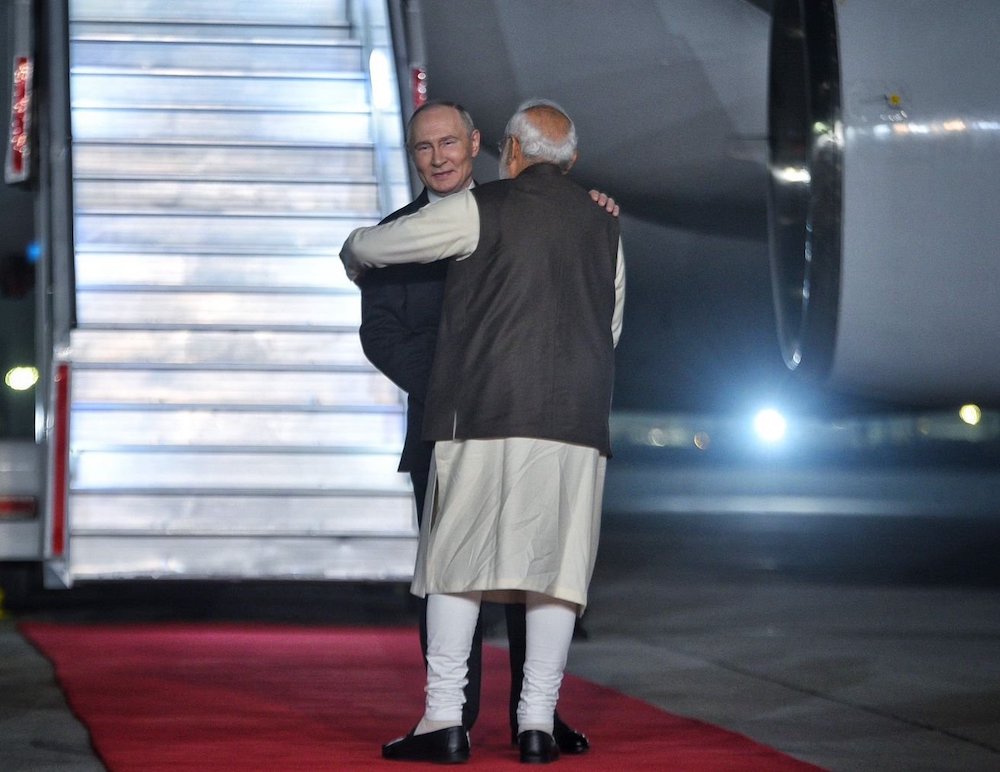
 Narendra Modi hugging Vladimir Putin after the latter landed in New Delhi, on December 4, 2025. (Photo: PMO)
New Delhi: The Russian president Vladimir Putin, has landed in New Delhi on Thursday night for his 2-day state visit to India. He was received in person by the prime minister, Narendra Modi, at the Palam technical area of the Delhi airport.
The visit has reinforced New Delhi’s commitment to maintaining robust ties with Moscow despite intensifying western pressure over sanctions and the Ukraine conflict, signalling that India’s strategic autonomy remains non-negotiable even as it deepens engagement with Washington and its allies.
The visit, formally designated as the 23rd India-Russia Annual Summit, will see the Russian president hold extensive talks with Modi after receiving a ceremonial welcome from the president, Droupadi Murmu, at the Rashtrapati Bhavan, on Friday.
Welcomed my friend, President Putin to 7, Lok Kalyan Marg.@KremlinRussia_E pic.twitter.com/2L7AZ1WIph
— Narendra Modi (@narendramodi) December 4, 2025
It is Putin’s first trip to India since December 2021, preceding Russia’s military operation in Ukraine, and comes at a particularly delicate moment as India navigates strained relations with the United States over tariffs and its continued purchase of Russian crude oil.
Consolidating ties under sanctions
The core agenda will centre on stabilizing energy flows and defence cooperation while developing sanctions-resistant trade mechanisms. Since 2022, India has emerged as one of Russia’s largest buyers of discounted crude oil, a relationship that has drawn criticism from Washington and European capitals. Moscow’s ability to maintain this energy partnership has become crucial as western markets remain largely closed to Russian exports.
Russian officials emphasized their desire to boost bilateral trade beyond the current $68 billion toward a target of $100 billion by 2030. Putin publicly stated his intention to increase imports of Indian goods, which addresses a trade imbalance heavily skewed in Russia’s favour. The discussions focused on strengthening rupee-rouble trade mechanisms and alternative settlement systems to insulate transactions from dollar-denominated channels vulnerable to western sanctions.
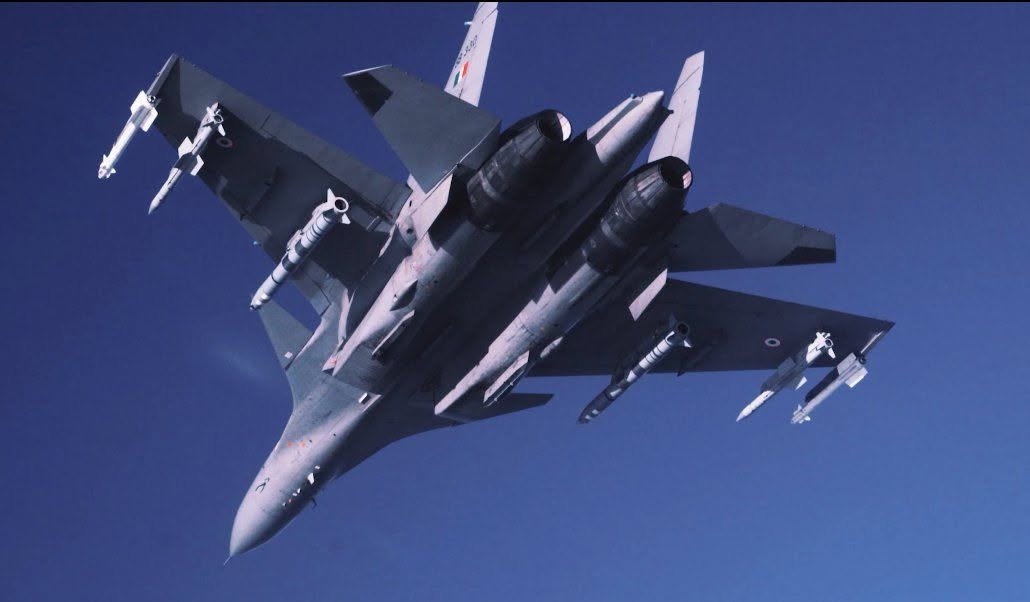
Defence cooperation, the historic backbone of India-Russia relations, is expected to feature prominently. India reportedly seeks five additional S-400 Triumf air-defence squadrons and more missiles for existing units, which have performed effectively in Operation Sindoor in May. Analysts expect progress on ongoing contracts, including timely delivery of already-ordered S-400 systems, spares and ammunition, despite Russian industrial strain from the Ukraine conflict.
However, scepticism exists about Russia’s capacity to execute new major platforms. The prolonged conflict has stretched Moscow’s defence industrial base, raising questions about its ability to deliver advanced systems like the Su-57 export variant or S-500-class capabilities that have been floated in media reports. Indian planners are consequently pushing for greater localization and co-production, including expanded joint manufacturing of BrahMos cruise missiles, to reduce vulnerability to future export disruptions while aligning with the government’s “Make in India” initiative.
Strategic signalling beyond bilateral ties
The visit’s timing is also carrying significant political weight. Hosting Putin amid western disapproval over India’s Russian oil purchases and broader geopolitical tensions demonstrates New Delhi’s determination to resist external pressure on its foreign-policy choices. For Moscow, being accorded a full state visit by Delhi provides valuable imagery to counter western narratives of Russia’s international isolation.
Russian commentary has emphasized that the visit showcases Moscow’s ability to maintain “strong relationships that matter beyond the west” and access to large markets. Thinktank voices in Moscow framed India-Russia ties as exemplifying equal partnership in a multipolar order, positioning Russia alongside major Asian powers rather than solely dependent on China.
India’s calculus involves preserving a working relationship with Russia to prevent an exclusively tight Moscow-Beijing bloc in Eurasia and Central Asia, while simultaneously advancing maritime security cooperation with the United States, Japan, Australia and Europe in the Indo-Pacific. The summit provides New Delhi an opportunity to keep channels open with Moscow on issues including Afghanistan, Central Asia and even aspects of China’s behaviour on the Eurasian landmass.
Modi is expected to reiterate India’s position on Ukraine, which will emphasize respect for sovereignty and territorial integrity while advocating cessation of hostilities through dialogue and diplomacy. Indian officials are likely to convey concerns about Russia’s deepening dependence on China and any moves that could strengthen Beijing’s hand in the Indo-Pacific and Himalayan regions.
Expected outcomes
The summit is anticipated to produce a package of economic and energy agreements, though headline numbers remain modest. Expected deliverables include joint statements on raising bilateral trade, memorandums of understanding on long-term crude supply arrangements, improved logistics and shipping cooperation, and mechanisms for settling more trade in national currencies.
A potentially significant development involves labour-mobility arrangements that would enable more Indian professionals and workers to fill gaps in Russia created by wartime conscription and emigration. Such an agreement would open a new dimension beyond the traditional energy-defence template, which will offer India opportunities for overseas employment and remittances while providing Russia with politically acceptable skilled and semi-skilled labour.
Defence announcements are likely to emphasize incremental consolidation rather than dramatic new commitments. Confirmation of continued S-400 deliveries, renewed focus on joint production and technology transfer projects, and quiet discussions on future systems appear probable, though western analysts highlight that Indian planners will insist on realistic timelines and substantial local manufacturing to mitigate delivery risks.
For Russia, the visit provides an important demonstration of retaining heavyweight partners beyond China. This will support its multipolar narrative and offer a critical revenue stream at a time when western markets remain constrained. Maintaining India as a core defence client helps sustain Russia’s military-industrial base financially while showcasing Russian systems in a large, operationally active military.
For India, successfully hosting Putin will reinforce its longstanding principle of maintaining diverse partnerships and making issue-based choices rather than serving as a camp follower. The visit helps manage India’s awkward dependence on Russian arms by securing near-term operational requirements in air defence, air power and armour, which allows New Delhi to pace its diversification toward western and indigenous platforms more smoothly without immediate capability gaps.
Pragmatic resilience
Geopolitical commentators have converged on describing the visit as pragmatic resilience rather than business as usual. The summit represents adaptation under new constraints rather than abandonment of the partnership, though structural limits exist on how far and how fast ties can expand given Russia’s economic and industrial strain and India’s need to maintain strong relations with the United States and Europe.
The partnership remains structurally asymmetric – India has diversified more than Russia – but both sides perceive sufficient mutual utility to invest in keeping it resilient under sanctions and great-power rivalry. Neither dramatic breakthroughs nor ruptures appear likely. Instead, the visit signals continuity with adaptation, concrete progress in energy, payments and select defence areas, and strong political messaging that both capitals remain committed to a special partnership and multipolar order where neither accepts being boxed into a single camp.
The real test will be implementation under evolving sanctions regimes. Official language has remained cautious and technical, reflecting awareness that western pressure, Russian industrial constraints and India’s balancing act with Washington will continue shaping the contours of this relationship. For now, both Moscow and New Delhi have demonstrated their determination to preserve strategic space for autonomous decision-making, even as global geopolitical fault lines deepen.