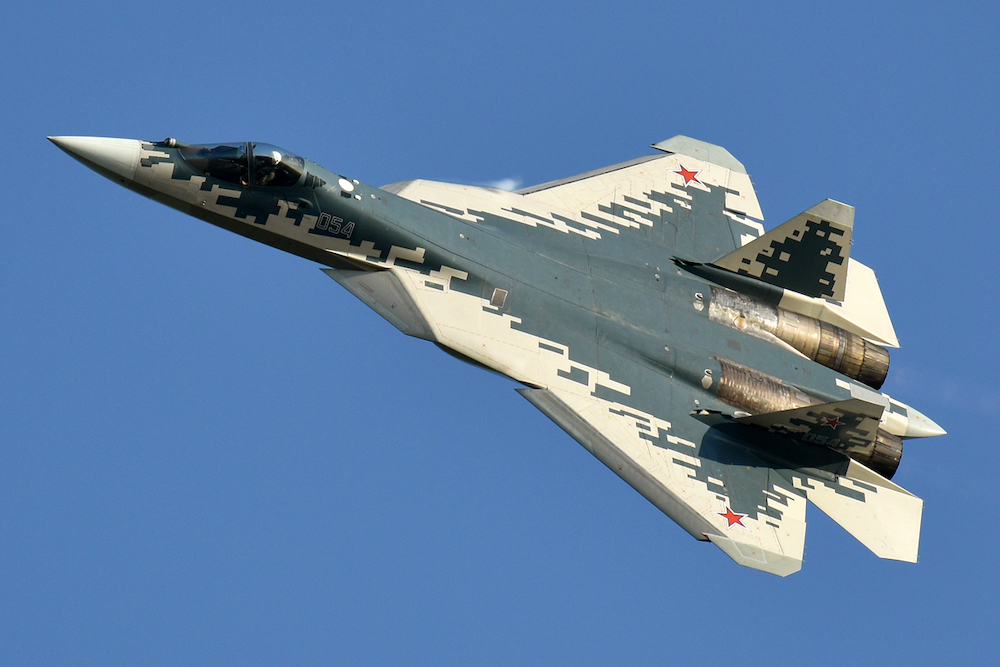
 An early prototype of Su-57. (Photo: Wikipedia/Creative Commons)
New Delhi: The Hindustan Aeronautics Limited is evaluating a landmark partnership with Russia’s Sukhoi Design Bureau to manufacture the Sukhoi-57E (Su-57E) “Felon” fifth-generation stealth fighter domestically. This is seen as a move that could reshape the Indian Air Force’s air-combat capabilities over the next decade.
According to a recent media report [archived link], in November 2025, Sukhoi submitted a comprehensive feasibility assessment to HAL, and expressed confidence that India’s current infrastructure readiness for domestic production is approximately 50 per cent ready because of domestically building Sukhoi-30MKIs (Su-30MKI) for over two decades. A critical cost analysis from Russian technical specialists, expected this month, will inform HAL’s formal recommendation to the defence ministry.
However, it must be noted that the proposed collaboration positions the Su-57 not as a replacement for India’s Rafale fleet but explicitly as an interim stealth platform to address capability gaps until the indigenous AMCA (advanced medium combat aircraft) becomes operational around 2034-35.
The stealth asymmetry
At present, the IAF confronts an unprecedented capability deficit. The People’s Liberation Army – Air Force (PLAAF) inducted approximately 120 J-20A and J-20S stealth fighters in 2025 alone, accelerating an already aggressive modernization trajectory. A recent analysis [archived link] by the United Kingdom’s Royal United Services Institute projects China will field approximately 1,000 J-20 stealth fighters alongside 900 J-16s by 2030, with additional J-35 variants entering service thereafter. China is simultaneously offering the J-35 to Pakistan, which will completely alter South Asia’s air-power balance.
The IAF currently operates zero fifth-generation stealth aircraft. Its sanctioned strength of 42 fighter squadrons has eroded to approximately 31 operational squadrons, with eight to 10 additional squadrons scheduled for retirement over the next decade. Air Marshal Ashutosh Dixit, chief of Integrated Defence Staff, acknowledged a critical eight- to 10-year shortfall in bridging existing capability gaps.
The operational implication is stark: without foreign procurement of an interim stealth platform, India will confront the PLAAF across the Himalayan frontier wielding only 4.5-generation fighters – the Rafale and upgraded Su-30MKI – against a numerically superior and qualitatively advanced adversary operating dual-engine, low-observable stealth platforms.
Satellite imagery from 2024 confirmed [archived link] six J-20 stealth fighters deployed at Shigatse airbase in Tibet, which is approximately 150 kilometres from India’s Sikkim border. The deployment eliminates geographical sanctuary assumptions that have historically underpinned India’s air-defence posture along the contested line of actual control (LAC).
Russia’s unprecedented offer
Russia has structured an offer centred on the Su-57E export variant with three principal components: off-the-shelf procurement from existing Russian production lines, licensed assembly at HAL’s Nashik facility modelled on the successful Su-30MKI arrangement, and comprehensive technology transfer encompassing source code access to onboard systems. This level of technology transfer is unparalleled in India’s defence-procurement history – no western partner has extended comparable access.
The Su-57E exhibits performance characteristics tailored to India’s operational requirements. With a maximum speed of Mach 2.0, combat range of 1,900 kilometres, and ferry range extending to 3,500 kilometres, it provides substantially greater endurance and reach than the Rafale. Its payload of 7,400 kilograms, combined with three-dimensional thrust-vectoring nozzles for superior manoeuvrability, addresses the close-range dogfighting vulnerability inherent in stealth-optimized designs.
Also, the Su-57 can carry the R-37M air-to-air missile, offering beyond-visual-range (BVR) engagement capability at distances exceeding 300 kilometres.
Preliminary discussions have centred on a phased induction model. Initial batches comprising two to three squadrons – 36 to 54 aircraft – would arrive in fly-away condition by 2028–2030, while additional squadrons would undergo domestic assembly at HAL’s Nashik facility, leveraging existing Su-30MKI production infrastructure with over 60 percent indigenization already achieved. Total proposed acquisition volumes range from 100 to 140 aircraft, though formal governmental commitment remains pending.
F-35 and strategic autonomy
The F-35 Lightning II, occasionally proffered as an alternative, presents intractable complications for India’s strategic autonomy. At approximately $80 million per unit with stringent operational restrictions, the F-35 imposes vendor lock-in preventing independent upgrades or integration of indigenous weapons systems. More fundamentally, United States law – the Countering America’s Adversaries Through Sanctions Act (CAATSA) – creates persistent risk of sanctions or technology denial given India’s existing S-400 “Triumf” air-defence procurement and its historical defence relationship with Moscow.
The IAF chief, Air Chief Marshal Amar Preet Singh, recently characterized [archived link] potential F-35 acquisition as “not like buying a washing machine”, and noted the extensive operational constraints and approval architectures embedded in the American stealth fighter’s procurement. India’s precision-guided weapons inventory – the Astra air-to-air missile, Rudram anti-radiation missile, and BrahMos supersonic cruise missile – cannot be integrated into the F-35 without congressional approval and subsequent design modifications.
Russia’s Su-57 offer, by contrast, decouples India’s stealth capability development from US approval architectures. The proposed technology transfer, including access to source code and know-how on stealthing methodologies, directly supports India’s AMCA development programme, which, in turn, may potentially shorten the indigenous fifth-generation fighter’s maturation timeline.
Timeline and AMCA factor
India faces an unprecedented temporal constraint. The AMCA’s first flight is scheduled for 2028, with service induction projected for 2034-35. This eight to nine-year interval presents a critical vulnerability window during which India’s fleet composition becomes progressively obsolete against China’s expanding stealth-fighter force.
The Tejas-Mk2, the advanced variant of India’s indigenous light combat aircraft, will achieve operational induction by 2030, but as a 4.5-generation platform, it cannot close the stealth capability gap. The first Tejas-Mk2 prototype is completing manufacturing with maiden flight scheduled for the first quarter of 2026. Assuming nominal testing progression, initial operational clearance by 2028 would enable production commencement and initial induction by 2030, creating temporal overlap with early Su-57 deliveries.
Su-57 induction by 2028–2030 would compress the vulnerability window, providing operational fifth-generation capability for approximately five years prior to AMCA’s arrival. This temporal overlap permits pilot training, weapons integration, maintenance protocol development, and operational doctrine refinement – all prerequisites for effective AMCA deployment when the indigenous platform achieves service readiness.
Technology transfer benefits
Beyond immediate operational requirements, Su-57 production represents a transformational opportunity for India’s defence-industrial base. HAL’s existing Su-30MKI manufacturing ecosystem, spanning Nashik’s production facilities, supplier networks, and engineering talent, provides immediate industrial scaffolding. The comprehensive technology transfer enables Indian engineers to participate in fifth-generation design methodologies, avionics integration, stealth shaping, and systems architecture – knowledge directly applicable to AMCA development.
The Su-57’s technical offerings span five critical domains: stealth design and low-observable shaping through serrated edges, composite material integration, and internal weapons bays; avionics integration and sensor fusion with modular architecture and multi-functional radar systems; thrust-vectoring propulsion with three-dimensional engine systems representing mature technology with operational validation; supply-chain and manufacturing resilience establishing high-temperature materials supply chains and composite manufacturing expertise; and operational doctrine development through Russian advisers embedded in the IAF’s Su-57 operations.
The proposed arrangement aligns with India’s “Atmanirbhar Bharat” initiative and “Make in India” defence manufacturing push. Local assembly of 50 to 75 per cent of the projected fleet would establish high-tech manufacturing capability, create skilled employment, and develop supply chain resilience for future indigenous programmes. Russia has pitched India’s HAL as a key Su-57E production partner for global exports, potentially bypassing western sanctions while creating revenue streams for Indian aerospace manufacturing.
Quantitative threat assessment
As of January 2026, the PLAAF operates approximately 250 operational J-20 stealth fighters with production rates stabilizing at 120 aircraft annually. By 2030, China will have accumulated a minimum of 450 to 500 J-20s, excluding concurrent production of J-35 variants and upgraded J-16 multirole fighters. This represents a stealth fighter ratio of approximately 25:1 in China’s favour by the early 2030s.
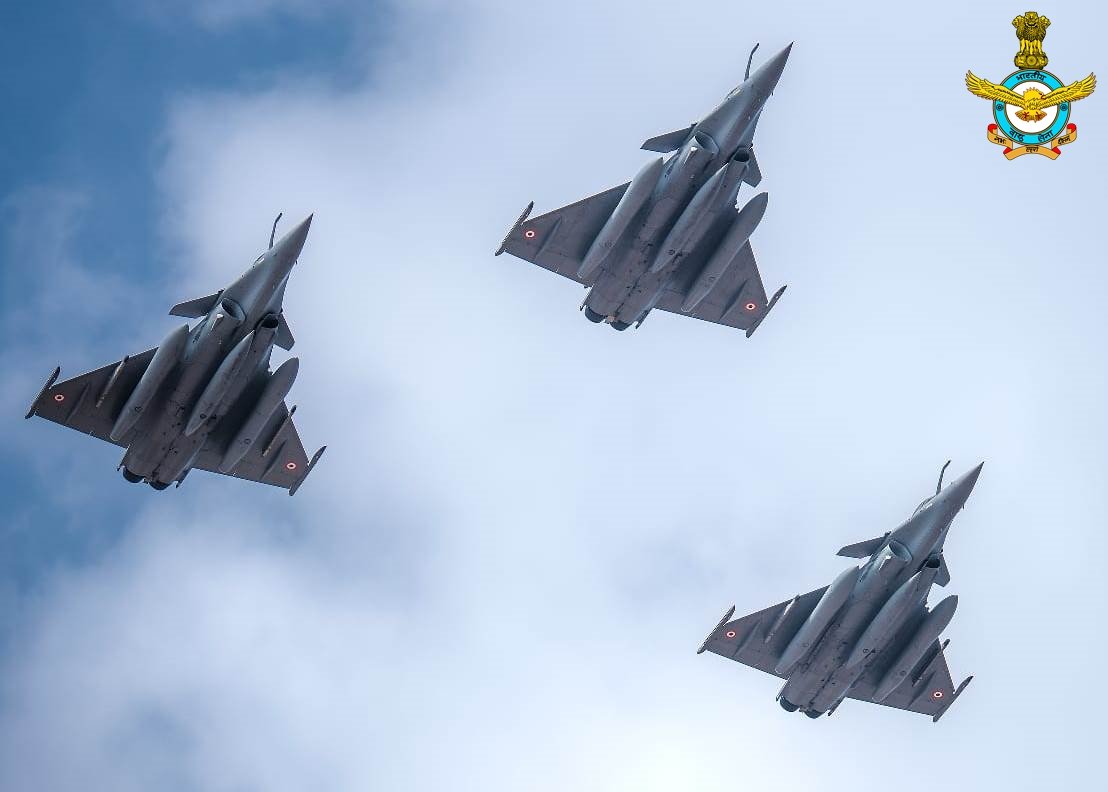
The J-20’s strengths – supercruise capability, advanced sensor fusion, long-range air-to-air missiles – impose asymmetric vulnerability upon the IAF’s 4.5-generation fleet. Indian Rafales, despite their superior manoeuvrability and electromagnetic warfare systems, confront a design optimized for BVR engagement where stealth provides decisive first-detection advantage. The Rafale’s combat radius of approximately 780 kilometres falls substantially short of the J-20’s 1,200-kilometre-plus operational envelope, compressing engagement geometry in China’s operational sphere along the Himalayan frontier.
The Su-57’s capabilities directly address this gap. Its 1,900-kilometre combat range, R-37M missile system with 300-kilometre-plus engagement range, and supercruise capability at Mach 1.3 sustained reconstitute India’s ability to contest Chinese air superiority. The Su-57’s three-dimensional thrust-vectoring engines provide unmatched agility in close-range combat – a characteristic the J-20 lacks – creating tactical parity in engagements where the Chinese stealth advantage diminishes.
Complementarity within existing modernization
A disciplined Su-57 procurement strategy need not disrupt existing fleet modernization. India’s current acquisition pipeline includes 114 Rafale aircraft under the MRFA (multi-role fighter aircraft tender), approximately 96 additional aircraft beyond the existing 36, 180 Tejas-Mk1A fighters, and the nascent 120-aircraft Tejas-Mk2 programme. These platforms address distinct operational niches.
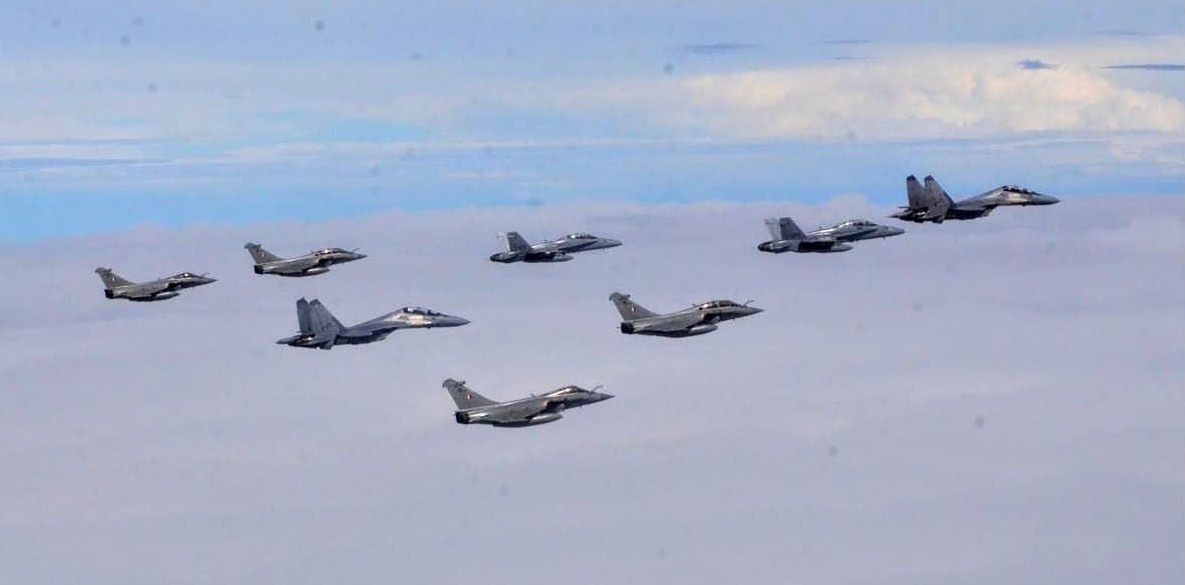
The Rafale serves as an advanced 4.5-generation multirole fighter excelling in contested airspace where stealth is secondary to sensor fusion and electronic warfare, optimal for air-to-ground strike, tactical reconnaissance, and force multiplication in alliance frameworks. The Tejas-Mk1A and Mk2 function as indigenous light and medium-weight fighters optimized for homeland defence, airfield base protection, and operations from austere airstrips. The Su-30MKI remains a heavy fighter with unmatched payload and range, specialized for deep penetration strike, anti-ship warfare, and intelligence and surveillance missions. The Su-57 would serve as a fifth-generation stealth air-superiority fighter optimized for contested high-threat environments and deterrence-by-denial against PLAAF superiority.
Rather than cannibalization, Su-57 acquisition enables heterogeneous fleet deployment. Tejas aircraft handle low to medium threat sectors, Su-30MKIs conduct strike missions, Rafales provide electromagnetic warfare and air-to-ground strike, and Su-57s maintain air superiority in the highest-threat enclaves.
Production feasibility and cost
HAL’s existing Su-30MKI production line, operating at Nashik with demonstrated capability to produce eight to 10 aircraft annually, provides industrial foundation. Russian expertise transfer enables targeted infrastructure enhancement – composite manufacturing, stealth coating application, avionics integration – without fundamental facility reconstruction. Conservative estimates suggest HAL’s capacity to produce 10 to 15 Su-57E aircraft annually after infrastructure upgrade, implying full induction of a 60-aircraft squadron by 2031-32.
Su-57 acquisition cost estimates, approximately $50 to $65 million per aircraft in the proposed co-production arrangement, remain substantially below F-35 acquisition cost of $80 million-plus per aircraft and marginally below additional Rafale procurements at $95 to $100 million per aircraft. A three-squadron Su-57E procurement totalling 60 aircraft at $55 million per unit would total approximately $3.3 billion in acquisition costs, roughly eight to 10 per cent of India’s projected five-year defence capital budget.
Strategic case for acquisition
The strategic case for Su-57 acquisition rests upon several critical conditions. First, the Su-57 must be recognized as an interim platform addressing the 2028–2034 vulnerability window, not a permanent fleet-modernization strategy. The AMCA’s development must remain on accelerated timeline without delay or reallocation of resources toward Su-57 production.
Second, procurement should be limited to 60 to 80 aircraft – three to four squadrons – not the 100 to 140 aircraft discussed in preliminary negotiations. Larger quantities risk transforming an interim solution into a permanent fleet component, diverting resources from indigenous AMCA production.
Third, Su-57 co-production must be explicitly structured to transfer design, manufacturing, and operational knowledge to HAL engineers and IAF personnel. Embedded Russian advisers should have defined knowledge-transfer objectives and measurable outcomes contributing to AMCA development.
Fourth, integration of indigenous weapons systems – BrahMos-A, Astra, and Rudram missiles – must precede operational deployment. Dependence on Russian-supplied weapons would recreate sanctions vulnerability the partnership aims to avoid.
Fifth, HAL production should not exceed 10 to 12 aircraft annually to preserve manufacturing quality and avoid undue strain on supply chains. Delays in AMCA development should not result in accelerated Su-57 production as compensation.
Decision point approaches
As Russia completes its cost assessment and HAL develops its formal recommendation, India’s decision-makers confront a binary choice: procure fifth-generation fighters from Russia now – which will enable parallel AMCA development, or delay pending AMCA maturation while accepting grave capability risks in the interim.
The quantitative dimension of India’s strategic predicament is stark. China’s stealth fighter production has accelerated beyond previous projections, with deployment patterns along the Himalayan frontier demonstrating operational intent. India’s temporal window for rational decision-making narrows as the capability gap widens and the AMCA timeline remains fixed by immutable development and certification requirements.
The Su-57 acquisition, bounded by the strategic conditions outlined, would fill an irreducible temporal gap while simultaneously advancing India’s long-term self-reliance agenda through comprehensive technology transfer. Strategic autonomy and operational necessity need not be antithetical – they can be reconciled through disciplined, time-bounded acquisition of proven capabilities coupled with parallel development of indigenous solutions.
The geopolitical clock is accelerating. India’s response to this challenge will define its air combat credibility for the next decade and beyond.
Follow us on social media for quick updates, new photos, videos, and more.
X: https://x.com/indiasentinels
Facebook: https://facebook.com/indiasentinels
Instagram: https://instagram.com/indiasentinels
YouTube: https://youtube.com/indiasentinels
© India Sentinels 2025-26