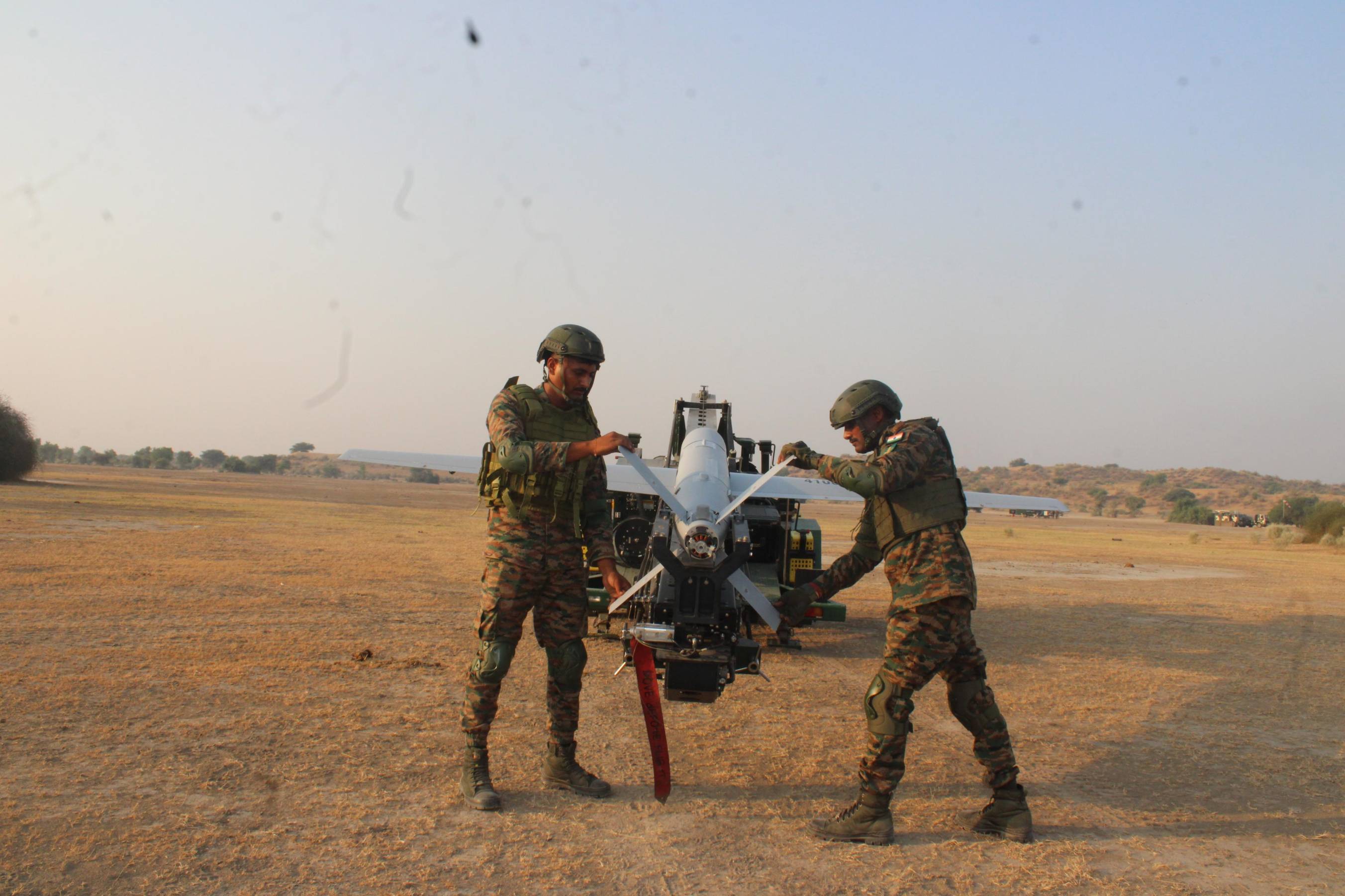
New Delhi: An indigenously assembled SkyStriker loitering munition carried out a successful precision strike during the ongoing India-US joint military exercise, Yudh Abhyas 2026, at the Mahajan Field Firing Range in Rajasthan, in what officials described as a clear demonstration of India’s expanding unmanned combat capability.
The munition located, tracked and destroyed its designated target during the drill, confirming its ability to deliver precision effects under realistic field conditions. The strike was part of a wider set of exercises this year focused on testing how modern technologies, including drones and autonomous systems, can be woven into conventional battlefield operations.
Yudh Abhyas 2026 is the 22nd edition of the annual India-US exercise and got under way on September 15, with about 600 soldiers from each side taking part. The drills are being conducted simultaneously at two locations - the Auli Foreign Training Node in Uttarakhand and the Mahajan Field Firing Range in Rajasthan - with the broader aim of sharpening joint capability for Integrated Battle Groups operating in mountainous and semi-mountainous terrain, and a particular focus on infantry operations.
SkyStriker itself is not new to the Indian armed forces. It is manufactured under an Indian Army contract signed with a joint venture between Bengaluru-based Alpha Design Technologies Limited and Israel’s Elbit Systems, under which 100 units were ordered for about ₹100 crore to meet urgent operational requirements.
According to Elbit, the system can cover roughly 20km within 10 minutes of launch and, once over the target area, can loiter for up to two hours when carrying a 5kg warhead, or about an hour with a 10kg warhead.
The loitering munition flies autonomously during its cruise and loiter phases before switching to an electro-optical lock as it closes in on a target. Operators retain control throughout the engagement and can abort a strike up to two seconds before impact, re-engage, or divert the munition to a safe, parachute-assisted recovery if no authorised target is available. It can be flown alone or as part of a coordinated swarm, and its electric propulsion keeps its acoustic signature low, making it difficult to detect at low altitude.
Defence officials at the exercise said the successful engagement reflected the Army's growing emphasis on precision effects, better situational awareness and the integration of unmanned systems into tactical-level operations - roles in which loitering munitions are increasingly being used for surveillance, target acquisition and rapid strikes on high-value targets while keeping personnel out of harm’s way.
The Mahajan Field Firing Range, one of the Indian Army’s principal training and weapons-testing facilities, provided the setting for the trial.
The demonstration also comes as India pushes to expand domestic defence manufacturing, with platforms such as SkyStriker - built locally through the Alpha Design-Elbit joint venture - held up as examples of that effort.
The performance at Yudh Abhyas 2026 mirrors a broader global trend, with armed forces worldwide investing more heavily in loitering munitions and semi-autonomous systems to gain flexibility and precision in future conflicts.
For India, the exercise adds to a growing body of evidence on how such indigenous unmanned platforms are being absorbed into evolving military doctrine.