 ideaForge's advance heavy-lift UAV platform ‘YETI’ (Photo: ideaForge)
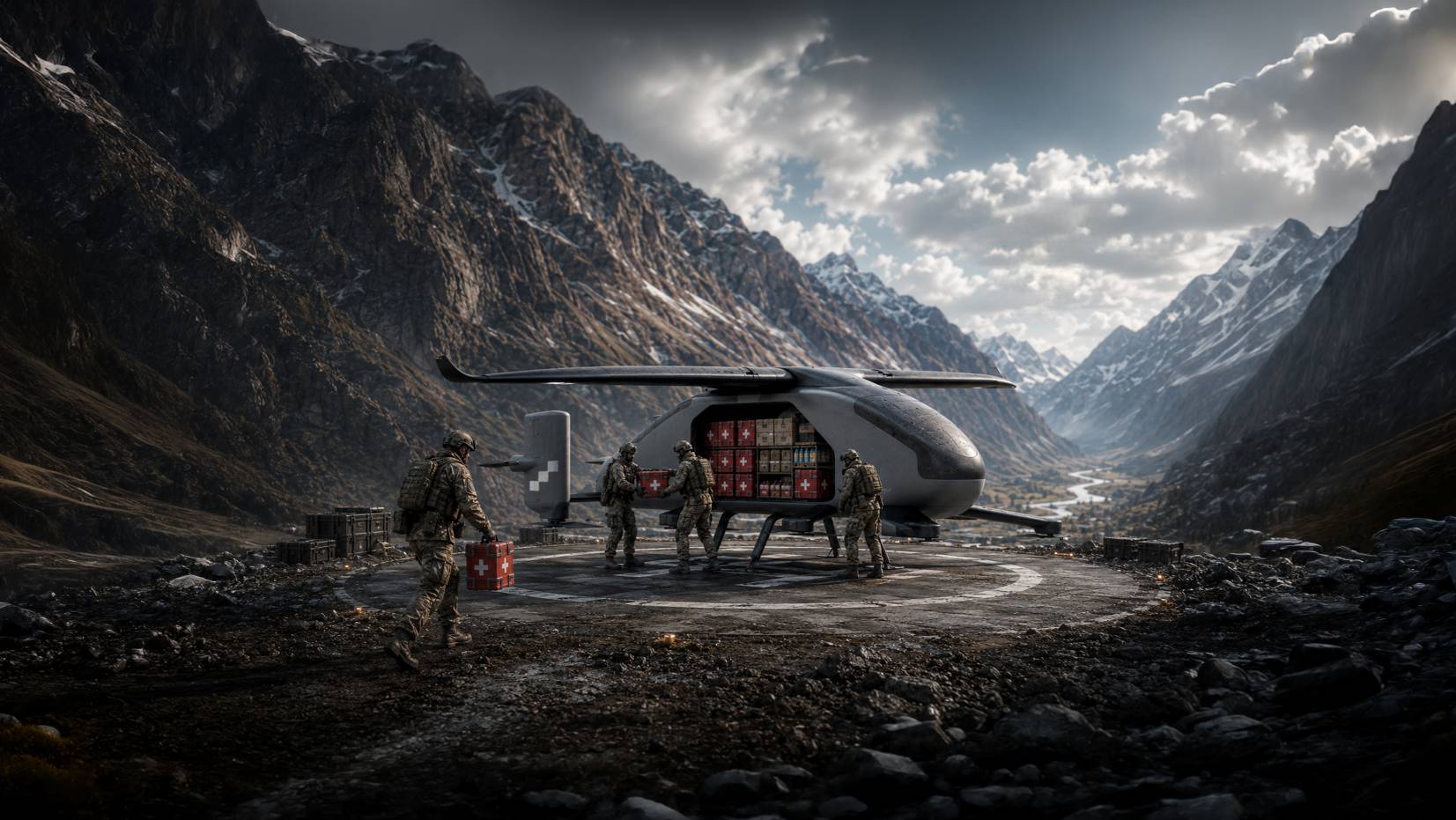
New Delhi: The Ministry of Defence has floated a request for information (RFI) for 2,715 logistic drones for the Indian Army, in what would be the largest single order of its kind placed so far, as the force looks to speed up the movement of rations, ammunition and other supplies to troops holding forward positions along the borders with China and Pakistan.
The RFI, issued on August 5, by the Army’s Directorate General of Capability Development, seeks three separate categories of drones, graded by the altitude at which they are meant to operate: a low-altitude variant for missions up to 6,000 feet, a medium-altitude variant working between 6,000 feet and 12,000 feet, and a high-altitude variant capable of operating between 12,000 feet and 20,000 feet.
Each category carries its own take-off elevation limits and minimum operating heights, reflecting how sharply the terrain shifts between the plains and the high Himalayan stretches along the Line of Control (LoC) and the Line of Actual Control (LAC).
The logic behind the requirement is straightforward. Forward posts scattered across Jammu and Kashmir, Ladakh, Himachal Pradesh, Uttarakhand, Sikkim and Arunachal Pradesh often sit at altitudes and on terrain that make road access difficult, or altogether impossible, for months at a stretch.
Supplies to such posts have traditionally travelled the last mile on the backs of porters and mules - a system that is slow, manpower-heavy and vulnerable to weather. The Army wants drones to take over as much of that burden as possible, in peace as well as in war.
According to the RFI, each drone system must come as a complete package - the aerial vehicle itself, a ground control station, a remote video terminal, a colour day camera and a thermal sensor for night operation.
Navigation is to rely on GPS as well as India’s own NavIC satellite system and Russia’s GLONASS, with compatibility for the Indian Military Grid Reference System alongside conventional latitude-longitude coordinates. The drones must also carry LIDAR-based obstacle-detection technology and a unit to track their own movement, and must be capable of flying in fully autonomous, manual and automatic return-to-home modes.
Read also: Indian Navy eyes indigenous surveillance drones as it extends spotter concept from ships to shore
Since most forward posts have no proper airstrips, the Army has insisted the drones be able to land on unprepared ground, operated by a crew of no more than two or three.
They are expected to withstand temperatures ranging from minus 30 degrees Celsius to 50 degrees Celsius, complete at least 1,000 landings, and remain in service for at least 7 years. Depending on the altitude band, mission range should not fall below 10 to 20 kilometres one way.
Resistance to electronic warfare is another core requirement. The drones must be hardened against jamming and spoofing to recognized military standards, so that hostile signals cannot block or hijack them mid-flight, and they must carry identification technology so that India’s own air-defence units do not mistake them for enemy aircraft in a live battle zone.
The document makes clear that only original equipment manufacturers, their authorized vendors, or government-backed export agencies may respond, and that the RFI - the preliminary stage of what is likely to be a long procurement process - commits the ministry to nothing at this point.
Earlier RFIs in this series, including a 2025 round for medium- and high-altitude drones, were categorized under the Buy (Indian-IDDM) route of the Defence Acquisition Procedure, 2020, which favours platforms designed, developed and manufactured in India, in keeping with the government's Atmanirbhar Bharat (self-reliant India) push in defence production.
A steadily rising number
What stands out is how quickly the scale of this requirement has grown. In December 2022, the ministry had floated an RFI for 570 logistic drones, split between a standard version for altitudes up to 12,000 feet and a high-altitude version above it.
A subsequent tender, run under a fast-track procedure, added 363 more - 200 for medium altitudes and 163 for high altitudes - largely to reinforce supply lines along the same border stretch.
Read also: What are the Indian Army’s Baaz battalions? New UAV units to boost border surveillance
A further RFI followed in 2025, again covering medium- and high-altitude drones for the same terrain.
Set against that history, the latest requirement of 2,715 drones - nearly five times the original 2022 figure - marks a considerable jump, and shows how central unmanned logistics have become to Army planning along the LoC and the LAC.
The move also fits a broader pattern across India’s border forces. The Army signed contracts for 130 tethered surveillance drone systems in 2023 to strengthen round-the-clock monitoring along the LAC, and the Border Security Force opened its own dedicated drone warfare school at Tekanpur, near Gwalior, in August 2025, in the aftermath of Operation Sindoor.
Taken together, these steps suggest that drones - for logistics, surveillance and combat alike - are fast becoming central to how India’s forces plan to sustain and defend its most difficult frontiers, rather than remaining a supplementary tool.
Follow us on social media for quick updates, new photos, videos, and more.
X: https://x.com/indiasentinels
Facebook: https://facebook.com/indiasentinels
Instagram: https://instagram.com/indiasentinels
YouTube: https://youtube.com/indiasentinels
© India Sentinels 2026-27