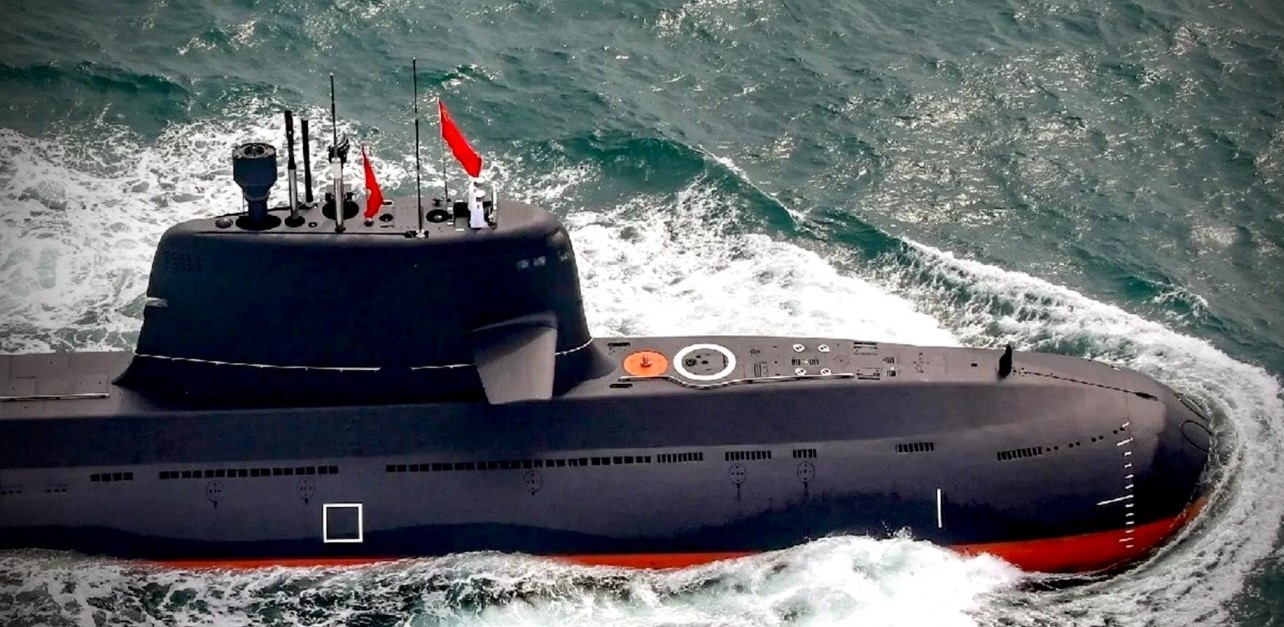
 China's Hangor-class submarine being inducted into Pakistan navy. (Photo: X)
New Delhi: India has taken a concrete step towards building a permanent, seabed-based surveillance network aimed at tracking submarines belonging to China and Pakistan, with the Defence Research and Development Organisation (DRDO) formally inviting industry to design, build, and operate the system.
The DRDO issued an expression of interest last month, seeking a lead system integrator for what it has termed “Deep Ocean Watch” – a turnkey project that would lay fibre-optic cable fitted with underwater sensor nodes across some of the most strategically sensitive stretches of the Indian Ocean.
Once operational, the network would cover the Ninety East Ridge – a submerged mountain chain running more than 5,000 kilometres from the Bay of Bengal towards the Southern Ocean – as well as the Bay of Bengal itself and the waters surrounding the Andaman and Nicobar Islands.
Read also: India and Australia deepen defence ties with undersea surveillance partnership
All three areas sit close to routes that foreign submarines would need to use to move between the Pacific and Indian Oceans, making them a priority for India’s navy and defence planners.
How the system would work?
The backbone of the network would be fibre-optic cable linking arrays of seabed sensors to the shore station in Kochi, which would serve as the nerve centre for the project.
According to the DRDO’s tender document, the Kochi facility is to include integration bays, acoustic analysis systems, automated reporting tools, and secure data storage, allowing data collected at sea to be processed and acted upon in near real time.
Among the more sensitive elements planned for the network are superconducting quantum interference devices, or SQUIDs, which are capable of picking up the faint electromagnetic signals given off by a submarine’s metal hull and machinery, even when the vessel itself is running silently. This would complement passive sonar sensors designed to detect the noise generated by propellers and onboard equipment without giving away the position of the listening system itself.
Read also: India’s Submarine Dream: Too late to catch up, too important to give up
The DRDO is not starting from a blank slate. Its Naval Science and Technological Laboratory has already trialled smaller seabed sensor suites – hydrophones, pingers, and junction boxes wired to shore-based control rooms – and demonstrated that such systems can track underwater vehicles moving through a defined area. Deep Ocean Watch is intended to scale up that proof of concept into a network covering hundreds of kilometres of ocean.
Why now?
The push comes against the backdrop of a steadily expanding Chinese submarine presence in the Indian Ocean region, which analysts say has roughly doubled since 2020, alongside repeated sightings of Chinese research vessels conducting seabed and sub-surface surveys near Indian waters – activity that Indian officials suspect goes beyond pure science and feeds into submarine navigation planning.
Pakistan’s own undersea capability has also grown. The first of eight Chinese-built, air-independent-propulsion submarines ordered by Islamabad, PNS Hangor, arrived in Karachi in June 2026, with Pakistani naval officers suggesting it could eventually give their navy a presence as far away as the Bay of Bengal – a claim that, if realised, would add a second front to India’s undersea concerns on top of the challenge from China.
The concept of a seabed sensor barrier is not new to Indian planners, who have long studied the American and Japanese “Fish Hook” system, an underwater listening chain stretching from Japan through Southeast Asia that has quietly tracked submarine movements for decades.
India’s Naval Physical and Oceanographic Laboratory in Kochi, which developed indigenous sonar systems such as Abhay and HUMSA-UG, is expected to play a central technical role in the new project, and any data gathered is likely to feed into the country’s broader maritime domain awareness architecture, including the Information Fusion Centre for the Indian Ocean Region.
Follow us on social media for quick updates, new photos, videos, and more.
X: https://x.com/indiasentinels
Facebook: https://facebook.com/indiasentinels
Instagram: https://instagram.com/indiasentinels
YouTube: https://youtube.com/indiasentinels
© India Sentinels 2026-27