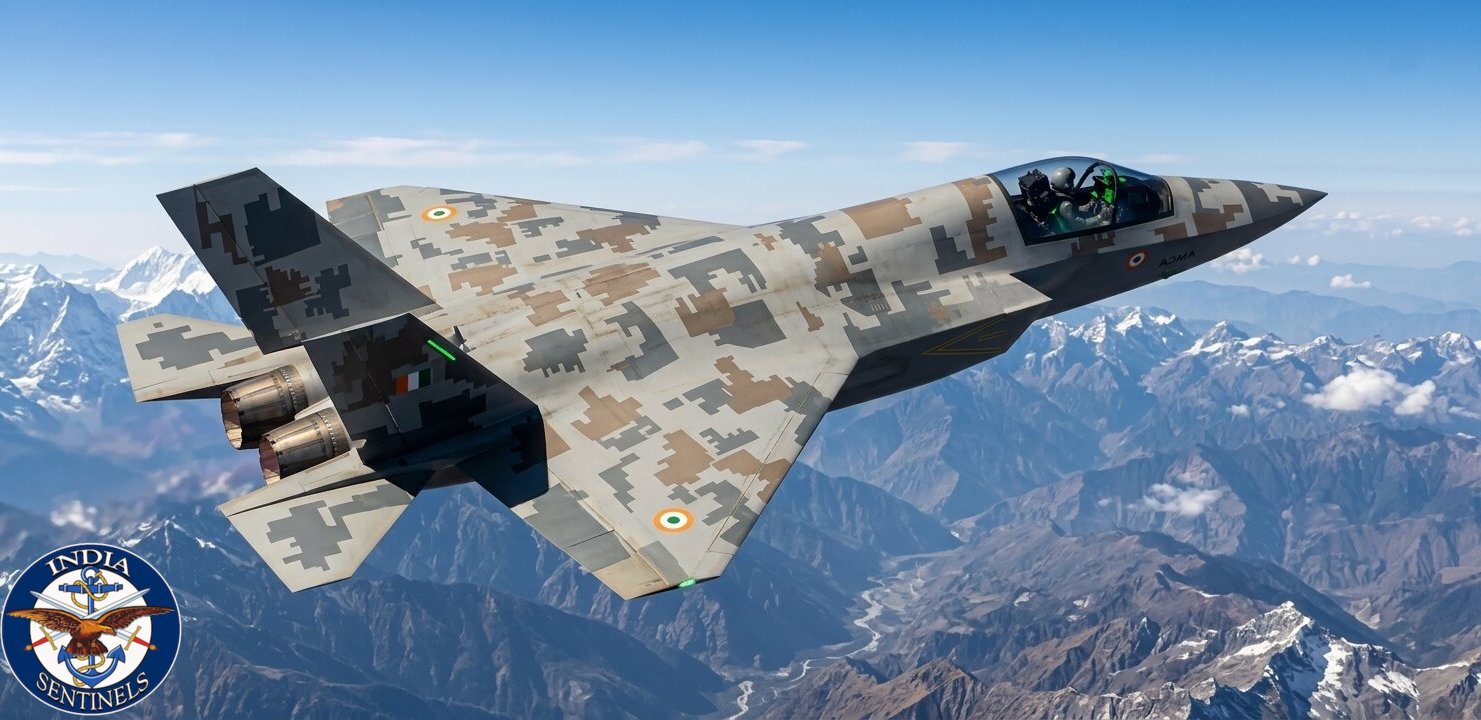
 Illustration for representation. (© India Sentinels 2026–27)
New Delhi: A sharp and unexpected escalation in the cost of American jet engines has placed India’s most ambitious military aviation programme at a critical juncture. The Aeronautical Development Agency (ADA) – the DRDO body that oversees the advanced medium combat aircraft (AMCA) project – is now actively evaluating alternate engine options for the aircraft’s prototype phase after the price of GE Aerospace’s F414-INS6 turbofan nearly tripled from its originally projected level, according to people familiar with the matter.
The development is significant not merely for what it signals about the AMCA programme’s near-term trajectory, but because the F414-INS6 was also earmarked as the interim powerplant for the first production variant, the AMCA-Mk1, which was to have been powered by the American engine until a more capable indigenous powerplant became ready.
The engine was planned to power the initial two to four squadrons of the aircraft – roughly 60 to 70 fighters – before a domestically developed successor takes over.
Sources in the know said the unit cost of the F414 engine, which had previously been estimated at between ₹70–80 crore, has surged to close to three times that figure during ongoing commercial negotiations. While the ADA is currently negotiating for a total of 15 engines to support five prototypes – each twin-engine aircraft requiring two operational units and one spare – the cost trajectory has prompted serious reconsideration of sole reliance on the American turbofan.
Why the price went up
The F414’s cost escalation is not an isolated development. It reflects a wider set of pressures that have reshaped global defence procurement over the past two to three years. Supply chain disruptions triggered by the Covid-19 pandemic, followed by a shortage of aerospace-grade raw materials and specialist components, have driven up manufacturing costs at GE Aerospace’s facilities in the United States. Geopolitical tensions affecting certain supplier nations have compounded the problem further.
In 2025, GE Aerospace announced an investment of nearly $1 billion in its domestic manufacturing ecosystem to stabilize its supply chain. That investment may have improved GE's long-term production stability, but it did little to contain the cost burden passed on to international customers such as India.
GE has also proposed establishing a dedicated F414 engine assembly and manufacturing line in India, to be set up at Hindustan Aeronautics Limited’s (HAL) facility in Bengaluru under a licensed production arrangement. However, GE has sought more than $800 million – roughly ₹6,000 crore – to establish the facility. HAL has set a target of rolling out the first indigenously assembled F414 engine by mid-2029, primarily for the light combat aircraft (LCA) Tejas-Mk2 fighter programme.
Two negotiations, not one
A complicating factor in this situation is that HAL and ADA are conducting separate commercial negotiations with GE Aerospace, each with distinct requirements and timelines. “The requirements are different, so we are negotiating separately,” a source said. “HAL is pursuing engines for its Tejas-Mk2, while ADA is negotiating for the fifth-generation AMCA programme.”
The technical agreement between HAL and GE Aerospace has already been concluded, with the two sides having progressed through a technical evaluation phase that covered technology transfer, technical documentation, assistance, and training. Commercial negotiations – covering delivery schedules, pricing, escalation formulas, warranties, and terms of the technology transfer of technology (ToT) – are now underway.
The deal, which could be worth up to $1.5 billion and involves an 80 per cent technology transfer, is being processed in the current financial year. By contrast, ADA’s parallel talks for the AMCA prototype engines remain in a more uncertain state, partly because the cost trajectory is now driving the agency to consider alternatives it had not previously prioritized.
Europe steps in
The GE pricing crisis has opened the door wider for European competitors who have been waiting patiently on the sidelines. France’s Safran and Britain’s Rolls-Royce have both submitted formal proposals to DRDO, each offering terms that, on paper at least, go considerably further than what GE has put on the table.
Safran – which already has an established relationship with the Indian Air Force through its M88 engines on the Rafale – has offered 100 per cent technology transfer, including full intellectual property rights and no export restrictions. Safran’s pitch for a jointly developed 120kN-class engine for the AMCA-Mk2 is said to involve collaboration with DRDO’s Gas Turbine Research Establishment (GTRE) in Bengaluru, building on institutional knowledge accumulated through India's long-running Kaveri engine programme.
Though the Kaveri never matured into a production-ready fighter engine, it gave India’s scientists and engineers meaningful experience in gas turbine design, materials science, and high-temperature component testing.
Rolls-Royce has matched Safran’s offer of 100 per cent technology transferand full intellectual property ownership. The British company’s executive vice-president for transformation in India, Sashi Mukundan, has confirmed that Rolls-Royce – backed by the UK government – is prepared to establish a dedicated aero gas-turbine complex on Indian soil and to co-develop a purpose-built engine for the AMCA programme.
The proposed engine, targeting a thrust class of 110kN to 130kN, would be an entirely new design – not a derivative of any existing Rolls-Royce family – with ground testing targeted for 2032 and a first flight by 2034, aligned with the AMCA-Mk2 timeline.
Rolls-Royce chief executive Tufan Erginbilgic has separately held high-level discussions with the prime minister, Narendra Modi, outlining a strategic roadmap that envisages India as the company’s “third home market” and a doubling of its local workforce to 10,000 people.
The AMCA-Mk2 requirement
Both Safran and Rolls-Royce are pitching specifically for the AMCA-Mk2, which will require a considerably more powerful powerplant than the F414 can provide. Where the F414-INS6 produces approximately 98kN of thrust in afterburner, the AMCA-Mk2 engine is expected to deliver between 110kN and 130kN – a level of performance needed to exploit the aircraft’s stealth, supercruise, and weapons payload potential fully.
The more powerful engine also has implications for the naval twin-engine deck-based fighter (TEDBF), raising the prospect of propulsion commonality across Air Force and Navy platforms, which would generate significant long-term savings in logistics and maintenance.
Where the prototype programme stands
Despite the engine uncertainty, the broader AMCA programme has been moving ahead. As Indian Sentinels reported earlier, the ministry of defence has issued a request for proposal (RFP) to three shortlisted private-sector-led consortia for the development of the five prototypes: Larsen & Toubro in partnership with Bharat Electronics Limited; Tata Advanced Systems Limited; and Bharat Forge in partnership with BEML.
The RFP mandates the first prototype flight within 30 months of contract signing, with 1,800 test sorties to be completed across all five aircraft within 84 months. Testing is to cover aerodynamics, flight control, engine performance, radar, sensor integration, weapons, and stealth characteristics.
A full-scale engineering model of the AMCA was publicly displayed for the first time at Aero India 2025 in Bengaluru, where it drew considerable attention. Built by Hyderabad-based private firm VEM Technologies using composite materials, the model provided the first tangible public demonstration of the aircraft's geometry.
In May 2026, the state cabinet of Andhra Pradesh cleared the free-of-cost transfer of 600 acres at the Puttaparthi airport in Sri Sathya Sai district, to DRDO for a dedicated AMCA flight-testing complex, residential township for scientists, and an assembly line. The Bengaluru facility of the ADA will continue to handle systems design, module fabrication, and initial integration before hardware moves to the Andhra Pradesh site.
The engine crisis in context
The F414 pricing crisis follows a troublingly familiar pattern in India’s aviation programmes. The GE F404 engine delays – which pushed back deliveries for the Tejas-Mk1A programme by more than 18 months – already exposed the risks of dependence on a single foreign engine supplier.
Both the Tejas-Mk1A and Tejas-Mk2 programmes are now contingent on American engines, and the AMCA-Mk1 was heading in the same direction before the cost surge forced a reassessment.
The episode has reinforced the urgency behind the National Aero Engine Mission, formally launched in February 2026, which aims to coordinate India’s industry, academic institutions, and government laboratories towards the long-term goal of indigenous jet engine production.
Modi had already set the direction on Independence Day 2025: “India’s own fighter aircraft must have an Indian jet engine.” India’s Gas Turbine Research Establishment, part of DRDO, has separately been making progress on materials for a 120kN-class engine, with MIDHANI – the Hyderabad-based defence metals company – reported to have completed around 50 per cent of the required alloys, with 80 per cent of those already certified.
Follow us on social media for quick updates, new photos, videos, and more.
X: https://x.com/indiasentinels
Facebook: https://facebook.com/indiasentinels
Instagram: https://instagram.com/indiasentinels
YouTube: https://youtube.com/indiasentinels
© India Sentinels 2026-27