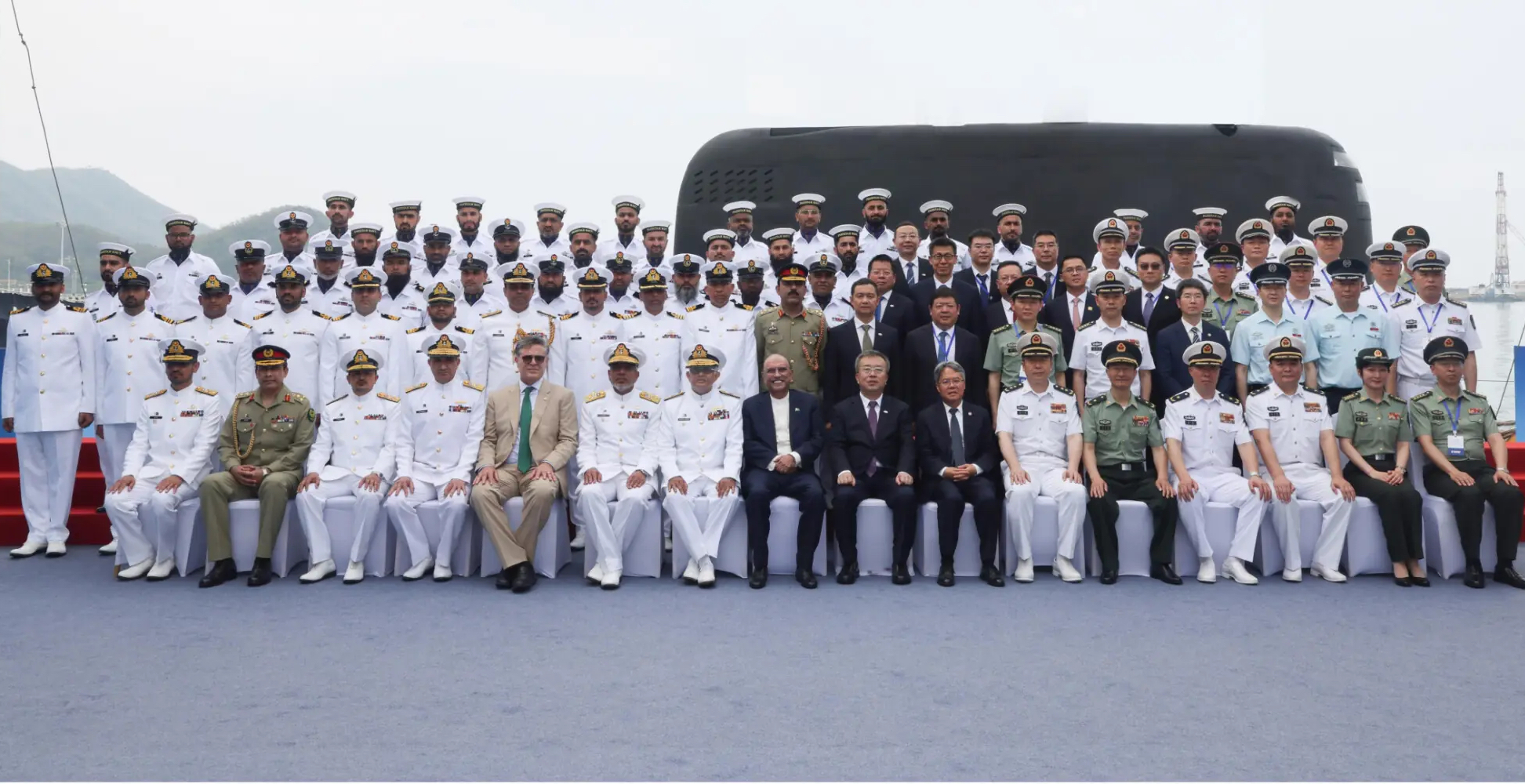
 Pakistan’s president, Asif Ali Zardari (8L), and the country’s navy chief, Admiral Naveed Ashraf (10R), during the commissioning ceremony of PNS/M Hangor in China’s Sanya, on April 30, 2026. (Photo: Pakistan Navy/Handout)
New Delhi: In a ceremony laden with strategic symbolism, Pakistan formally inducted its first Hangor-class submarine, Pakistan Naval Ship/Markab (PNS/M) Hangor, into the Pakistan Navy at Sanya – a southern Chinese port city that also serves as a principal base for the People’s Liberation Army – Navy (PLA-N). The event, held on Thursday, was presided over by the Pakistani president, Asif Ali Zardari, flanked by the country’s navy chief Admiral Naveed Ashraf and senior military representatives from both Islamabad and Beijing.
The commissioning marks the first delivery under a landmark $4–5 billion, eight-submarine deal signed in 2015 – the single largest arms export contract in Chinese military history.
The Hangor class is an export derivative of China’s Type 039A/041 Yuan-class attack submarine, co-manufactured by the China Shipbuilding Industry Corporation (CSIC) and Karachi Shipyard & Engineering Works (KSEW). Under the arrangement, the first four submarines are being built entirely in China, while the remaining four will be constructed in Pakistan under a technology-transfer agreement – a provision that significantly upgrades Pakistan’s indigenous shipbuilding capacity.
Adm Ashraf has confirmed that the programme is “advancing smoothly”, with all four China-built boats expected to be operational by 2028.
Formidable undersea platform
The newly commissioned PNS Hangor is a diesel-electric submarine with a surfaced displacement of approximately 1,800 tonnes and a submerged displacement of around 3,600 tonnes, stretching 76 metres in length. Its most operationally significant feature is its Stirling-type air-independent propulsion (AIP) system – Chinese-made after Germany refused to supply MTU engines – allowing it to remain submerged for up to three weeks without surfacing. This gives it a major stealth advantage for covert patrol in the north Arabian Sea and the Indian Ocean.
For armament, the submarine carries six 533mm torpedo tubes capable of firing heavyweight torpedoes such as the Chinese Yu-6, anti-ship cruise missiles including the YJ-82, and is believed to be configured for Pakistan’s Babur-3 submarine-launched cruise missile (SLCM) – a weapon with a reported range of 450–500 kilometres that provides a credible nuclear second-strike capability. The Babur-3 integration, if confirmed, effectively completes Pakistan’s nuclear triad and gives Islamabad a sea-based deterrent that India must factor into every crisis calculus.
China-Pakistani naval axis
The commissioning of PNS Hangor is by all means a strategic signal. The choice of Sanya as the ceremony venue is itself telling: Sanya hosts China’s South Sea Fleet and nuclear submarine base, and is the hub from which Beijing projects power across the Indo-Pacific. Zardari’s presence lends the event a rare political gravitas, underscoring that this submarine programme is a crown jewel of the China-Pakistan Economic Corridor (CPEC) ecosystem – an alliance that increasingly blurs the line between economic partnership and military entente.
Beyond the Hangor submarines, Pakistan’s partnership with China has also yielded Type 054A/P multirole frigates now in active service, further hardening its naval posture. Together, these platforms signal that China is effectively co-designing Pakistan’s maritime deterrent architecture to keep India’s Navy occupied in its western flank.
Two-front maritime threat
For New Delhi, the induction of PNS Hangor is alarming on multiple counts. First, it significantly narrows India’s current qualitative edge in submarine warfare. India’s Project-75 Kalvari-class submarines, though capable, lack AIP, and the ageing Kilo-class Sindhughosh fleet – though being upgraded with Klub cruise missiles – was designed in the Soviet era. Now, Pakistan’s navy armed with eight AIP-capable submarines, configured for nuclear second-strike, fundamentally complicates Indian naval planning in the Arabian Sea, and probably beyond.
Second, the Babur-3 SLCM threat forces India’s anti-submarine warfare (ASW) assets – already stretched between the Bay of Bengal and the Arabian Sea – to maintain constant vigilance on a second front. India’s Project 75-India (P-75I) programme, intended to add six more advanced submarines with AIP, has been delayed for years. The gap between intent and induction is a window of strategic vulnerability that Islamabad is now actively exploiting.
Third, there is the technology diffusion risk: as Pakistan builds the latter four Hangor-class boats domestically at KSEW in Karachi, Chinese naval technology will be embedded in Pakistani industrial infrastructure for decades. This raises concerns in India’s naval intelligence community about PLAN access to the Arabian Sea littoral under a cooperative security arrangement.
Submarine capabilities comparison
The table below compares the Hangor-class against India’s frontline submarine classes across key operational parameters.
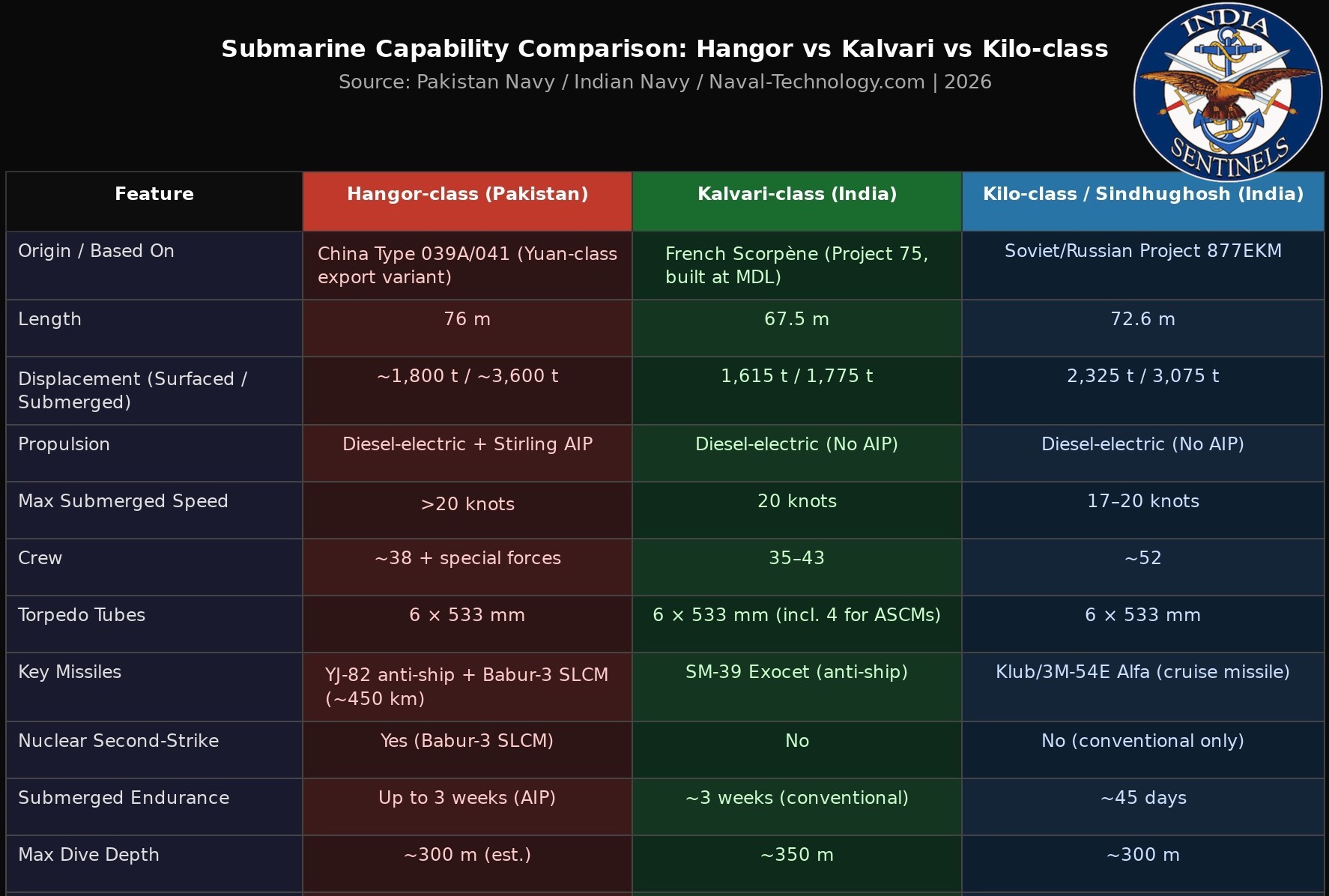 Hangor- vs Kalvari- vs Kilo-class submarines
India’s Kalvari-class, while stealthy and capable in coastal and blue-water operations, lacks AIP – a gap that the Navy has long sought to address under P-75I. The Kilo-class boats carry a larger weapons load and considerable cruise missile capability, but their age and maintenance burden limit operational readiness. The Hangor’s AIP and SLCM combination make it, on paper, a more versatile asset than either current Indian class.
New Delhi’s response options
India’s response must be calibrated and multi-layered. In the near term, the Indian Navy should accelerate the upgrade of its Kilo-class boats and push harder for P-75I finalization. Strategically, India should deepen ASW cooperation with the US, France, and Australia under the Quad and bilateral frameworks. Diplomatically, New Delhi must continue pressing Washington and European capitals to scrutinize Chinese technology transfers that enable nuclear-capable delivery platforms.
The commissioning of PNS Hangor is a reminder that the Indo-Pacific’s underwater domain is being actively contested, and that India’s maritime security margin is narrowing with every submarine launched at Sanya.
Follow us on social media for quick updates, new photos, videos, and more.
X: https://x.com/indiasentinels
Facebook: https://facebook.com/indiasentinels
Instagram: https://instagram.com/indiasentinels
YouTube: https://youtube.com/indiasentinels
© India Sentinels 2026-27