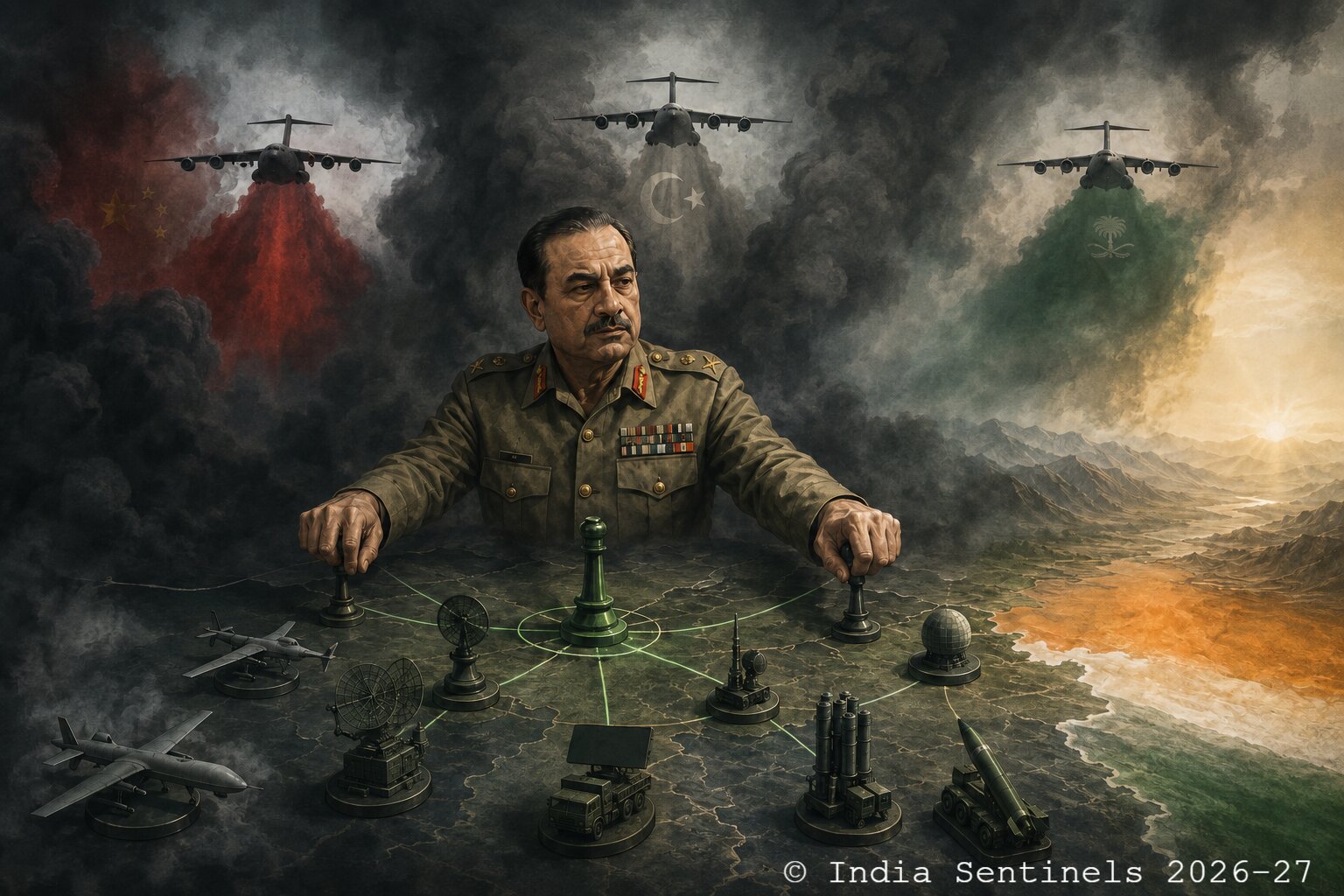
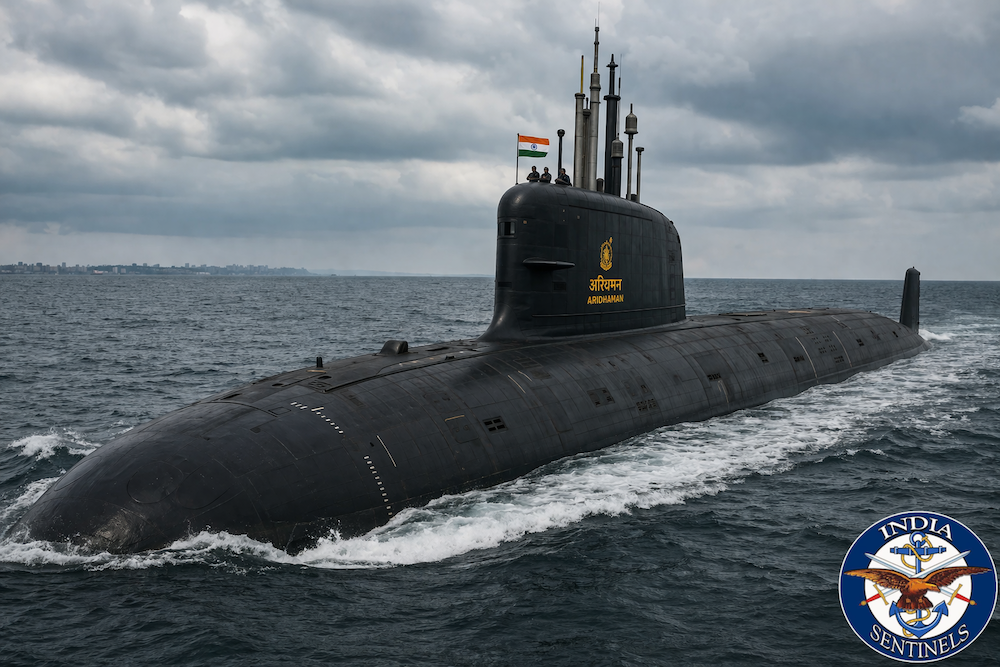
 Illustration for representation. (© India Sentinels 2026–27)
In July 1999, the prime minister-headed Cabinet Committee on Security (CCS) approved one of the most ambitious naval modernization plans in the country’s post-Independence history: build 24 submarines in 30 years, establish two parallel production lines, and transform India into a self-sufficient submarine power by 2029. Nearly three decades later, with that deadline just three years away, India has managed to induct exactly six of those 24 submarines.
The other 18 remain on drawing boards, in procurement limbo, or trapped inside the bureaucratic maze that has come to define our country’s defence acquisition ecosystem.
This story of missed deadlines is actually a story of strategic drift at a time when the underwater dimension of the Indian Ocean has never been more contested, more dangerous, or more decisive. While India debated, deliberated, and deferred, China built. Pakistan acquired. And India’s ageing submarine fleet continued its slow march towards obsolescence – one decommissioned diesel-electric boat at a time.
A Fading Fleet
India currently operates 17 conventional submarines. On paper, that sounds respectable. In reality, it masks deep structural fragility. Eleven of those 17 boats – the Russian-origin Kilo-class (Sindhughosh) and the German-built Type 209 (Shishumar class) – are nearly 30 years old, kept afloat through serial life-extension programmes that amount to mechanically resuscitating platforms that should have been retired years ago. Given that it takes five to six years to construct a single conventional submarine, every year of delay compounds the gap.
The six Scorpene-class submarines of the Kalvari class – INS Kalvari, INS Khanderi, INS Karanj, INS Vela, INS Vagir, and INS Vagsheer – represent the sole modern conventional force India fields today. Built under Project-75 (P-75) at Mazagon Dock Shipbuilders Limited (MDL) in collaboration with France’s Naval Group, these boats were contracted in October 2005. The first was commissioned in December 2017; the last was acquired in January 2025. Twenty years for six submarines. That tells you much of what you need to know.
The P-75 boats are capable – modern, stealthy, armed with long-range torpedoes and anti-ship missiles, and equipped with contemporary sonar suites. But over 60 per cent of each boat remains imported. No transfer of technology meaningful enough to enable indigenous design was achieved, despite the original intent. The programme delivered submarines, but it did not deliver self-sufficiency.
Read also: MoD confirms ‘mystery missile’ test as ‘advanced Agni with MIRV’
Project-75I: Two Decades of Waiting
If P-75 represents a partial success buried under delay, Project-75I (P-75I) represents something closer to institutional failure. Conceived as the second parallel production line of the 1999 plan – six submarines under the “strategic partnership” (SP) model – P-75I formally received an acceptance of necessity in 2010. The request for proposal was issued to MDL and Larsen & Toubro in July 2021.
The response deadline was postponed multiple times – from November 2021 to June 2022, to December 2022, and beyond. As of 2026, Germany’s ThyssenKrupp Marine Systems (TKMS) has been shortlisted as the foreign original equipment manufacturer (OEM), but the contract remains unsigned. The price tag – reportedly around ₹1.2 lakh crore for six submarines – continues to be a sticking point.
The P-75I saga is a textbook illustration of “requirement creep” colliding with “acquisition paralysis”. The Indian Navy’s staff qualitative requirements became progressively more ambitious – air-independent propulsion (AIP), advanced stealth, land-attack capability, superior combat management systems. These are legitimate operational demands, but they outpaced what any OEM could offer off the shelf. Russia, France’s Naval Group, and others declined to participate, citing unworkable liability clauses, stringent technology-transfer demands, and unachievable integration timelines.
Sixteen years after the programme formally began, India is still negotiating. The best-case scenario now sees P-75I submarines entering service in the mid-2030s – 25 years after the government’s acceptance of necessity.
Read also: SSBN INS Arighat – China says nukes not for flexing muscles or blackmailing
China’s Undersea Juggernaut
While India was mired in procurement delays, China was building. The People’s Liberation Army – Navy (PLA-N) today operates the world’s largest navy by numbers, and its undersea fleet is expanding at a pace that has no modern precedent outside wartime production. By 2040, China is projected to field 88 submarines – 16 SSBNs, 26 SSNs (short form for ship, submersible, nuclear), and 46 conventional submarines. It has six SSNs in service today and is expected to have 13 by 2030, including the formidable Type 095.
India cannot match China’s submarine fleet – not in the next decade, not in the one after. China’s industrial base, shipbuilding capacity, naval R&D investment, and established nuclear propulsion technology are structural advantages that no procurement reform can close quickly. The PLA-N’s presence in the Indian Ocean region (IOR) has grown steadily. Chinese submarines have been detected in the Indian Ocean with increasing frequency. The “string of pearls” – access arrangements at Gwadar, Djibouti, and across the IOR littoral – has become a functioning operational architecture from a theoretical geopolitical construct.
India’s ability to track, shadow, and deter Chinese nuclear submarines in the IOR is severely constrained by the absence of nuclear attack submarines (SSNs) of its own. Only SSNs can operate effectively in contested waters for extended periods, shadow adversary submarines, and project credible deterrence in depth. India has none. It may have its first by 2038, if the P-77 project stays on schedule – which, given India’s track record, is far from guaranteed.
Read also: Pakistan commissions China-built PNS Hangor, reshapes IOR balance
Pakistan’s Underwater Threat
While China represents the long-term structural challenge, Pakistan presents a more immediate and tactically urgent underwater threat. Pakistan has contracted for eight Chinese Yuan-class (Type 039B) submarines, with deliveries expected to be completed by the late 2020s. These are AIP-equipped boats – quieter, more enduring, and more capable than Pakistan’s existing Agosta-class submarines by a significant margin.
AIP technology allows a conventional submarine to remain submerged without running its diesel engines for extended periods, dramatically reducing acoustic detectability. A Pakistan Navy operating eight AIP-equipped submarines in the Arabian Sea, the approaches to Mumbai, and the sea lanes off India’s western coast changes the threat calculus materially. This makes India’s six P-75 Scorpenes in the western theatre feel thin – particularly given that several older conventional boats may not be operationally reliable enough to constitute genuine force multipliers in a conflict scenario.
India can still address the Pakistani threat if it acts decisively. AIP retrofits planned for the P-75 submarines – using DRDO’s indigenous fuel-cell-based system – would enhance their endurance and stealth significantly. Clearing P-75I at the earliest possible timeline, even at a premium, would add six more modern submarines to the western fleet within the decade.
Read also: Pakistan’s Hangor bet – Billions spent, timelines slipping, questions ignored
Containing China in the IOR
The loss of parity with China in overall submarine numbers does not mean India cannot maintain meaningful deterrence in the Indian Ocean. The IOR is India’s home waters. Geography, logistics, and familiarity are advantages that China’s navy, however capable, cannot simply purchase. But they are being eroded by inaction.
India’s nuclear-powered ballistic missile submarines are its most significant strategic asset. Three SSBNs (short form for ship, submersible, ballistic, nuclear) are now in service (under the Strategic Forces Command) – INS Arihant, INS Arighat, and INS Aridhaman. A fourth, expected to be called INS Arisudan, is on sea trials and could join the force in 2027. Armed with K4 SLBMs with a range of over 3,500 kilometres, these submarines guarantee India’s second-strike capability – the cornerstone of the country’s no-first-use nuclear doctrine.
The next-generation S5-class SSBNs, displacing 13,500 tonnes, will each carry 12 K5 or K6 SLBMs. The K6, a three-stage solid-fuel missile with a range of over 6,000 kilometres designed to carry MIRVs, will allow a single S5 boat from the Bay of Bengal to hold virtually every strategic target in China and Pakistan at risk.
On the conventional side, India’s anti-submarine warfare (ASW) capabilities – built around P-8I Poseidon maritime patrol aircraft, surface combatants with modern sonars, and the submarine force – provide a layered detection architecture that China cannot easily replicate in unfamiliar waters. India’s partnerships under the Quad and bilateral maritime frameworks add intelligence-sharing, joint patrols, and interoperability that multiply the effectiveness of India’s own assets.
The lease of a Russian Akula-class SSN (INS Chakra 3), expected to join the Navy around 2028 under a $3 billion agreement, will provide India’s only nuclear attack submarine capability until P-77 SSNs arrive in the late 2030s.
Read also: ‘N-submarine programme will have transformative impact on India’s defence ecosystem’
P-76, P-77, and the Long Game
Perhaps the most significant development in India’s submarine story is one that has received far less attention than the P-75I drama: the emergence of genuine indigenous design capability. For decades, a strange bifurcation existed. The strategic submarine programme – the Arihant class and successors – was run from the east coast, drawing on an ecosystem of 500-plus Indian companies supplying everything from combat management systems to indigenous steel. The conventional submarine programme on the west coast at MDL continued chasing foreign technology transfers that never fully materialized.
An internal study found that there was 60 to 70 per cent commonality between conventional and nuclear submarine systems – in fire control, hydraulics, auxiliary power, diving and surface control, and hull materials. India had, without fully realizing it, already built much of the industrial and technological foundation needed for indigenous conventional submarine design. It simply had not connected the dots.
Project-76 (P-76), a class of 12 indigenously designed conventional submarines, represents the attempt to correct this oversight. Designed by the Navy’s Submarine Design Group (SDG) and drawing extensively on the Arihant-class ecosystem, P-76 submarines will be genuinely Indian – unlike the P-75 Scorpenes, where over 60 per cent remains imported. Equipment orders are projected to begin around 2028, with the first-of-class entering service around 2034.
These submarines could even be exported, creating the kind of defence export capability that South Korea built through spiral development.
Project-77 (P-77), India’s indigenous nuclear-powered attack submarine programme, received Cabinet Committee on Security sanction in October 2024 for the first two units. Six P-77 SSNs are planned. Significantly, these have been redesigned as larger SSGNs (ship, submersible, guided missile, nuclear) of approximately 10,000 tonnes, similar to the Akula class, capable of carrying not just torpedoes and anti-ship missiles but also conventionally armed ballistic and hypersonic missiles.
The first P-77 SSGN is expected to be launched around 2036 and commissioned a few years later.
Read also: India test-fires 3,500km-range K-4 missile from INS Arighat
What India Must Do
Looking at India’s submarine decision-making, one can predict what the government is likely to do, and separately recommend what it must do. These two are not the same thing.
The likely trajectory: P-75I inches toward contract conclusion with TKMS in 2026 or 2027; the first P-75I boat enters service around 2037–38. P-76 stays on track with the first hull launched around 2034. The first S5 SSBN commissions around 2035 and the first P-77 SSGN around 2038–40. India’s total submarine force in 2035 will likely stand at around 20 to 22 boats.
Against China’s projected 88 submarines and Pakistan’s expanding Yuan-class fleet, this is a force that will struggle to maintain credible conventional deterrence across both its eastern and western maritime flanks simultaneously.
What India should do is different in urgency. First, close the P-75I deal now – not at the perfect price or with perfect technology transfer, but at an acceptable price with a guaranteed production timeline. The opportunity cost of further delay is greater than the cost of an imperfect deal. Second, fast-track AIP retrofits for the P-75 Scorpenes.
Third, and most critically, India must resist the temptation to silo its submarine programmes. The SDG designing P-76, the ATV team building S5 SSBNs, and the P-77 design team must operate as an integrated naval-industrial complex with shared personnel, infrastructure, and R&D. The 60 to 70 per cent commonality between conventional and nuclear submarine systems is an asset India has never properly exploited. Fourth, protect P-76 from the requirement inflation that crippled P-75I – it deserves budget priority and political attention.
Fifth, India needs to be brutally realistic about numbers. For a developed, ocean-dependent Viksit Bharat of 2047 – with 88 per cent of its energy imported by sea – naval experts suggest the minimum submarine force requirement is six SSBNs, 12 SSNs/SSGNs, and 24 conventional submarines: 42 hulls in total. India currently operates 17 conventional submarines and three SSBNs, with no SSNs of its own.
The gap is stark, and it will not close without a sustained 20-year commitment to funding, reform, and execution.
The Hour Is Late, But Not Over
India’s submarine story is ultimately a story about the compounding strategic cost of treating an existential capability as a procurement problem rather than a national priority. The 1999 vision was correct. Had it been executed, India would today possess a submarine force capable of credibly deterring both China and Pakistan while preserving the Navy’s traditional dominance of the IOR. Instead, 26 years later, India is commissioning the very boats that should have been built in the 2010s.
The situation is serious, but it is recoverable – if India is willing to make the hard choices. Catching up with China is not possible. Maintaining meaningful deterrence in the IOR is. Containing Pakistan’s emerging underwater threat is achievable. Building a genuine indigenous submarine-industrial complex – capable of producing both conventional and nuclear boats for the next century – is within reach.
India’s SSBNs, quietly patrolling the Bay of Bengal with their nuclear warheads, are proof that when the political will exists, India can build submarines of extraordinary complexity and capability. The question is whether that same will can be summoned for the conventional fleet – the submarines that will actually fight, deter, and prevail in the contested waters of the Indian Ocean in the decades ahead. India has never needed them more than it does right now.
Disclaimer: The views expressed in the article are the author’s own and don’t necessarily reflect the views of India Sentinels.
Follow us on social media for quick updates, new photos, videos, and more.
X: https://x.com/indiasentinels
Facebook: https://facebook.com/indiasentinels
Instagram: https://instagram.com/indiasentinels
YouTube: https://youtube.com/indiasentinels
© India Sentinels 2026-27